How Artificial Intelligence Makes EMI Testing Easier for Engineers
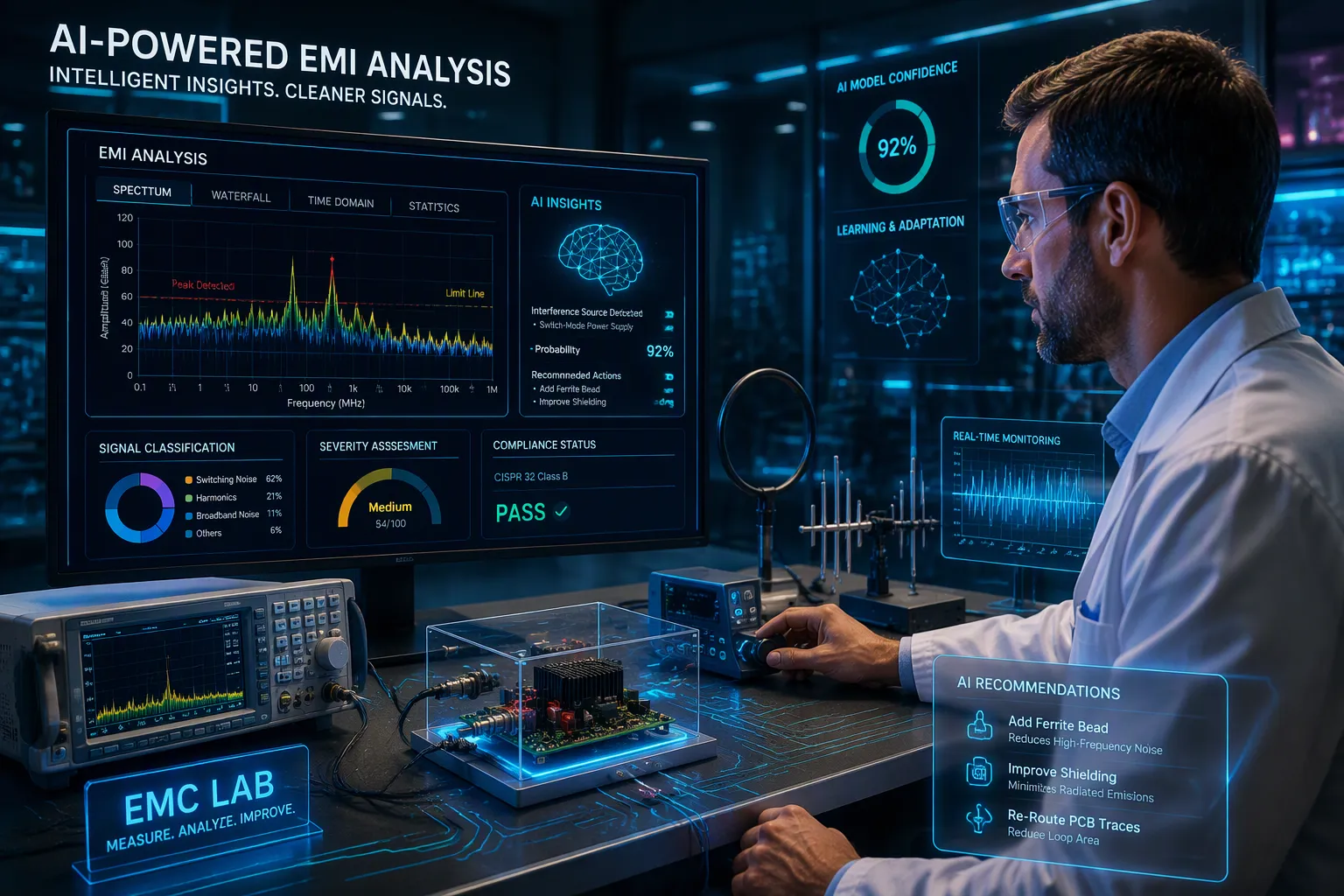
Artificial intelligence cuts the hours you spend chasing electromagnetic interference. Picture a radiated emissions failure at 300 MHz. Instead of manually reviewing hours of spectrum data, AI flags the likely source in minutes. That speed changes how you approach EMI testing.
AI brings automation, accuracy, and speed to your workflow. It helps simplify EMI testing by highlighting patterns humans miss. Yet you keep final engineering judgment. These tools assist, not replace, your compliance decisions.
Modern EMI test receivers now integrate AI directly. This combination helps simplify EMI testing further. You gain faster insights into difficult EMI issues. The result: less guesswork, more reliable testing outcomes.
Key Takeaways
AI speeds up EMI testing by automatically finding interference patterns in data.
AI predicts EMI issues early, saving time and money on redesigns.
AI handles repetitive tasks, so you can focus on solving problems.
AI works with traditional spectrum analysis to improve accuracy and speed.
AI ranks test scenarios by risk, helping you test the most critical cases first.
AI generates test plans and reports, reducing manual data entry errors.
AI monitors tests in real time and alerts you to issues immediately.
You still make final compliance decisions; AI supports your engineering judgment.
Why Engineers Need AI for EMI Testing
Rising Complexity of Compliance Requirements
Modern products pack more functionality into smaller enclosures. Wireless modules, switching power supplies, and high-speed digital buses now share the same board. Each addition raises the risk of electromagnetic interference. Regulatory bodies keep tightening limits for electromagnetic compatibility. You must meet these limits across more frequency bands and more operating modes than ever before.
Traditional test plans struggle with this scope. A single device may require dozens of configurations to cover all modes. Manual planning cannot keep pace with this growth. Artificial intelligence helps you manage the expanding matrix of test cases. It ranks scenarios by risk and highlights the configurations most likely to fail. This approach keeps your emc compliance effort focused and efficient.
Manual Emission Analysis and Human Error Risks
Spectrum analyzers and EMI test receivers generate massive data sets. A full scan can produce thousands of data points across a wide frequency range. Engineers traditionally review these plots by eye. Fatigue sets in after hours of inspection. Subtle interference patterns may escape notice. A peak that looks like noise at 2 a.m. might be the exact emi issue that fails your compliance test.
Human error also creeps into data entry and report generation. Copying values between tools invites mistakes. AI reduces this risk through automated fault detection. Machine learning models scan emi emissions data and flag anomalies. They compare current results against historical baselines. You receive a short list of suspect frequencies instead of a wall of raw data. This shift lets you focus on solving the problem rather than finding it.
High Cost of Late EMI Fixes and Redesigns
Discovering an emi problem late in development hurts. A failed emissions test at the final stage forces design changes. You may need to add shielding, reroute traces, or swap components. Each change ripples through the schedule and the budget. In severe cases, a full redesign delays product launch by months.
AI helps you catch these problems earlier. Predictive modeling simulates electromagnetic interference before you build hardware. Virtual EMI testing identifies weak points in a layout. You can address them during the design phase. This proactive approach saves money and reduces stress. The earlier you find an issue, the cheaper it is to fix. AI gives you that early warning.
How Artificial Intelligence Solves EMI Testing Challenges
Automated Fault Detection in EMI Test Data
You face a flood of data every time you run an emissions scan. A single sweep can generate thousands of data points. Reviewing that volume by hand takes hours. Artificial intelligence changes this dynamic by automating the search for real problems.
AI algorithms process hundreds of measurements per second. They separate genuine interference signals from background noise. This capability lowers false positives and keeps your attention on actual threats. Instead of scanning every peak, you receive a ranked list of suspect frequencies. The system ties each anomaly to a likely design flaw. Pattern recognition in emissions uncovers hidden relationships that humans may overlook. A recurring spike at a specific clock harmonic, for example, points directly to a routing or grounding issue.
Automated detection does not stop at finding faults. Machine learning models compare current emi test data against historical baselines. They learn what normal looks like for your product family. When something deviates, the system flags it immediately. You gain faster insight into interference sources. This approach helps simplify emi testing by removing the manual review burden. Yet you still make the final call on whether a flagged event violates a limit. AI improves workflow speed but does not replace the final compliance check.
Predictive Modeling and Virtual EMI Simulation
Finding an emi problem after you build hardware costs time and money. Predictive modeling lets you catch issues during the design phase. AI works with digital twins to simulate electromagnetic behavior before physical testing. You can test layout changes, component placements, and shielding options in a virtual environment. This capability reduces the number of physical prototypes you need.
Virtual emi simulation also helps you rank design risks. The AI examines pre-compliance results to predict pass or fail outcomes. You learn which configurations are most likely to cause trouble. This foresight lets you address weak points early. The cost of a fix during design is far lower than a redesign after a failed test. Predictive compliance assessment gives you that early warning. You can iterate quickly and converge on a robust design.
The simulation does not operate in isolation. It feeds back into your test plan. AI suggests which physical tests to run first based on simulated risk. This integration keeps your emc compliance effort focused. You avoid wasting time on low-risk configurations. The result is a faster path to a compliant product.
Faster Reporting and Compliance Documentation
Documentation consumes a large share of your emi testing timeline. You must record test setups, equipment settings, measurement results, and pass or fail determinations. Manual data entry invites errors. Copying values between tools creates opportunities for mistakes. AI reduces this burden through automated test execution and data capture.
AI algorithms control test equipment and optimize measurement parameters. They adapt test sequences in real time based on what they observe. This automation removes the data-entry layer from your workflow. Results flow directly into report templates. You spend less time formatting and more time analyzing. The system also maintains a traceable record of every measurement. This traceability matters for audits and regulatory submissions.
Real-time data analysis adds another layer of speed. The AI flags issues immediately as they appear. You do not wait until the end of a test session to discover a problem. This immediate feedback lets you adjust and re-test without delay. Faster reporting means faster decisions. Your team can move to the next phase of development sooner.
AI test receivers now integrate these capabilities directly. They combine traditional spectrum analysis with intelligent pattern recognition. You get the accuracy of established measurement techniques plus the speed of automated detection. This combination helps simplify emi testing across your entire workflow. The final compliance check remains your responsibility. AI handles the repetitive work and highlights the risks. You apply engineering judgment to the results.
Core AI Methods and EMI Test Receivers
Machine Learning for Interference Recognition
Machine learning gives EMI test receivers the ability to recognize interference patterns without explicit programming. You train a model on known emissions data. The model learns to distinguish real signals from noise. This capability forms the foundation of modern interference identification.
Training Data Sets for Reliable Classification
Your model performs only as well as the data you feed it. You need EMI datasets that cover the frequency ranges, modulation types, and operating modes your product will face. A diverse training set helps the classifier handle new interference types it has never seen. You should include both passing and failing scans. Label each sample with the correct source category. This labeling lets the model learn the difference between a switching regulator harmonic and a clock spur. Over time, the system improves its accuracy as you add more labeled examples.
Combining AI with Traditional Spectrum Analysis
AI does not replace the superheterodyne architecture inside your EMI test receivers. It works alongside it. Traditional spectrum analysis provides precise amplitude and frequency measurements. AI algorithms then scan those measurements for anomalies. This combination gives you the best of both worlds. You keep the measurement integrity of established techniques. You gain the speed of automated detection. The receiver still performs the core sweep. The AI layer interprets the results and flags what matters.
Smart EMI Test Receivers and Automated Mitigation
Next-generation EMI test receivers use artificial intelligence and machine learning to deliver several improvements over traditional designs. According to the EMI Test Receiver Market report, these benefits include:
Automate data analysis and anomaly detection
Reduce testing times
Improve measurement accuracy
Enable predictive maintenance
These capabilities show the benefits of AI in EMI test receivers. The role of AI in EMI test receivers now extends beyond simple data logging.
Receiver Interfaces and Protocol Compatibility
An AI-driven EMI test receiver must connect to your existing test setup. Look for interfaces that support standard communication protocols. Common options include GPIB, USB, and Ethernet. The receiver should also work with your automation software. Protocol compatibility ensures the AI can control the instrument and pull data without manual intervention. This integration of AI in EMI test receivers removes the data-entry layer from your workflow. You spend less time configuring equipment and more time analyzing results.
Automated Interference Identification and Mitigation
Modern AI-powered EMI test receivers offer several automated mitigation functions. These functions help you move from detection to resolution faster:
Real-time adaptive filtering adjusts signal processing on the fly to improve measurements even in noisy environments.
Multi-antenna beamforming uses multiple antennas to more precisely locate interference sources.
Automated mitigation strategies leverage insights from historical data to quickly fix interference problems.
Adaptive learning keeps test receivers intelligent as new interference types appear.
AI algorithms can suggest or apply defenses after identifying interference sources. By analyzing historical data and learning from past mitigation tactics, the receiver recommends the most effective methods to reduce or eliminate interference impacts. Machine learning allows EMI test receivers to automatically adjust to changes in background noise. AI algorithms continuously update their knowledge bases and improve their ability to detect and mitigate EMI as new devices and technologies emerge. This interference detection and mitigation capability ensures ongoing effectiveness across your test program.
Natural Language Review of Schematics and Layouts
AI now reads your design files. Natural language processing models can review schematics and PCB layouts for potential EMI risks. You feed the tool your design documentation. The AI scans for common problem areas. It looks for long traces that act as antennas. It checks ground plane continuity. It flags component placements that could couple noise into sensitive circuits. This review happens before you build hardware. You receive a list of concerns ranked by severity. The integration of AI in EMI test receivers and design tools helps simplify EMI testing by catching issues at the source. You still make the final call on which changes to implement. The AI provides the map. You drive the car.
Using AI Across the EMI Testing Workflow
Automated Test Scenario Selection and Risk Ranking
You face a long list of possible test configurations for any modern product. Each operating mode, cable arrangement, and clock setting creates a new scenario. Manual selection wastes time on low-risk cases. Artificial intelligence changes this by ranking scenarios automatically.
The system studies your design files and historical test results. It identifies critical test scenarios and potential failure modes. A switching regulator near a sensitive analog input draws immediate attention. The AI assigns a risk score to each configuration. You then run the highest-risk tests first. This approach helps simplify EMI testing by focusing your effort where it matters most. You still decide which scenarios meet your compliance goals.
AI-Guided Test Generation and Data Entry Reduction
AI algorithms now generate test sequences directly from your product specifications. The tool reads your requirements and builds a test plan. It selects frequency ranges, modulation types, and measurement parameters. This automation removes the data-entry layer from your workflow. You no longer copy values between spreadsheets and instruments.
The generated plan feeds straight into your EMI test receivers. Results flow back into the report without manual handling. This step cuts hours of repetitive work from every test campaign. Yet the AI does not grant compliance. You review the output and confirm the final pass or fail determination. Engineering judgment stays with you.
Real-Time Monitoring and Adaptive Feedback
Traditional EMI testing waits until the end of a session to reveal problems. AI monitors data as it arrives. The system watches for interference patterns that exceed your limits. When it spots an anomaly, it alerts you immediately. You can adjust the setup and re-test without losing the whole session.
Adaptive feedback goes further. The AI adjusts measurement parameters in real time based on what it observes. It may narrow a frequency sweep to focus on a suspect band. It may increase resolution where the data looks noisy. This capability reduces wasted measurements and speeds up diagnosis of EMI issues. Your EMI test receivers become active partners in the test, not passive recorders. The result is faster insight and fewer repeated runs across your testing program.
Future of EMI Testing with Artificial Intelligence
Neural Network Prediction for Power Electronics
Power electronics present some of the hardest emi problems you will face. Switching converters generate broadband noise that shifts with load and temperature. Neural networks now predict these emissions with remarkable accuracy. A review of recent studies reports that a neural-network GAN model called FBA-PIGAN predicted emi on a 10 kW SiC inverter with a mean spectral error of 2.1 dB and peak-frequency accuracy of 93.8%. The same review cites a KNN baseline for conducted-emi prediction in DC-DC converters, achieving R² above 0.97 and mean absolute error under 5.9 dBμV.
Study context | Model | Task | Reported accuracy |
|---|---|---|---|
Tlig et al. (review) | KNN (non-neural ML baseline) | Conducted-EMI prediction in DC-DC converters | R² > 0.97; MAE < 5.9 dBμV |
Li et al. (review) | FBA-PIGAN (neural-network GAN) | EMI prediction on a 10 kW SiC inverter | Mean spectral error 2.1 dB; peak-frequency accuracy 93.8%; physical-consistency score 0.93 |
These results show that neural networks can predict emissions before you build a prototype. You gain a virtual preview of compliance risk.
Smarter Test Automation Across the Delivery Pipeline
The role of ai in emi testing with artificial intelligence is shifting. Early tools assisted with test design. Future systems will generate, adapt, and maintain tests across your entire delivery pipeline. Deep learning techniques such as CNNs and RNNs are being explored to enhance interference detection and mitigation under complex, dynamic conditions. Edge computing places ai algorithms directly inside emi test receivers, enabling real-time analysis without cloud dependency. This reduces latency and improves privacy.
Integration with simulation tools lets ai-powered emi test receivers perform virtual testing during design. You identify and mitigate interference issues early. Collaborative platforms for sharing data and ai models among engineers and academics will accelerate development. Ai is disrupting EMC testing environments by automating complex procedures, providing insight into interference patterns, and predicting compliance issues. This has reduced human errors, improved efficiency, and accelerated product certification cycles. Ai tools are expected to become indispensable across many EMC testing environments.
Regulatory Evolution and AI Validation
Regulators will need to validate ai outputs before accepting them in compliance submissions. You should expect new guidance on how to document ai-assisted emi testing with artificial intelligence. The automation you adopt today must produce traceable, auditable records. Start with existing test data. Validate ai outputs against known cases. Expand adoption as confidence grows. This approach keeps your emi testing with artificial intelligence defensible under regulatory scrutiny.
Building an AI-Assisted EMI Testing Strategy
Combining Engineering Judgment with AI Outputs
A sound strategy pairs automation with human oversight. The table below shows how this division of labor works across common engineering workflows.
Workflow | How AI Helps | The Engineer's Role |
|---|---|---|
Engineering Knowledge & Search | Finds standards, requirements, guidelines, past decisions, and similar parts using natural language, with links to sources | Verifies each source is current, relevant, and correctly interpreted |
Generative Design | Creates geometry options within defined constraints; supports topology optimization and CAD features | Sets constraints, then assesses performance, manufacturability, and practical fit |
Simulation & Analysis | Helps set up studies and meshes, builds surrogate models, automates iterations, compares variants | Validates assumptions and models, interprets results, decides on further validation |
Design Review | Checks drawings and 3D models for standards, GD&T, DFM, and completeness; compares revisions | Verifies findings, filters false positives, weighs tradeoffs, approves changes |
PLM & Traceability | Searches product data and change history, summarizes revisions, traces requirements, flags affected parts | Confirms downstream impact and decides required analysis, updates, or approvals |
AI cannot replace the role of engineers or the need for their expertise. A tool may excel at assembling and analyzing data, checking outputs for errors, or performing bounded tasks under supervision. But it remains the responsibility of qualified engineers to establish rules for AI tools, verify results, and remain accountable for product decisions.
That principle anchors your entire program. You set the rules, check the results, and own every product decision.
Choosing Compatible Tools and Data Sets
Tool selection determines how smoothly AI fits your lab. Three practices keep adoption practical:
Validation and Verification: AI algorithms used in EMI test receivers must undergo rigorous validation, including testing in real-world conditions, benchmarking against manual analysis, and evaluation against known interference sources.
Integration and Compatibility: AI-driven EMI test receivers should integrate smoothly into existing test setups, using widely supported interfaces and protocols to ease adoption.
Intelligent Decision Support: AI-enhanced EMI test receivers should provide engineers with data-driven insights and suggestions, enabling them to make informed judgments and identify more effective, tailored interference mitigation strategies.
Your data sets matter just as much. Curate labeled scans that reflect your product family and operating modes. Clean, well-documented data gives the model a reliable foundation.
Training Teams to Adopt AI Gradually
Roll out artificial intelligence in stages. Begin with one product line and a small set of known failures. Let the team compare AI findings against manual results. Confidence grows when the tool proves itself on familiar cases.
Pair every new capability with training. Engineers need to understand what the model can and cannot see. Assign a reviewer for each automated output during the early phase. This habit builds trust and catches errors before they reach a compliance submission. Over time, expand the scope of emi testing, add more data, and let the team take on harder problems. Gradual adoption protects your emc compliance record while your people learn the tools.
Artificial intelligence makes EMI testing easier now. Automated analysis finds interference fast. Predictive simulation catches problems before you build hardware. Smarter EMI test receivers flag risks in real time. Faster workflow decisions keep your project on schedule. These tools simplify EMI testing by removing repetitive work. They highlight risks and leave every compliance call to you. AI supports your judgment. It does not replace your responsibility. You stay in charge.
Start with the test data you already have. Validate AI outputs against known cases. Expand adoption as your confidence grows. That path lets you simplify EMI testing without giving up engineering control.
FAQ
Will AI replace the need for EMC engineers?
No. AI automates repetitive analysis and flags risks. You still verify results, apply engineering judgment, and make final compliance decisions. The responsibility stays with qualified engineers.
How accurate are AI predictions for EMI?
Studies show strong results. The FBA-PIGAN neural-network GAN predicted EMI on a 10 kW SiC inverter with a mean spectral error of 2.1 dB and peak-frequency accuracy of 93.8%. A KNN baseline achieved R² above 0.97 for conducted-EMI prediction in DC-DC converters.
Does AI replace traditional spectrum analysis?
Traditional spectrum analysis remains essential. AI complements it. The receiver performs the core sweep. The AI layer interprets results and flags anomalies. You keep measurement integrity. You gain automated detection speed.
Do I need new test equipment to use AI?
Modern EMI test receivers integrate AI directly. Many support standard interfaces including GPIB, USB, and Ethernet. They also work with your automation software. You connect them to your existing setup without major changes.
What data do I need to train AI models?
Curate labeled scans covering your product family and operating modes. Include both passing and failing scans. Label each sample with the correct source category. Diverse data helps the model handle new interference types.
How do I start using AI in my EMI testing workflow?
Start with existing test data. Validate AI outputs against known cases. Expand adoption as confidence grows. Begin with one product line and a small set of known failures.
Can regulators accept AI-assisted test results?
Regulators will need to validate AI outputs before accepting them in compliance submissions. Document every AI-assisted measurement. Traceable, auditable records keep your results defensible.
