How to Choose the Right Medical Device Contract Manufacturer for Your Business
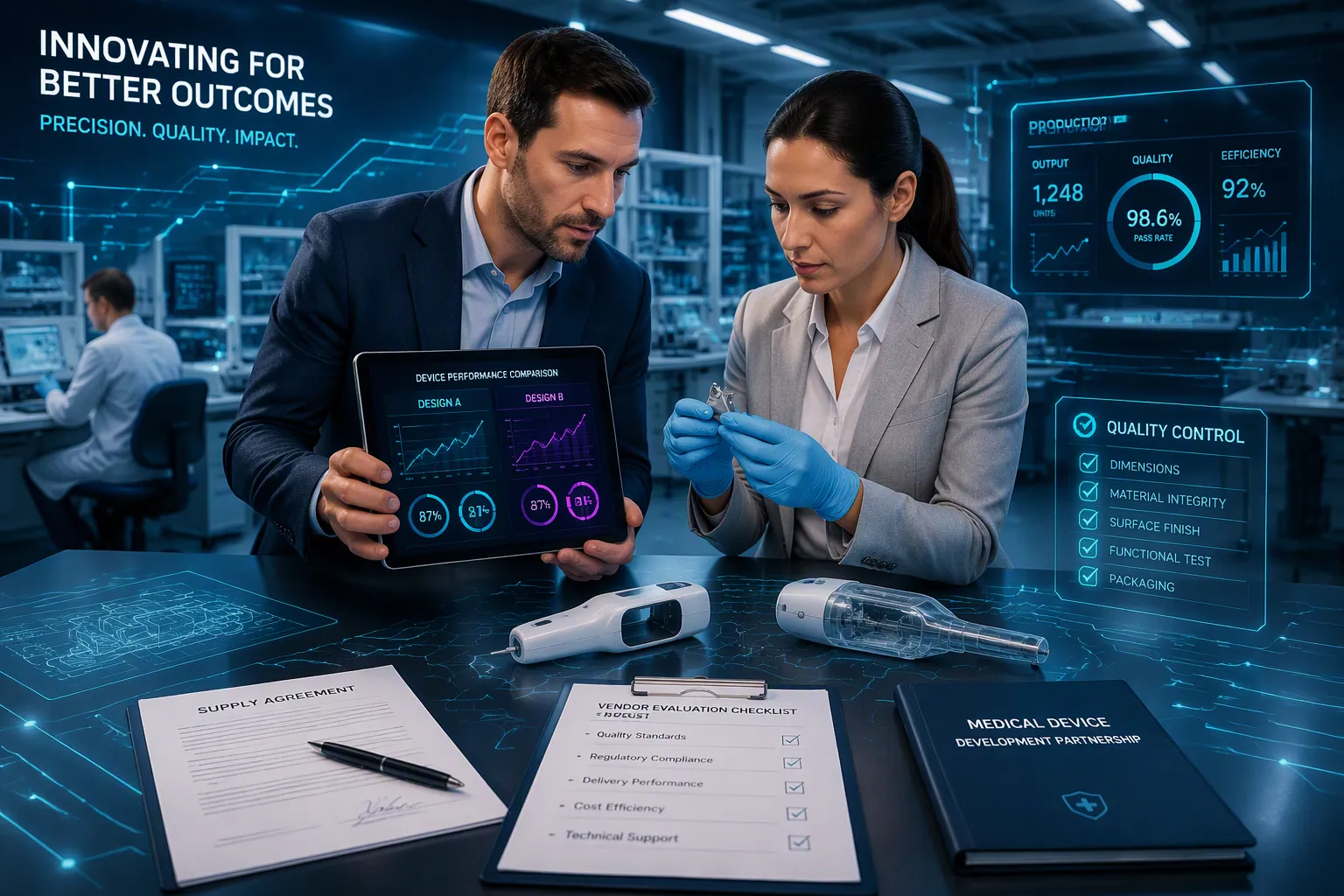
Choosing poorly carries severe consequences. A weak medical device contract manufacturing partner can delay your launch, trigger regulatory findings, damage your brand. You must choose the right medical device contract manufacturer based on product type, growth stage, regulatory pathway, and long-term goals, not price or capacity alone.
BCC Research projects this contract manufacturing market will reach $155.2 billion by 2030. You should weigh regulatory compliance, technical capabilities, quality systems, scalability, location, and partnership fit.
This guide gives OEM engineers and procurement leaders a practical, criteria-based framework. You will learn what to verify, which questions to ask, and which red flags to avoid. That structure lets you select a contract manufacturer with confidence.
Key Takeaways
Base your choice on regulatory compliance, technical capabilities, and long-term partnership fit.
Verify ISO 13485 certification, FDA registration, and MDSAP coverage before signing.
Match cleanroom classification to device risk for safe, validated production.
Use a supplier scorecard with weighted criteria to compare candidates objectively.
Look beyond unit price; compute total cost of ownership for each proposal.
Sign a quality agreement that assigns complaint, CAPA, and change control duties.
Audit facilities, check references, and review FDA inspection history before choosing.
Build a transparent, long-term partnership with shared quality goals and regular reviews.
What Is a Medical Device Contract Manufacturer?
A medical device contract manufacturer makes products or components that another company sells. This relationship is a form of medical device contract manufacturing. You, as the OEM, outsource design, production, packaging, and distribution. The partner may build an entire product line or one specialized component. Work can happen domestically or overseas.
No medical device reaches patients without a reliable production chain. The medical device market rewards speed, quality, and regulatory discipline. A good partner becomes an extension of your team rather than a distant supplier.
Role in the Supply Chain
A contract manufacturer holds a central position in the medical device supply chain. It helps you satisfy strict delivery timelines, control production costs, and meet industry standards. Many partners run validated cleanrooms and employ skilled technicians. They can absorb the full range of manufacturing duties, from facilities and equipment to staffing and logistics.
You can hand over specific production stages. Contractors routinely handle prototypes and large-scale rollouts, casting and molding, automated manufacturing, and custom packaging. They also manage ancillary services like welding, decorating, and sterilization. That arrangement lets your internal group focus on innovation and patient care.
CMO vs. CDMO Explained
Understand the difference between a CMO and a CDMO before you evaluate partners. A CMO builds your device using specifications you provide. It does not design the product. A medical device CDMO, by contrast, adds design, engineering, and regulatory support. This makes it a true development partner rather than a simple builder. Use a CMO when your design is complete. Choose a CDMO when you need help moving from concept to production.
CDMOs provide development services, formulation, manufacturing, packaging, and distribution. Their engineering teams help with pre-formulation and process development. The aim is to improve product characteristics and maintain regulatory compliance. Every medical device requires careful process validation. This distinction influences who owns design decisions. A CMO executes your plan; a CDMO creates the plan with you.
When Outsourcing Makes Sense
Consider outsourcing your medical device manufacturing needs when your internal resources run short. Common triggers include limited cleanroom capacity, specialized process requirements, and new product launches. You might need laser machining, cleanroom molding, injection molding, or automation you do not own. Outsourcing also helps when demand exceeds line capacity or when capital costs are too high. An established, validated production environment shortens time-to-market.
Contract sterilization is a classic example. Most contract manufacturers avoid sterilizing in-house. Ethylene oxide and gamma radiation require years of experience and state-by-state operator licenses. These methods also carry safety and environmental concerns. Your partner often relies on a third-party sterilizer for this final step. A capable medical device manufacturer brings regulatory expertise and mature quality systems. For many medical device companies, this competence makes market entry smoother and helps your business scale without fixed overhead.
Choosing a Medical Device Contract Manufacturer: Key Criteria
You need a structured framework when choosing a medical device contract manufacturer. Price and capacity matter, but they sit below compliance, capability, and fit. The criteria below help you select a contract manufacturer who protects your timeline, your regulatory standing, and your brand.
Regulatory Certifications to Verify
Start with certifications. A partner without the right credentials cannot legally or safely support your medical device manufacturing.
Look for ISO 13485 certification as your baseline. This standard covers the quality management system expectations across most regions. However, ISO 13485 certification alone does not satisfy FDA requirements. The FDA does not accept ISO 13485 certificates in place of FDA inspections or compliance responsibilities. Your partner must meet the Quality System Regulation under 21 CFR Part 820, including purchasing controls under 21 CFR 820.50. FDA warning letters frequently cite inadequate supplier supervision, so you carry responsibility for validating and monitoring all outsourced work.
Verify FDA registration and listing. If your partner falls under FDA jurisdiction, they must maintain registration even when MDSAP evidence exists. MDSAP covers ISO 13485:2016 plus country-specific requirements from five regulatory authorities: Australia, Brazil, Canada, Japan, and the USA. A single MDSAP audit report may replace routine inspections by each member authority. MDSAP is mandatory in Canada for Class 2 and above devices.
Check regional frameworks. The EU MDR 2017/745 requires CMOs to be identified as critical subcontractors, and unannounced audits are permitted. Japan requires a Marketing Authorization Holder for Class II–IV devices. India requires a Plant Master File and Device Master File. Your quality agreement must clearly assign responsibility for complaints, change control, CAPA activities, risk file maintenance, and labeling compliance.
A partner who cannot produce current audit reports, Device History Records, and a signed quality agreement before you commit is a partner who will cost you time and money later.
Technical and Cleanroom Capabilities
Your partner's technical depth must match your product's complexity. Medical device cleanroom manufacturing demands validated environments with strict environmental monitoring.
Match the ISO cleanroom class to your device risk. Class III implantable devices such as pacemakers and orthopedic implants typically require ISO Class 3–5. Class II devices like sterile surgical instruments may operate in ISO Class 6–7. Assembly and packaging of non-sterile devices often fits ISO Class 8. GMP grades map to these classes: Grade A equals ISO Class 5, Grade B equals ISO Class 5 at rest and ISO Class 7 in operation, Grade C equals ISO Class 7 at rest and ISO Class 8 in operation, and Grade D equals ISO Class 8.
Confirm monitoring practices. Your partner should use laser-based particle counters for ISO 14644-1 compliance, viable air sampling, surface swabs, settle plates, and personnel garment sampling. They must control temperature, humidity, and differential pressure. A minimum 10 Pascal pressure differential between adjacent rooms of different cleanliness grades is standard per Health Canada GMP, EU GMP Annex 1, and ISPE guidance. Recertification occurs annually per ISO 14644-2 as a baseline, with continuous particle and pressure monitoring between certifications.
Ask about process validation. Your partner must validate processes and maintain validated states. Material selection must satisfy biocompatibility, suitability, and repeated sterilization without degradation. Documentation of material origins supports global regulatory compliance.
Cost, Location, and Services
Cost matters, but total cost of ownership matters more. A low unit price often hides weak regulatory expertise, poor process validation, or limited scalability.
Evaluate location against your market access needs. A domestic partner simplifies communication and audit logistics. An overseas partner may reduce labor costs but adds shipping time, tariff exposure, and time-zone friction. Australia, Brazil, and Japan require local sponsors or registration holders. The UK requires a UK Responsible Person for OEMs outside the country.
Review the service scope. Does your partner offer design support, prototyping, sterilization coordination, packaging, and distribution? Contract sterilization is a common gap. Most contract manufacturers avoid in-house ethylene oxide or gamma radiation because these methods require years of experience and state-by-state operator licenses. Your partner likely relies on a third-party sterilizer.
Demand transparency on quality standards. Ask for their audit history, nonconformity trends, and CAPA effectiveness records. Common MDSAP findings include missing documented processes, release of nonconforming devices, weak audit programs, and training records that do not demonstrate competence. A partner who tracks and closes these findings demonstrates maturity.
Balance cost against regulatory requirements and patient safety. The cheapest option rarely survives an FDA inspection or an EU MDR audit. Choose a partner whose pricing reflects real compliance infrastructure, not shortcuts.
Identifying the Right Medical Device CDMO for Your Needs
Identifying the right medical device CDMO requires you to look beyond basic manufacturing. You need a partner who supports design, development, and regulatory submission. This section helps you evaluate development capability, design support depth, and production scalability.
Evaluating an Experienced Medical Device CDMO
An experienced medical device CDMO brings more than production lines. It brings disciplined design controls, audit-ready documentation, and a proven path from concept to market. Use the criteria below to assess development and design transfer experience.
Criterion | What to Evaluate in the CDMO | Why It Matters |
|---|---|---|
Design and engineering depth | CAD modeling capability and in-house rapid prototyping (FDM, SLA, SLS, CNC, metal AM) | Engineering depth is as important as manufacturing footprint for development-support programs |
Design History File (DHF) management | Ability to manage the DHF in a structured, audit-ready format from day one | A CDMO without disciplined DHF management creates regulatory liability as the program advances toward submission |
Design transfer experience | Proven process for translating a validated design into a manufacturable production specification | Design transfer is where many programs lose time and cost |
Regulatory submission track record | Number of submissions supported under the sponsor's specific regulatory pathway in the last 36 months, and their outcomes | Confirms relevant pathway experience and predictable success |
Inspection and quality history | FDA inspection history for the past five years, including 483 observations and CAPA responses | Reveals quality system robustness and corrective-action maturity |
Assigned program team | Named individuals by role and their relevant device class experience | Ensures the actual team has applicable expertise |
Capacity and prioritization | Current capacity utilization rate and how competing program priorities are managed | Guards against schedule conflicts and delays |
Verify ISO 13485 certification and confirm the scope it covers. A partner inside a certified quality system produces design records that can be defended in an audit. Confirm the firm builds proper design controls and a design and development file as it goes, not retroactively. Check in-house human factors and usability capability, since use error is a leading source of device problems. Assess regulatory and submission support. Ask whether they have taken devices in your class through 510(k), De Novo, or PMA. Ask how they handle design transfer and manufacturing handoff. Evaluate therapeutic-area fit. Gauge communication quality, because clear updates and honest pushback matter as much as capability.
Design Support and Product Complexity
Product complexity determines how much design support you need. A single-use sterile Class II or III device requires Design for Manufacturing and Assembly, prototyping, benchtop performance characterization, material and tooling selection, and sterile disposable manufacturing such as bonding, tipping, heat sealing, ultrasonic welding, and kitting. A complex electromechanical system demands full electro-mechanical assembly and box builds, cable and harness assembly, PC board flashing, PC imaging, and integration with full functional test.
Some medical device CDMOs specialize in complex interventional, minimally invasive surgical, and targeted delivery systems. Others support pharmaceutical, diagnostic, and MedTech devices requiring integrated development. Match the partner's specialty to your product.
Your medical device manufacturing partner should offer DfMA consultation, prototype fabrication, first article inspection, and capability studies. Early-stage engineering involvement shapes design decisions before concepts solidify. Risk management integration ensures compliance with ISO 14971. Cross-domain technical experience helps when your device spans multiple subsystems.
Production Capacity and Scalability
You must confirm your partner can scale up medical device production as demand grows. Ask about current capacity utilization rate and how the firm manages competing program priorities. A partner running near full capacity may delay your program when another client's needs shift.
Evaluate whether the CDMO can develop and validate your device with the same partner that will scale it to volume production. A single-partner path reduces transfer risk and documentation gaps. Confirm the partner offers compliant clinical pilot production, electronic and PCB assembly, box-build and functional testing, and after-sale support under one roof.
The right medical device manufacturer grows with you. A partner who cannot expand capacity or add shifts will become a bottleneck. Choose a partner whose scalability matches your long-term forecast, not just your current order volume.
Quality, Communication, and Track Record
Assessing the Quality Management System
You must audit your partner's quality management system before you sign any quality agreement. A strong system ties ISO 13485 certification to software validation, supplier quality, risk management, post-market surveillance, and market-specific regulatory obligations. Ask for documented procedures, work instructions, training records, and change control. Verify that document control includes review and approval before release, complete version history, and routing of revised documents to affected personnel.
Focus your audit on these critical areas:
Design controls, document controls, and purchasing controls
Identification and traceability, production and process controls
Labeling and packaging controls, product risk management
CAPA, design change control, root cause analysis, complaint handling, and non-conformance
Look beyond formal compliance. Ask which gaps are truly systemic, which are local execution issues, and which reveal deeper operating-model weaknesses. Pay particular attention to complaint trends, repeat CAPAs, supplier issues, missing validation, and breakdowns at design transfer or change management.
Your quality agreement must clearly assign responsibility for complaints, change control, CAPA activities, risk file maintenance, and labeling compliance. A medical device manufacturer who cannot produce current audit reports and Device History Records before you commit will cost you time and money later.
Communication and Responsiveness
Evaluate communication before you commit to a quality agreement. Ask about quote turnaround time, technical inquiry response time, complaint acknowledgment speed, and documentation provision timeliness. These metrics reveal how quickly your partner will respond when a medical device issue arises.
Category | What to Measure |
|---|---|
Responsiveness metrics | Quote turnaround time, technical inquiry response time, complaint acknowledgment speed, documentation provision timeliness |
Communication protocols | Dedicated account managers, monthly business review meetings, direct technical support channels, shared quality monitoring dashboards, escalation procedures |
A medical device CDMO with dedicated account managers and monthly business reviews keeps you informed. Shared quality dashboards and escalation procedures cover urgent or audit-related response expectations. Poor communication signals deeper problems with quality control for medical devices.
Years in Business and References
A partner's track record reveals more than a resume. Ask for references from clients in your device class. Contact those references directly. Ask about responsiveness, quality standards, and how the partner handled problems.
Review the partner's FDA inspection history for the past five years, including 483 observations and CAPA responses. Check whether repeat nonconformances were corrected locally or escalated systemically. A medical device partner with fragmented change control and thin supplier monitoring will struggle with your program. Verify that process validation and training records are complete and current. A medical device partner who tracks and closes findings demonstrates maturity. Your quality agreement should reflect these expectations.
Vetting a Medical Device Contract Manufacturer
Questions to Ask Candidates
A structured vetting process separates capable partners from confident talkers. Start with a desktop assessment. This remote review examines submitted documentation, certificates, and records without a site visit. Assign this level to major suppliers as a preliminary step. Then conduct an on-site audit for critical suppliers. Your team visits the facility to observe operations, review records, interview personnel, and verify that documented procedures match actual practice. Sample production comes next, so you can evaluate output quality before committing to volume.
Use a supplier scorecard to convert evaluation data into a weighted scoring framework. Rate each candidate from 1 to 5 across six dimensions.
Dimension | Weight |
|---|---|
Quality management system | 25% |
Regulatory compliance | 20% |
Technical capability | 20% |
Financial health | 15% |
Supply chain and logistics | 10% |
Service and communication | 10% |
Set minimum thresholds at 80 or above overall and above 70% per critical dimension. Ask every candidate about iso 13485 certification scope, FDA registration, audit history, sample turnaround, and capacity limits. Request lot traceability records and proof of how each medical device was handled at every stage.
Common Mistakes and Red Flags
Choosing on price alone ranks as the most costly mistake. Suspiciously low labor costs and rigid cost models that cannot adapt to volume or supply-chain changes signal trouble. Skipping site audits ranks a close second. You must visit the facility in person or virtually to verify quality standards and cleanroom conditions.
Watch for these red flags. Missing, expired, or out-of-scope iso 13485 certification. A history of FDA warning letters or import alerts. Refusal to share compliance documentation and audit reports. No independent quality function. Slow, inconsistent, or vague communication. Resistance to facility visits. Undefined change-control processes. No NCR or CAPA usage for process improvement. Weak root-cause investigation of deviations. Missing process validation of equipment and processes. Partners who claim they can do everything signal inexperience. No cleanroom environments matching your production and sterilization needs. Financial instability or inability to invest in equipment, staff, and infrastructure.
Single vs. Multi-Supplier Models
A core tension exists in medical device manufacturing. Healthcare systems and payers push prices down, while resilience measures like dual sourcing, safety stock, and near-shoring raise operating costs. You must balance cost efficiency against business continuity and regulatory risk mitigation.
Depending on a single supplier for critical materials or components heightens vulnerability to supply interruptions. It also limits your ability to ramp up production when that supplier is already stretched. Pinpoint critical single-sourced items. Evaluate key suppliers to find second-source candidates. Set rules for splitting volumes between dual sources. Keep transparent, ongoing communication with suppliers about dual-sourcing expectations. Without qualified backup suppliers, an unforeseen disruption could escalate into a crisis. Bringing qualified backup and dual-source suppliers on board reduces exposure to supply disruptions, quality problems, and performance issues. It also strengthens your negotiating power and capacity to scale rapidly. When you select a contract manufacturer, weigh these trade-offs against your risk tolerance and growth plans.
Building a Long-Term Partnership
Your relationship with a contract manufacturer extends beyond the purchase order. Unit price says little about the true cost of a partnership. A medical device contract manufacturing partner shapes your regulatory standing, your time-to-market, and your brand reputation for years.
Total Cost of Ownership
Total cost of ownership (TCO) for a medical device includes far more than product price. You must consider one-time launch costs, batch-level costs, inventory risk, and logistics. Each layer adds cost that price-per-unit ignores.
Cost layer | What it includes |
|---|---|
One-time launch | NRE, tooling, fixtures, validation |
Batch-level | Line setup, QC release, retained samples, stability pulls, OOS investigation |
Unit-level | Reagents, consumables, labor, packaging, yield loss |
Inventory risk | Shelf life, lead time, safety stock, obsolescence, storage |
Landed cost | Freight, insurance, customs duty, import VAT, warehousing |
Commercial terms | Audit rights, CAPA, IP and tooling ownership, transfer assistance |
A low quote often hides weak process validation or missing regulatory expertise. Compute the full lifecycle cost before you commit. Every medical device carries hidden expenses.
Contracts and IP Protection
Your quality agreement defines the boundaries of this relationship. It must assign responsibility for complaints, change control, CAPA activities, risk file maintenance, and labeling compliance. Without this clarity, a regulatory finding can land on you even when the contractor made the error.
No medical device program can succeed without clear IP terms. Will the contractor own process improvements? Who owns the tooling once production ends? Answer these questions in writing. Exit clauses matter too. Termination inventory, transfer assistance, and regulatory inspection support should be documented. A quality agreement without exit provisions locks you into a failing relationship.
Your quality agreement should also grant audit rights over the partner's quality management system, records, and facilities. These rights protect you across the contract's life.
Cultural Fit and Transparency
The strongest partnerships move beyond transactional procurement. They become strategic alliances where both sides share risk and reward. A steering committee with engineering, quality, and executive participation keeps alignment on design changes, operational KPIs, and issue escalation.
Hold regular cross-functional business reviews. These sessions surface friction points before they affect product quality or delivery. Track shared quality metrics together: yield expectations, scrap management, SPC coverage, and Six Sigma or DMAIC initiatives. When both teams monitor these numbers, problems become shared problems.
Create linkages at all levels of management, not just within the supply chain group. Nurture executive-level contacts. Treat your medical device manufacturing partner as an extension of your organization. Share information early and openly so they can plan ahead. A partner who understands your strategic direction will invest in your success. Commit to a shared fate: both sides win or both sides lose.
Cultural fit matters as much as capability. Choose a partner whose transparency and quality standards match your own.
To choose the right medical device contract manufacturer, weigh regulatory compliance, technical capability, quality, scalability, and cultural fit. A structured evaluation protects you. Site audits, reference checks, and early questions expose hidden risks. Assign 30–40% of your supplier score to regulatory risk. A 5–15% premium for a compliant partner creates lifecycle value. Each medical device program carries unique regulatory demands, and every medical device launch tests your quality chain. Prioritize long-term partnership over short-term savings. Revisit your medical device criteria as your business evolves. Download a vendor evaluation checklist or consult a sourcing specialist.
FAQ
What is the difference between a CMO and a CDMO?
A CMO builds your device from specifications you provide. A medical device CDMO adds design, engineering, and regulatory support. Choose a CMO when your design is complete. Choose a CDMO when you need help moving from concept to production.
Which certifications should I verify first?
Start with ISO 13485 certification as your baseline. Confirm FDA registration and listing. Check MDSAP coverage for Australia, Brazil, Canada, Japan, and the USA. Verify EU MDR 2017/745 compliance if you sell in Europe. A partner without current audit reports will cost you time later.
How do I match cleanroom class to my device?
Match the ISO cleanroom class to your device risk. Class III implantable devices typically require ISO Class 3–5. Class II sterile instruments may fit ISO Class 6–7. Non-sterile assembly often fits ISO Class 8. Confirm continuous particle and pressure monitoring.
What should my quality agreement cover?
Your quality agreement must assign responsibility for complaints, change control, CAPA activities, risk file maintenance, and labeling compliance. It should also grant audit rights over the partner's quality management system, records, and facilities. Without this clarity, a regulatory finding can land on you.
How do I score and compare candidates?
Use a supplier scorecard with weighted dimensions. Quality management system carries 25%, regulatory compliance 20%, technical capability 20%, financial health 15%, supply chain 10%, and service 10%. Set minimum thresholds at 80 overall and above 70% per critical dimension.
What red flags should make me walk away?
Watch for missing or out-of-scope ISO 13485 certification. A history of FDA warning letters or import alerts signals trouble. Refusal to share compliance documentation, no independent quality function, and resistance to facility visits all point to deeper problems. Slow or vague communication compounds the risk.
Should I use one supplier or several?
Depending on a single supplier for critical components heightens vulnerability to supply interruptions. Pinpoint critical single-sourced items and qualify second-source candidates. Dual sourcing reduces exposure to disruptions and strengthens your negotiating power. Weigh these trade-offs against your risk tolerance and growth plans.
How do I calculate total cost of ownership?
Total cost of ownership includes one-time launch costs, batch-level costs, unit-level costs, inventory risk, landed cost, and commercial terms. A low quote often hides weak process validation or missing regulatory expertise. Compute the full lifecycle cost before you commit to any medical device partner.
