Choosing Between Soldering Barrier Coating Types for Reliable Results
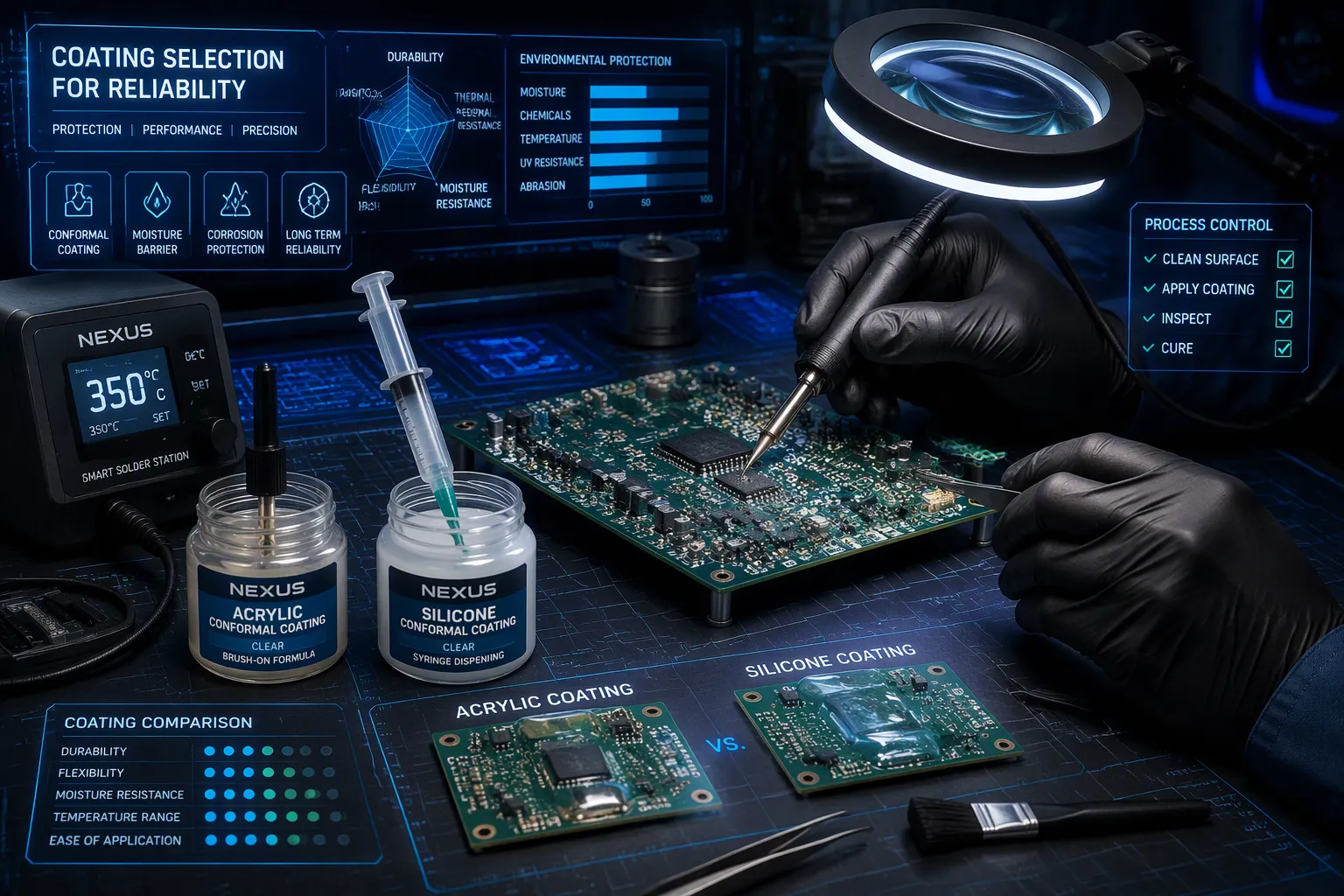
Choose a soldering barrier coating by matching its environmental resistance, solderability, durability, cost, shelf life, and compliance to your specific PCB application and assembly process. This guide covers both PCB surface finishes and conformal coatings. Surface finishes protect copper pads before soldering, while conformal coatings protect assembled boards after soldering.
Start with the decision factors. Your operating environment sets the required thermal and corrosion limits. Board density and fine-pitch features then narrow the viable surface finish options. Assembly volume, rework needs, and budget shape the final choice. You must also confirm compliance with standards such as RoHS and IPC-A-610. A careful match between coating properties and process demands delivers the reliability your product needs.
Key Takeaways
Surface finishes protect copper pads before soldering. Conformal coatings protect the assembled board after soldering.
Match the coating to your board's needs: environment, temperature, solderability, shelf life, durability, cost, and compliance.
For fine-pitch components, choose a flat finish like ENIG, OSP, or immersion silver. HASL is not suitable below 0.5 mm pitch.
ENIG offers the longest shelf life (12+ months) and good corrosion resistance. HASL is cost-effective and handles multiple reflows.
Consider reworkability: acrylic and urethane coatings remove easily. Silicone and parylene are harder to remove.
Prevent failures by storing finishes properly and controlling processes. Black pad in ENIG is a process-control issue.
Follow a step-by-step decision process: define needs, rank priorities, match to coating strengths, and confirm with your manufacturer.
Always verify compliance with standards like RoHS, REACH, and IPC-A-610 to ensure reliability and market acceptance.
Define Soldering Barrier Coating Types
A soldering barrier coating serves one of two jobs. It protects bare copper pads before soldering. It also protects the assembled board after soldering. Understanding soldering barrier coating types begins with separating these two categories. The first category, surface finishes, preserves solderability and prevents oxidation during storage and assembly. The second category, conformal coatings, shields the completed board from moisture, chemicals, and mechanical damage.
Surface Finishes for Pre-Solder Protection
Surface finishes in printed circuit board manufacturing fall into metallic and organic families. All of them prevent copper oxidation before the solder joint forms. Each pcb surface finish balances planarity, shelf life, and cost. No single surface finish wins every category. You match the finish to your assembly process. The table below lists commonly reported coating thickness ranges.
Surface Finish | Coating Thickness Ranges |
|---|---|
OSP | 0.2–0.5 μm |
HASL | 2–12 μm (solder coating) |
ENIG | Ni: 3–6 μm; Au: 0.05–0.125 μm |
ENEPIG | Ni: 3–6 μm; Pd: 0.05–0.15 μm; Au: 0.025–0.05 μm |
Immersion Silver (ImAg) | 0.05–0.125 μm |
Immersion Tin (ImSn) | 1.0–1.3 μm |
Acceptance standards may differ. IPC-4553A, the governing specification for immersion silver, sets its range at 0.12 to 0.40 μm.
HASL and Lead-Free HASL
The hot air solder leveling process applies a molten-solder coating to exposed copper. Hot air knives then level the solder into a uniform layer. Historically, the alloy contained tin and lead, or SnPb. Today, lead-free hasl commonly uses SAC305 alloy. You will see the hot air solder level listed as HASL on assembly drawings. The hot air solder leveling method produces a thick, durable finish with excellent solderability.
The lead-free hasl variant meets the Restriction of Hazardous Substances directive, known as RoHS. IPC-A-610, the acceptability standard for electronic assemblies, confirms standard-pitch use for hot air solder leveling. The standard notes ultrafine-pitch limitations. This finish remains a top choice for through-hole and large-pitch pcb designs. The lead-free hasl finish handles multiple reflows without degrading the joints.
OSP, ENIG, and ENEPIG
Organic Solderability Preservative (OSP) uses a water-based compound. It forms a thin protective layer on bare copper. The coating decomposes when it reaches soldering temperatures. OSP delivers excellent flatness, making it ideal for fine-pitch applications and BGA. Its shelf life is limited. It tolerates only one or two reflow cycles.
The electroless nickel immersion gold (ENIG) finish deposits a consistent nickel layer followed by a thin gold layer. The nickel barrier provides corrosion resistance. The gold layer preserves solderability over a long shelf life. Because electroless nickel immersion gold contains no lead, it is inherently RoHS compliant. It supports fine-pitch components, BGA, and wire bonding. It suits harsh environments and impedance-controlled circuits. ENIG costs more than OSP or HASL, but it earns that cost in reliability.
ENEPIG adds a palladium layer between the nickel and gold. Electroless Nickel Electroless Palladium Immersion Gold (ENEPIG) improves corrosion resistance further. It offers excellent shelf life for high-reliability applications.
Immersion Silver and Immersion Tin
Immersion silver deposits silver directly on copper. IPC-4553A governs its acceptance. It has no nickel barrier. Therefore, it avoids magnetic effects near high-frequency traces. Immersion silver delivers ENIG-grade flatness. It works well for large fine-pitch BGA where warpage threatens joint formation. It demands careful storage and handling to control tarnish.
Immersion tin deposits 1.0 to 1.3 μm of tin. This finish offers strong shelf life and durability over multiple reflows. It provides a flat, solderable surface for dense assemblies.
Conformal Coatings for Post-Solder Protection
After soldering, assembled pcbs face moisture, chemicals, and mechanical stress. Conformal coatings form a thin polymer layer over the completed board. They protect components and traces after assembly. This soldering barrier coating category reduces creep-corrosion exposure. It does not eliminate the mechanism. Coverage can be incomplete at edges, vias, connector shadows, and masked areas. Treat conformal coating as part of a validated protection system, not the sole control.
Acrylic, Silicone, and Urethane
Acrylic coatings apply easily and remove easily. They offer good moisture resistance and dielectric strength. Silicone coatings handle the widest temperature range. They remain flexible across thermal cycling. Urethane coatings deliver excellent abrasion and chemical resistance. All three apply as a liquid and cure to a film.
Epoxy and Parylene
Epoxy coatings form a hard, tough barrier. They resist solvents and mechanical wear. They are harder to remove than acrylic or urethane. Parylene applies through vapor deposition. The process creates a pinhole-free coating that covers sharp edges and complex geometry. Parylene delivers strong barrier properties in thin layers. It demands specialized equipment.
Match Coating Types to Applications
You narrow your choice by matching the finish or coating to your board's demands. Board density, signal speed, environment, and assembly steps all matter. Surface finish selection happens before assembly. Conformal coating selection happens after you define the operating environment.
Fine-Pitch and Signal-Integrity Needs
Dense boards with fine-pitch components require a planar pad surface. A flat pad ensures stable solder paste deposits and consistent joint formation. Your fine-pitch compatibility depends on the finish's flatness. That same planarity governs fine pitch compatibility with dense stencils. OSP, electroless nickel immersion gold, and immersion silver all provide excellent planarity. Hot air solder leveling produces an irregular surface. The irregular surface limits it below roughly 0.5 mm pitch.
Immersion silver stands out for signal integrity. It has no magnetic nickel interface. Therefore, it does not consume insertion-loss budget on outer-layer multi-GHz traces. The corrosion resistance of electroless nickel immersion gold comes with a trade-off: its nickel barrier can alter measured RF behavior. You must model this finish with your geometry, frequency, and insertion-loss target. Use the same stack-up, copper profile, and finish in both simulation and measurement. Product evidence, not a label, should decide.
Environmental and Assembly Needs
Harsh or corrosive environments favor finishes with a nickel barrier. ENIG provides the storage life and corrosion resistance these boards need. If you face multiple reflows, HASL handles them easily. OSP tolerates only one or two cycles. Immersion tin also handles repeated thermal exposure. Shelf life matters in the same way. OSP lasts six to twelve months under controlled storage. HASL lasts twelve to twenty-four months under standard warehouse conditions.
Your pcb manufacturing partner can confirm compatibility and certification. Ask about curing, cleaning, and rework before finalizing the specification. These checks protect the reliability you designed into the board.
Key Factors for Choosing a Soldering Barrier Coating
Five factors drive your decision: operating environment, temperature, solderability, shelf life, durability, cost, and compliance. You must rank them for your board. No coating wins every category. A smart match between process and coating produces reliable soldering connections and field-proven reliability. Start with environmental limits, then work through cost and compliance.
Operating Environment and Temperature
Temperature Tolerance and Thermal Cycling
Your operating environment sets the first limits. An automotive bay brings wide temperature swings. A medical monitor stays stable. The coating must handle swings without cracking. Choose a coating that remains flexible over the full range. Silicone coatings flex across thermal cycling. Acrylic and urethane resist moisture and chemicals but flex less. For surface finishes, the environment matters little after assembly. The finish has done its job by then. The thermal budget during assembly still belongs here.
High-Heat Assembly and Multiple Reflows
Assembly heat tests every finish. HASL handles multiple reflows without degrading joints. OSP tolerates only one or two reflow cycles. Immersion tin also handles repeated thermal exposure. If your board passes through several reflow ovens, choose HASL or immersion tin. If you run a single reflow and a wave step, OSP may still work. Your reflow count shapes surface finish selection.
Solderability, Shelf Life, and Durability
Shelf Life Comparison by Finish
Solderability means the wetting ability that finishes preserve. Shelf life describes how long that ability lasts. The table below shows typical values under controlled storage.
Finish | Typical Shelf Life (months) |
|---|---|
OSP (Organic Solderability Preservative) | 6 |
Immersion Silver | 6 |
Immersion Tin | 6 |
ENIG (Electroless Nickel Immersion Gold) | 12+ |
HASL (Sn/Pb and Lead-Free) | 12 |
ENIG provides the longest shelf life at 12+ months. HASL follows at 12 months. OSP and immersion tin sit near 6 months. Immersion silver also sits near 6 months and needs dry, low-sulfur storage. You must handle every finish with gloves. OSP demands assembly within weeks of opening vacuum packaging. Immersion tin offers strong durability over multiple reflows despite moderate shelf life. This combination suits dense assemblies with repeated thermal exposure.
Fine-Pitch Compatibility and Reworkability
Planarity drives this decision. OSP, ENIG, and immersion silver create flat pads. Flat pads support stable solder paste deposits. HASL produces an irregular surface. That irregularity limits its use below roughly 0.5 mm pitch. For pcbs with fine-pitch components and BGA, choose a flat finish. Fine pitch compatibility remains hard without a planar pad. Fine-pitch applications also need consistent solder paste volume. Immersion tin provides a flat surface as well.
Reworkability also matters. HASL rework is straightforward. OSP leaves no metallic layer. ENIG requires controlled etching if reworked. Conformal coatings differ. Acrylic and urethane coatings remove with solvents. Silicone resists many solvents. Parylene removal usually requires abrasive methods. Match rework ability to your repair strategy.
Cost, Compliance, and Corrosion Risks
RoHS, REACH, and IPC-A-610 Compliance
Cost ranks finishes clearly. OSP and lead-free HASL sit at the lowest cost. Immersion tin costs slightly higher. ENIG costs about 1.5 to 3 times lead-free HASL. ENEPIG ranks high. Immersion silver remains a niche finish. Balance price against expected lifetime.
Compliance closes out the selection. Immersion tin is lead-free and RoHS compliant. OSP is an eco-friendly, lead-free organic protectant. HASL LF is lead-free by designation. Confirm RoHS status for ENIG, ENEPIG, and immersion silver with your supplier. REACH classifications change by formulation. Confirm target-market compliance before ordering. IPC-A-610 confirms standard-pitch use for HASL. Tin whisker mitigation for immersion tin should comply with J-STD-001 and IPC-A-610. These standards protect your inspection process and your customer.
Galvanic Corrosion and Coating Selection
Avoid pairing noble finishes with active substrates. Immersion silver and gold are noble metals. Over a more active copper or nickel substrate, they create a galvanic cell. Moisture completes the circuit and accelerates corrosion. The same risk applies to conductive polymers in conformal coatings. Do not use silver-filled or gold-filled coatings as barriers in corrosion-prone environments. Choose coatings that keep galvanic action low. This is a critical soldering barrier coating principle. Your pcb surface finish choice should reduce corrosion risk.
When you compare surface finish options, include corrosion resistance in the ranking. A noble outer layer can look stable and hide undercutting. The right finish improves solder joint reliability. The wrong one threatens long-term reliability. Your pcb manufacturing partner can confirm compatibility and certification. Ask about cleaning, curing, and rework before finalizing. These checks protect the design intent.
Use a Soldering Barrier Coating Comparison
Use a side-by-side comparison to reveal trade-offs. Understanding soldering barrier coating types starts with a hard truth: no single soldering barrier coating wins every category. HASL and OSP cost less, but they struggle with fine-pitch components. Noble-metal finishes resist corrosion and support dense pcbs, but they cost more. Your application and budget decide.
Compare Properties Across Coating Types
Thickness, Coverage, and Dielectric Strength
Thickness controls coverage. OSP deposits a thin organic layer at 0.2–0.5 μm. Hot air solder leveling applies 2–12 μm of solder. Electroless nickel immersion gold uses a nickel layer of 3–6 μm and a gold cap of 0.05–0.125 μm. Immersion tin deposits 1.0–1.3 μm. These ranges come from industry process standards.
Dielectric strength follows material and film thickness. Epoxy and parylene offer high dielectric strength in thin layers. You apply the minimum thickness that meets your voltage and environmental needs. Your pcb surface finish choice starts with these ranges.
Here is a side-by-side view of the main surface finishes:
Surface finish | Coverage thickness | Shelf life | Planarity |
|---|---|---|---|
OSP | 0.2–0.5 μm | 6 months | Excellent |
HASL | 2–12 μm | 12 months | Limited |
Lead-free HASL | 2–12 μm | 12 months | Limited |
ENIG (electroless nickel immersion gold) | Ni: 3–6 μm; Au: 0.05–0.125 μm | 12+ months | Excellent |
Immersion silver | 0.05–0.125 μm | 6 months | Excellent |
Immersion tin | 1.0–1.3 μm | 6 months | Excellent |
These surface finishes protect copper before assembly. A flat surface improves fine pitch compatibility for dense boards. Match the finish to your assembly schedule and component pitch.
Moisture, Chemical, and Mechanical Protection
Surface finishes protect copper from oxidation before assembly. OSP offers limited moisture resistance. Immersion silver tarnishes in sulfur-rich air. Electroless nickel immersion gold resists corrosion well, but it can develop defects if process control slips.
After soldering, conformal coatings take over. Acrylic gives moderate protection and simple removal. Silicone flexes across wide temperature swings. Urethane resists abrasion and chemicals. Epoxy forms a hard shell. Parylene covers sharp corners and complex geometry. No coating reaches every area. Masked regions, connector shadows, and board edges remain exposed.
HASL vs ENIG: Solderability and Reliability
The most common hasl vs enig decision comes down to cost versus reliability. After you review the data, hasl vs enig becomes clear. You face a hasl vs enig choice when your board combines fine-pitch parts with harsh storage. Weigh hasl vs enig using these pros and cons.
HASL Pros and Cons
Hot air solder leveling gives you a thick, rugged finish with proven solderability. Lead-free hasl removes lead and meets RoHS requirements. The finish handles multiple reflows without degrading.
However, hot air solder leveling leaves an uneven pad surface. That surface limits fine-pitch compatibility. Below roughly 0.5 mm pitch, solder paste may not deposit consistently.
ENIG Pros and Cons
Electroless nickel immersion gold provides a flat, corrosion-resistant pad. The gold cap preserves solderability beyond 12 months. That surface supports fine-pitch components and BGA. The flat pad improves solder joint reliability.
Yet electroless nickel immersion gold costs more than lead-free hasl. It demands strict process control. Poor control creates black pad defects. Rework requires careful etching that can damage pads. The enig finish suits high-reliability boards and advanced assemblies.
For dense assemblies, hasl vs enig favors ENIG. For through-hole boards, hasl vs enig favors HASL. Every hasl vs enig evaluation starts with shelf life. Run a practical hasl vs enig test with your own stencil and reflow profile. ENIG wins on planarity and long-term reliability. HASL wins on cost and ruggedness.
Quick-Reference Selection Checklist
Coverage, Shelf Life, and Thermal Resistance
Use the checklist to lock your decision. Ask how much of the board needs coverage. Conformal coatings leave gaps at masked areas. Check shelf life against your build schedule. OSP lasts six months. Electroless nickel immersion gold lasts more than 12 months. Match shelf life to your inventory rotation.
Thermal resistance shapes the choice too. HASL and immersion tin take multiple reflows. OSP tolerates one or two cycles. If your board sees repeated heat, choose a finish that can handle it.
Reworkability and Repair Options
Reworkability depends on finish and coating. HASL rework is straightforward. OSP leaves no metallic layer to manage. ENIG requires controlled etching. Acrylic and urethane coatings dissolve with solvents. Silicone resists solvents. Parylene needs abrasive removal. Match the repair path to your field service plan.
No finish is universally best. Your final choice balances cost, planarity, corrosion resistance, and rework. Confirm each option with your pcb manufacturing partner. Ask about cleaning, curing, and repair before sign-off. That validation supports overall reliability.
Prevent Common Soldering Barrier Coating Failures
Oxidation, Poor Wetting, and Shelf Life Issues
Identify Visual and Electrical Warning Signs
You spot oxidation before solder ever touches the pad. Discolored copper, dull metallic surfaces, and uneven tarnish patterns signal a compromised surface finish. For OSP, a cloudy or streaked appearance indicates the protective layer has degraded. Immersion silver shows yellow or brown tarnish when exposed to sulfur. These visual cues tell you the soldering barrier coating has failed its storage test.
Electrical tests confirm what your eyes suspect. High contact resistance and erratic wetting during reflow point to oxidation. You measure poor solder spread and weak fillet formation. These signs mean the finish no longer supports reliable solder joint reliability.
Manage Storage and Handling
Storage conditions determine how long your surface finishes remain viable. OSP demands assembly within weeks of opening vacuum packaging. Immersion silver requires dry, low-sulfur storage. You must handle every finish with gloves to prevent contamination.
Control humidity and temperature in your storage area. Track shelf life against your build schedule. ENIG lasts beyond 12 months. HASL lasts 12 months. OSP and immersion silver sit near 6 months. Rotate inventory so older boards move first.
Peeling, Delamination, and Black Pad Defects
Black Pad in ENIG Finishes
Black pad results from excessive corrosion of the nickel finish during the gold displacement reaction. The enig finish develops this defect through aggressive gold bath chemistry, extended immersion, poor bath-age control, and nickel deposits outside the qualified process window. This is a process-control failure, not an inherent property of ENIG.
Optical inspection methods such as microscopy, spectroscopy, and machine vision identify the characteristic dark appearance and surface anomalies of black pad. Chemical techniques such as EDX/EDS, XPS, and electrochemical testing reveal excessive phosphorus concentration, nickel corrosion products, and phosphorus enrichment at the nickel-gold interface. Mechanical testing shows brittle fracture at the nickel-gold interface rather than within the solder.
Preventive monitoring uses bath chemistry analysis and statistical process control. Track catalyst concentration to limit over-activation. Maintain nickel bath age, temperature, pH, and phosphorus content within qualified ranges. Control gold bath pH and immersion time. Request IPC-4552B corrosion evaluation rather than relying only on thickness data.
Avoid Adhesion and Peeling Problems
Peeling and delamination stem from poor surface preparation before coating application. Contamination, moisture, and inadequate cleaning prevent proper adhesion. You must clean boards thoroughly before applying any conformal coating. Verify cure schedules match the manufacturer's specification.
Rework and Removal Challenges
Surface Finish Rework Methods
Rework methods differ by finish type. Hot air solder leveling rework is straightforward. OSP leaves no metallic layer to manage. ENIG requires controlled etching that can damage pads if you rush the process. Immersion tin demands careful handling to preserve the tin layer.
Conformal Coating Removal
Conformal coating removal depends on the material. Acrylic and urethane coatings dissolve with solvents. Silicone resists many solvents. Parylene removal usually requires abrasive methods. Match your repair strategy to the coating you select. Your pcb manufacturing partner can confirm the best removal approach for your specific application.
Apply a Step-by-Step Decision Process
Define Needs and Rank Priorities
Start with a written list of requirements. Include assembly steps, board density, and operating environment. Rank these needs from most to least critical. This ranking guides every later choice.
Assembly Process and Board Density
Your assembly process sets the first constraint. Count the reflow cycles. One reflow plus a wave step tolerates OSP. Multiple reflows need HASL or immersion tin. Dense boards with fine-pitch components demand a flat finish. OSP, ENIG, and immersion silver deliver it. Hot air solder leveling cannot match that planarity below roughly 0.5 mm pitch.
Your stencil design depends on the chosen pcb surface finish. A flat pad ensures consistent solder paste deposits. For fine-pitch apertures, choose a finish that preserves pad geometry. Your pcb manufacturing partner can verify stencil thickness and aperture ratios. This check confirms fine-pitch compatibility.
Environment and Lifespan Requirements
The operating environment sets corrosion and thermal limits. A factory-floor board faces humidity and chemicals. A medical monitor board stays stable. Corrosive environments favor nickel-barrier surface finishes like ENIG. Wide temperature swings demand flexible coatings such as silicone.
Lifespan matters. A ten-year product warrants finishes with proven long-term reliability. Short-life consumer boards can use lower-cost options.
Match Priorities to Coating Strengths
Once you rank needs, match them to coating strengths. Perfection is rare. You trade cost against solderability, or planarity against shelf life.
Solderability-First Decisions
A soldering barrier coating that prioritizes solderability suits high-volume assembly. HASL delivers proven wetting across multiple reflows.
For fine pitch compatibility, choose ENIG or immersion silver. These planar surface finishes accept consistent solder paste. Immersion tin balances flatness with durability across multiple reflows.
Protection-First Decisions
Protection-first boards live in harsh settings. ENIG provides corrosion resistance and a long shelf life.
For post-solder protection, match the coating to the threat. Acrylic resists moisture and removes easily. Urethane resists chemicals and abrasion. Parylene covers complex geometry without pinholes. Your environment decides.
Confirm with the Manufacturer
Your final step is validation. Never finalize a spec without manufacturer input. Process capability varies. Confirm your chosen surface finish and coating apply consistently.
Compatibility and Certification Checks
Ask your supplier for certification evidence. Confirm RoHS and REACH compliance for selected materials. Request IPC-A-610 acceptance criteria for your finish.
Immersion silver should meet IPC-4553A requirements. Evaluate ENIG against IPC-4552B. These standards protect your inspection process and product reliability.
Curing, Cleaning, and Rework Checks
Clarify curing parameters for conformal coatings. Verify the cure schedule fits your production flow. Confirm pre-coating cleaning to avoid adhesion failures.
Ask about rework options. Can your field team remove the coating without damaging components? Acrylic and urethane dissolve with solvents. Silicone resists solvents. Parylene needs abrasion. These checks prevent surprises.
Choose a soldering barrier coating by matching its environmental resistance, solderability, durability, cost, shelf life, and compliance to your pcb application. Your decision path: define the coating categories, evaluate key factors, compare trade-offs, avoid common failures, and confirm with the manufacturer. These steps protect long-term reliability.
Lock in the final choice using a quick-reference checklist. Compare coverage, thickness control, dielectric strength, thermal resistance, and moisture/chemical/mechanical protection. Then ask your supplier key questions: operating temperature, moisture, chemicals, rework, lifespan, certifications, no-clean flux compatibility, cleaning, curing, and removal.
A strategy combining soldering barrier coatings and a surface finish improves overall reliability. Planar surface finishes support fine-pitch pcbs. The right surface finish preserves solderability.
FAQ
How do I choose between a surface finish and a conformal coating?
These coatings serve different stages. A surface finish protects bare copper pads before soldering. A conformal coating protects the assembled board after soldering. You often need both. Match each one to its stage in your pcb assembly process.
Which surface finish offers the longest shelf life?
ENIG lasts beyond 12 months under controlled storage. HASL lasts about 12 months. OSP, immersion silver, and immersion tin sit near 6 months. Choose based on your inventory rotation and build schedule.
Can HASL handle fine-pitch components?
No. Hot air solder leveling leaves an uneven pad surface. That irregularity limits its use below roughly 0.5 mm pitch. For fine-pitch parts and BGA, choose a planar finish such as ENIG, OSP, or immersion silver.
What causes black pad in ENIG finishes?
Black pad comes from excessive nickel corrosion during the gold displacement reaction. Aggressive bath chemistry, extended immersion, and poor bath-age control drive this defect. It is a process-control failure, not an inherent property of ENIG. Request IPC-4552B corrosion evaluation from your supplier.
How many reflow cycles can OSP survive?
OSP tolerates only one or two reflow cycles. If your board passes through multiple reflow ovens, choose HASL or immersion tin instead. Both handle repeated thermal exposure without degrading solder joints.
Which conformal coatings remove easily for rework?
Acrylic and urethane coatings dissolve with solvents. Silicone resists many solvents. Parylene removal usually requires abrasive methods. Match your repair strategy to the coating you select. Confirm removal options with your pcb manufacturing partner before finalizing the specification.
Do I need RoHS and REACH compliance for every finish?
Yes. Immersion tin and OSP are lead-free and RoHS compliant. Lead-free HASL meets RoHS by designation. Confirm RoHS status for ENIG, ENEPIG, and immersion silver with your supplier. REACH classifications change by formulation, so verify target-market compliance before ordering.
