How to Decide Between Potting and Conformal Coating for Your PCB Project
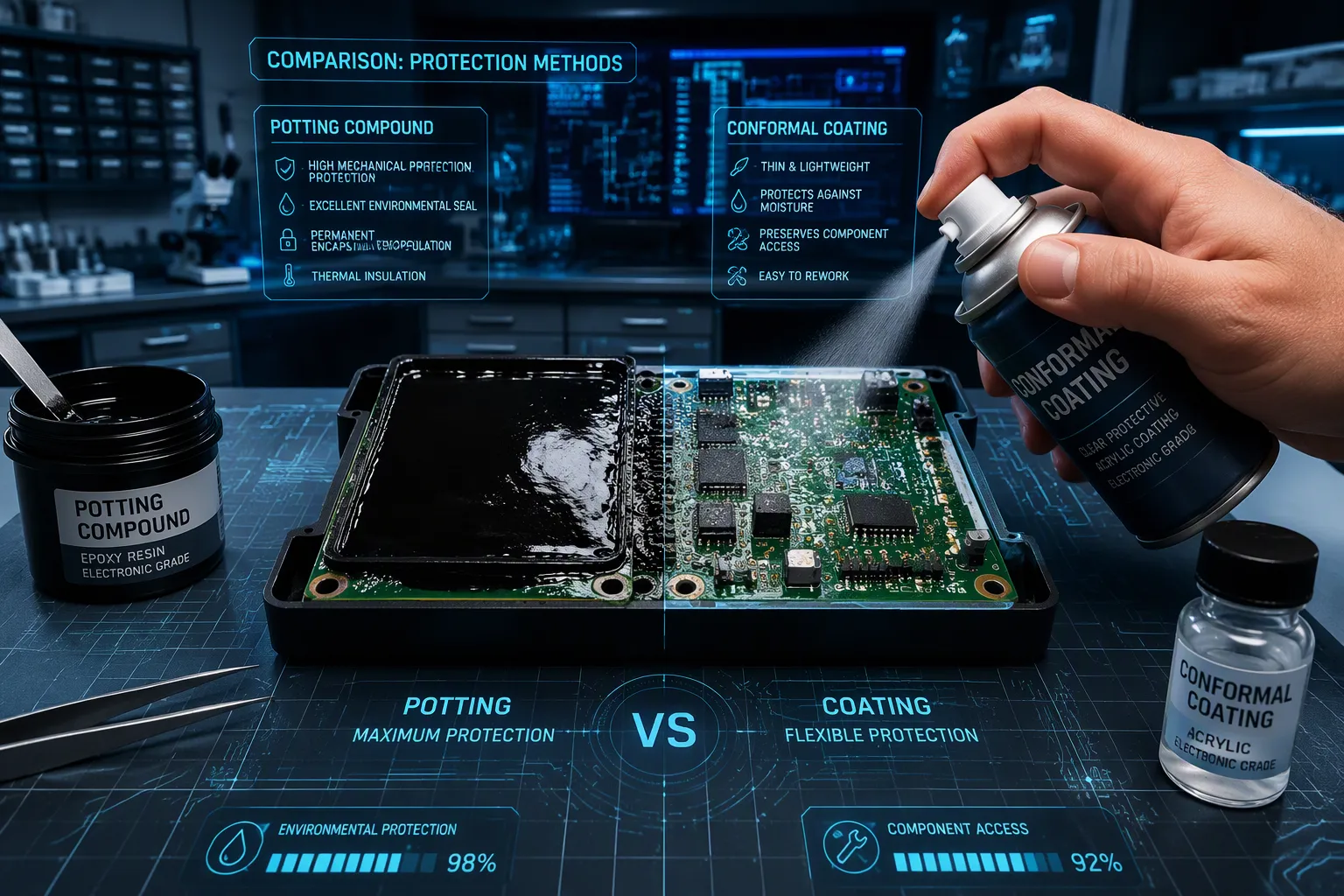
Should you pot your PCB or apply a conformal coating? Both methods protect your PCBs from moisture, dust and other contaminants, yet they differ in coverage, weight, durability, cost, and repairability. Conformal coating forms a thin film over components. Potting fully encases the board in a solid compound. The right choice depends on your operating environment, physical stress, electrical requirements, and production needs. To decide between potting and conformal coating, you must weigh these factors against your project goals. Harsh conditions demand heavy protection. Serviceable designs favor thin coatings. Your PCBs deserve the method that matches their real-world demands. Consider your priorities carefully.
Key Takeaways
Conformal coating forms a thin film, while potting fully encases the board in solid resin.
Choose coating for lightweight, serviceable designs; choose potting for harsh, high-stress environments.
Coating allows easy rework with solvents, but potting makes repair nearly impossible.
Potting offers maximum protection against vibration, shock, and chemicals, but adds significant weight.
Consider a hybrid approach: coat the whole board and pot only high-stress areas.
Evaluate environmental threats, cost, repairability, and production volume before deciding.
Test both methods on prototypes under real conditions to validate your choice.
Consult standards like MIL-STD-810 and IPC-CC-830 to guide your validation.
Potting vs. Conformal Coating: What’s the Difference?
Both potting and coating compounds are organic polymers. They provide electrical insulation and chemical resistance. The main difference is coverage. One method creates a thin layer of protective material over the board. The other fills an enclosure with resin and creates a solid block around the assembly. Your choice between potting and coating depends on how much protection you need and whether you plan to service the board later.
What Is Conformal Coating?
This coating starts as a liquid resin. You apply it to printed circuit boards, and it cures into a thin film that follows component contours. Typical dry film thickness falls between 1 and 5 mils (25 to 127 microns). That thin layer adds negligible weight and keeps component labels readable. For many pcbs, this approach stops moisture, salt spray, and dust from reaching solder joints.
Industry standards provide guidance. IPC-CC-830 groups coatings into families and sets qualification requirements. IPC-A-610J Table 10-1 lists common cured thickness values. Acrylic, epoxy, and urethane coatings range from 0.03 to 0.13 mm (30-130 μm). Silicone coatings range from 0.05 to 0.21 mm (50-210 μm). Parylene ranges from 0.01 to 0.05 mm (10-50 μm). A dry film thicker than 5 mils crosses the line into encapsulate or potting territory. That boundary helps you decide whether a thin film still works or whether you need a bulk fill.
What Is Potting?
Potting, or pcb potting, takes the opposite path. You place the board inside a housing or mold and fill the cavity with resin. Once cured, the compound surrounds every component. The housing remains part of the final assembly. This process creates a complete barrier against environmental factors. It resists shock, vibration, impact, and aggressive solvents much better than a film can.
Material choice determines performance. Epoxy cures rigid and offers high chemical resistance and heat tolerance. Polyurethane stays flexible and damps mechanical stress. Silicone remains elastic through wide temperature swings. When you need to completely encapsulate the pcb, these resins deliver the durability that a film cannot. The trade-off is serviceability. A potting fill is permanent; replacing a failed component usually means discarding the assembly. If you expect rework, a thin coating gives you better access.
Conformal Coating vs. Potting vs. Encapsulation
Encapsulation is a broader term. It describes any process that surrounds electronics with protective material, with or without a housing. Potting is one type of encapsulation: the resin fills a specific "pot" or enclosure. Encapsulation can also mean glob-topping a single chip, overmolding a board, or dipping an entire unit. So the contrast between conformal coating vs. potting vs. encapsulation comes down to coverage: a thin surface film, a filled housing, or a custom resin shell.
When you compare conformal coating vs. potting, look at repairability and stress. A thin coating remains accessible and easy to probe. Potting locks the board in place and stops vibration. For pcbs that operate outdoors, the fill often wins. For serviceable, weight-sensitive designs, choose the film. The choice of potting vs conformal coating often comes down to whether you protect the whole assembly or just its surface.
Pros and Cons of Potting and Coating
Advantages and Limitations of Conformal Coating
Conformal coating gives you a thin, lightweight film that follows every component contour. You can apply it by brushing, spraying, or dipping, so it fits both small batches and automated lines. This film shields against fungus, moisture, salt spray, and corrosion. It adds almost no weight or size, which makes it ideal for wearables, IoT sensors, and portable electronics. Acrylic coatings offer good moisture resistance and easy removal with solvents. Silicone holds flexibility from -65°C to 200°C. Parylene delivers a pinhole-free film with IPX7/IPX8 waterproofing.
The limits appear under heavy-duty threats. A thin film cannot match the durability of a solid resin block. Acrylic coatings resist high temperatures only up to 130°C. Epoxy coatings crack under thermal cycling. Polyurethane cures slowly and resists rework. These coatings also contain VOCs in their solvents, though newer low-VOC options exist. You gain serviceability and design flexibility, but you trade away maximum resilience.
Advantages and Limitations of Potting
PCB potting encases the entire assembly in resin. This method provides heavy-duty, all-encompassing protection. It resists vibration, impact, abrasion, heat, and chemicals far better than any film. Silicone offers excellent impact resistance and stays elastic across wide temperature swings. Polyurethane gives the best anti-vibration performance. Thermally conductive compounds help dissipate heat. Full sealing blocks liquids, dust, and corrosive gases, which suits immersion and washdown environments.
The trade-offs are significant. Potting adds bulk and weight, and mismatched thermal expansion can strain components. General-purpose epoxy handles only about 100–150°C. Polyurethane ages poorly under UV light and may discolor. Once cured, epoxy potting is nearly impossible to remove without damaging the board. You lose inspection access and field serviceability. Voids from poor adhesion can also compromise the seal.
Where Each Method Performs Best
Conformal coating wins in standard environments where weight, thickness, and repair access matter. Medical devices, consumer electronics, and automotive modules rely on it. It also suits high-humidity, dusty, or chemically exposed sites like outdoor installations and coastal locations. When you must protect your PCBs without adding bulk, this film is the practical answer.
Potting dominates harsh or extreme conditions. High-volume production naturally causes abrasion and scratches, so PCB potting handles that wear. Industrial systems, defense electronics, and immersion applications need the resin barrier. The table below summarizes the core trade-offs between these types of potting and coating materials.
Factor | Conformal Coating | Potting |
|---|---|---|
Weight | Minimal | Significant increase |
Repairability | Easy removal with solvents | Permanent, not field-serviceable |
Protection level | Moderate | Maximum |
Best use | Compact, serviceable devices | Harsh, high-stress environments |
Compare the trade-offs honestly. A thin, serviceable coating keeps your options open. A thick, permanent encapsulation locks in reliability. Your choice between potting and coating should match the real threats your board will face.
Key Factors to Consider Before You Choose
Your decision between potting and coating should start with the environment in which the PCB will be used. Every hazard your board faces narrows the field of suitable materials. You must identify the dominant threat before you compare product datasheets. Protection is specified against the primary risk, not against every possible risk combined.
Environmental Hazards and Exposure
Moisture, Chemicals, and Dust
Moisture drives most coating and potting decisions. Conformal coating forms a thin polymeric layer that reduces water vapor transmission and blocks ionic contamination. This barrier prevents dendritic growth and contact corrosion. An intact coating maintains insulation resistance above 100 megaohms even after humidity exposure. The protection depends on proper thickness and adhesion. A breach in the film exposes the board to the same damage as an uncoated assembly.
Chemical exposure varies by chemistry. Acrylic coatings resist solvents and chemical contamination. Silicone offers good chemical resistance. Polyurethane provides strong resistance to solvents. Epoxy resists abrasion and chipping. For potting compounds, epoxy delivers outstanding chemical resistance after full cure. Polyurethane handles fuels, oils, and aggressive chemicals well. You must verify compatibility with the specific substances your board will contact.
Dust and salt ingress cannot reach sensitive areas under an intact coating. Acrylic coatings resist UV exposure, which makes them ideal for sunlight-exposed boards. Silicone provides good vibration and mechanical stress protection. Polyurethane offers a tough, adhesive barrier suited to harsh environments. Epoxy creates a smooth finish resistant to cracking.
Temperature Cycling and UV Stress
Temperature swings stress every protective material. Silicone coatings hold flexibility from -65°C to 200°C. Acrylic coatings resist high temperatures only up to 130°C. Epoxy coatings crack under thermal cycling. General-purpose epoxy potting handles only about 100–150°C. Polyurethane ages poorly under UV light and may discolor. These limits matter when your board operates outdoors or near heat sources.
UV stress degrades many polymers over time. Acrylic coatings resist UV exposure well. Polyurethane potting compounds break down under prolonged sunlight. You need to match the material to the actual light exposure your product will see.
Physical Damage, Shock, and Vibration
Mechanical stress separates the two methods clearly. Conformal coating provides limited protection against shock and vibration. It mainly protects surfaces from abrasion. Potting acts as a shock absorber. It stabilizes delicate solder joints and components. Silicone is especially valued for its damping characteristics. Polyurethane gives the best anti-vibration performance.
The table below shows how the two methods compare on key mechanical factors.
Comparison point | Potting compound | Conformal coating |
|---|---|---|
Applied thickness | Substantial (mm–cm) | Very thin (µm) |
Coverage | Full encapsulation | Surface-level film |
Vibration/shock protection | High | Moderate |
Added weight | Heavier | Lightweight |
When vibration and shock exceed what the bare soldered assembly can hold, potting becomes the stronger choice. For less severe mechanical environments, conformal coating may provide adequate protection from physical damage while keeping the design lightweight.
Electrical and Thermal Performance
Electrical requirements shape material selection. Conformal coating maintains high insulation resistance. Potting compounds offer dielectric strength between 15,000 and 25,000 volts per mil. Thermal conductivity for potting materials typically ranges from 0.2 to 1.5 watts per meter-kelvin. Filled grades can improve the thermal path to a metal housing.
The chart below shows thermal conductivity and dielectric strength values for several potting compounds.
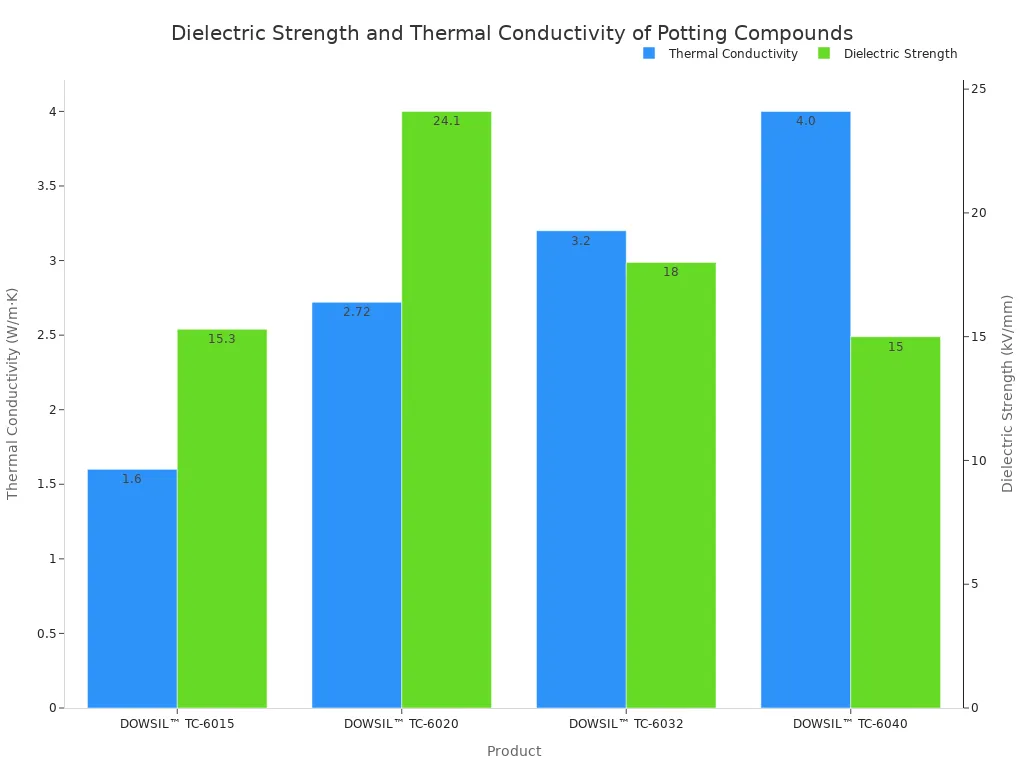
Conformal coating has a small impact on thermal dissipation. Airflow and convection largely remain. Potting adds thermal mass. Unfilled resin is a poor conductor. You must confirm thermal performance by running a thermal survey at maximum load.
High-voltage designs need careful evaluation. Potting may support a high-voltage insulation strategy only when the compound, geometry, interfaces, and qualification tests satisfy applicable product safety requirements. You should not assume potting replaces required creepage or clearance distances on its own.
The environment in which the PCB will be used determines whether you need the thick resilience of PCB potting or the serviceable protection of a thin film. Potting offers thicker, more durable resilience against moisture, heat and vibration. Conformal coating may be enough for less severe environments where serviceability matters. Weigh protection from environmental hazards against your need for repair access. That balance defines your choice between potting and coating.
Cost, Repairability, and Production Impact
Material and Application Costs
You must compare material costs, application labor, and tooling requirements before you commit to either method. Potting generally costs more than conformal coating. It uses more material, may require an extra housing, and involves more complex process steps. Conformal coating usually costs less, especially in high-volume production, because it uses less material and applies faster.
The table below breaks down the cost categories for both methods.
Cost category | Conformal coating | Potting |
|---|---|---|
Material (per board) | $0.10–$0.50 | $0.80–$5.00 |
Labor (per board) | $0.40–$1.70 | $0.80–$3.00 |
Tooling (initial) | $200–$500 | $500–$3,000 |
Total per-board cost | $0.50–$3.00 | $2.00–$15.00+ |
A crossover point exists at 1,000–2,000 units. Above that volume, automated selective conformal coating becomes markedly cheaper than potting. The per-unit advantage grows further above 5,000 units. Your production volume directly shapes which potting or coating material makes financial sense.
Rework and Repair Difficulty
Conformal coating allows easier rework. You can remove most coatings with solvents, provided the solvent does not damage components. Acrylic coatings are the easiest and fastest to remove. Silicone and urethane require longer soak times and often brushing. Heated solvent products can quickly remove acrylic, silicone, and urethane coatings. Precision remover pens exist for small areas. Some silicone and flexible coatings can be peeled away. You can also burn through the coating with a soldering iron during board rework.
Potting makes component replacement difficult or impossible. PCB potting creates a permanent encapsulation. Epoxy potting is nearly impossible to remove without damaging the board. Physical removal methods for epoxy include hand ablation, micro-ablation, and plasma removal. These methods carry risks such as damage to solder joints and metal surfaces. You lose inspection access and field serviceability. For PCBs that need repair access, conformal coating is the practical choice.
Production Speed and Scalability
Production speed depends on your application method and curing time. Manual spraying suits small runs, prototypes, or low-budget jobs. Brush coating is low-cost but labor-intensive and highly variable. Automated spraying supports larger production runs. Dip coating is standard for high-volume production. Selective coating uses automated robotic nozzles to reduce masking needs.
Curing time affects throughput significantly. Moisture curing takes minutes to cure but a few days for full cure. Evaporation curing lets you handle boards within about an hour, with full cure over several days. UV curing offers very high throughput because the lit surface cures almost immediately. Heat curing shortens cure time to as little as 20 minutes. Urethane coatings can require up to 30 days unless you use additional curing equipment. Potting application is fast and efficient for assembly lines. Your batch size and curing method determine how quickly you can scale.
A Framework to Decide Between Potting and Conformal Coating
You need a practical path to decide between potting and conformal coating. Start with the operating environment, then move through mechanical stress, electrical performance, cost, and repairability. This sequence keeps one dramatic threat from controlling your decision.
Ask These Questions First
Answer these questions before comparing material datasheets. They define the boundary between a thin film and a full fill for your pcb.
What mechanical support does the board need? A thin film offers limited structural restraint. Potting can immobilize components and cables, but cure shrinkage and expansion stress need management.
Do you require inspection and repair access? Coating keeps parts and solder joints visible. Potting hides internal features after cure.
What weight and volume limits apply? Coating adds little mass. Potting adds significant mass and enclosure fill-level constraints.
How severe are moisture or contamination threats? A continuous film helps against humidity, condensation, and dust. A complete resin system provides stronger isolation.
What thermal behavior do you expect? Coating has a minor thermal impact. Potting can spread or trap heat depending on resin conductivity, voids, thickness, and enclosure design.
Can your production controls handle the process? Coating requires control of cleaning, masking, viscosity, film thickness, coverage, and cure. Potting requires control of mix ratio, degassing, dispense volume, exotherm, voids, and adhesion.
What repair or end-of-life policy applies? Coating suits serviceable assemblies. Potting suits assemblies that stay sealed for life.
These environmental factors and maintenance priorities define the practical choice. You may find the film is enough. You may discover the board needs a solid resin block.
Match the Method to Your Application
Map those answers onto real applications. The table below matches each application area with the stronger approach.
Application area | Potting is stronger when... | Coating is enough when... |
|---|---|---|
Factory machines | Hard-wearing encapsulation handles continuous operation and severe conditions | A light film resists dust and chemicals in less demanding spots |
Marine electronics | A thick seal keeps moisture and salt away from the circuit | Constant saltwater exposure needs more than a film |
Aerospace | Robust casing protects electronics under extreme flight conditions | Low weight is critical and the environment is moderate |
Medical devices | Body-safe materials give long-lasting protection for implanted tools | Diagnostic instruments get accurate shielding without compromising safety |
Small pcbs | Bulk becomes a problem on miniaturized boards | Negligible added weight and precise coverage are ideal |
Small boards usually need coating. Heavy industrial controls often need potting. When vibration and shock dominate, potting beats coating. When serviceability dominates, coating wins. The core tradeoff between potting and coating remains simple: coating preserves reworkability; potting sacrifices it for higher robustness. Let your enclosure's field service strategy guide the decision, not cost alone.
When to Consider a Hybrid Approach
The choice is not always strict. Many teams compare conformal coating and potting as opposing options, but a hybrid can serve both goals. Use this three-step approach:
Apply a conformal coating across the entire board for broad environmental protection.
Add selective potting compound only in areas that need sealing or mechanical reinforcement.
Validate the combination on prototypes before moving to production.
High-stress areas include cable entries, connectors, heavy components, and regions exposed to severe vibration, shock, or harsh chemical exposure. When you weigh conformal coating vs. potting, keep this hybrid path in mind. It preserves the serviceability of the film while gaining resin durability exactly where it matters.
A hybrid approach also controls cost. You avoid paying for full potting when only a connector or coil needs it. You also avoid leaving the rest of the board exposed. Automotive modules and industrial sensors commonly benefit from this layout.
Prototyping and testing both options under real operating conditions remains the most reliable confirmation. Apply each method to prototype boards. Run thermal cycling, vibration, and humidity tests. Compare failure modes and rework times. The empirical result tells you which approach matches your reliability targets.
In the end, select the right potting or coating by balancing operating environment, mechanical stress, electrical needs, cost, and repair policy. Potting and coating both protect, but they serve different priorities. Potting gives maximum resilience and accepts permanence. Coating gives accessibility and accepts a thinner barrier. Use this framework to make your decision, then validate it before full production.
Final Checklist and Next Steps
Walk through a focused checklist before you decide between potting and conformal coating. This review keeps your choice aligned with real operating demands. Balance environmental threats, cost, serviceability, and validation results. Each step moves you closer to a production-ready answer.
Review Environmental and Mechanical Threats
Start with the harshest conditions your assembly will face. Military and automotive standards offer a useful baseline. MIL-STD-810 tests temperature cycling from -55°C to 125°C, humidity up to 95% RH, salt fog, vibration from 10 to 2,000 Hz, and shock up to 75 g. AEC-Q100 thermal cycling repeats 1,000 cycles between -40°C and +125°C. You may not need that full range, but name the specific extremes for your product.
Separate the board's internal environment from the external enclosure environment. Housing, seals, ventilation, and installation affect what reaches the electronics. Protection should complement these features rather than compensate for unresolved enclosure gaps. A sealed metal housing reduces moisture risk enough for a thin coating. An open plastic enclosure demands a stronger barrier. Mechanical support and potting matter more than coating alone in vibration-dominant environments.
Use these categories as your threat checklist:
Temperature cycling and thermal extremes
Moisture, salt, dust, and chemical exposure
Vibration and shock magnitude
UV aging and sunlight exposure
Rank them by likelihood for your installation site. Each ranking brings you closer to the right potting or coating choice.
Compare Cost and Serviceability Targets
Potting material costs more than conformal coating and makes repair nearly impossible. Conformal coating costs less and permits solvent-based rework. Rework access often becomes the deciding factor when components need inspection or replacement. The resin fill wins when the assembly stays sealed for life. This trade-off between potting and coating rarely changes.
Identify connectors, switches, test points, and programming interfaces that must remain open. Document masking and exclusion boundaries clearly. Verify space for compound containment when potting, and confirm interfaces extend through the potted area. Check the bond between potting and coating layers in hybrid designs. Poor adhesion lets moisture track along the interface. The dam line therefore requires adhesion testing and visual inspection.
Prototype, Test, and Validate
Prototype boards reveal whether your potting or coating selection truly performs. A supplier's general claim does not prove your finished assembly works. Run damp heat testing at 85°C/85%RH for 1,000 hours. Vibration and shock tests confirm the film does not peel or crack. Salt spray testing confirms the chosen method will protect pcbs from corrosion in coastal or chassis-mounted modules.
Sequence application and testing correctly. Determine which inspections, programming, and tests occur before treatment. Define post-application checks for coverage and fill. Use the NPI EVT, DVT, and PVT phases; DVT focuses on environmental stress screening and long-term reliability. Consult a potting or coating material supplier for product recommendations, then validate on your own pcb and enclosure before full production.
You must weigh environment, mechanical stress, electrical needs, cost, and repair access to decide between potting and conformal coating. Potting delivers stronger protection with lower repairability. Conformal coating balances protection with accessibility. Evaluate your pcb project against these practical criteria before you commit.
Test both methods on prototype boards under real operating conditions. This step validates performance and confirms your choice. You can protect your pcbs from damage with either approach. Consult a coating manufacturer or an experienced PCB assembly partner to protect your pcbs with confidence.
FAQ
How thick is a conformal coating compared to potting?
Conformal coating cures into a thin film between 1 and 5 mils (25 to 127 microns), depending on the material family. Potting fills the entire enclosure with resin, so its thickness reaches millimeters or centimeters. That coverage gap defines the protection level you get from each method.
Can you rework a PCB after potting?
Rarely. Epoxy potting is nearly impossible to remove without damaging the board. Physical removal methods like hand ablation and plasma removal risk harm to solder joints and metal surfaces. Conformal coating allows easier rework because solvents, remover pens, and even a soldering iron can break through the film.
Which method handles vibration and shock better?
Potting wins. It acts as a shock absorber and stabilizes delicate solder joints and components. Silicone offers excellent damping characteristics, and polyurethane delivers the best anti-vibration performance. Conformal coating provides only moderate protection against mechanical stress, mainly guarding surfaces from abrasion.
Does potting replace creepage and clearance requirements in high-voltage designs?
No. Potting may support a high-voltage insulation strategy only when the compound, geometry, interfaces, and qualification tests satisfy applicable product safety requirements. You should not assume potting replaces required creepage or clearance distances on its own.
What does conformal coating cost compared to potting?
Conformal coating typically runs $0.50 to $3.00 per board, while potting ranges from $2.00 to $15.00 or more. A crossover point appears at 1,000 to 2,000 units, where automated selective coating becomes markedly cheaper than potting. Volume shapes which material makes financial sense.
When should you consider a hybrid approach?
Use a hybrid when only part of the board faces severe stress. Apply conformal coating across the entire assembly for broad environmental protection, then add selective potting compound at cable entries, connectors, heavy components, and vibration-prone regions. Validate the combination on prototypes before moving to production.
Which standards should guide your coating or potting validation?
MIL-STD-810 covers temperature cycling from -55°C to 125°C, humidity up to 95% RH, salt fog, vibration from 10 to 2,000 Hz, and shock up to 75 g. AEC-Q100 repeats 1,000 thermal cycles between -40°C and +125°C. IPC-CC-830 groups coating families and sets qualification requirements.
How do you test whether your choice actually works?
Run damp heat testing at 85°C/85%RH for 1,000 hours. Vibration and shock tests confirm the film does not peel or crack. Salt spray testing confirms corrosion protection for coastal or chassis-mounted modules. Prototype boards reveal whether your potting or coating selection truly performs under real operating conditions.
