Quick Turn PCB: Shorten Time-to-Market for Your Products
You need to move fast in today’s market. Quick turn pcb production lets you launch products ahead of your competition. With quick turn pcb, you can reduce lead times from weeks to just days. The average cycle time for quick turn pcb ranges from 1 to 5 days, while traditional methods can take 2 to 6 weeks:
Metric | Quick Turn PCB | Traditional PCB |
|---|---|---|
Average Cycle Time | 1-5 days | 2-6 weeks |
Quick turn pcb helps you test ideas early, fix mistakes, and meet tight deadlines. You gain flexibility for prototypes, small batches, or urgent needs. This approach gives you a real edge in time-to-market.
Quick turn pcb production speeds up design-to-delivery cycles.
You reach customers faster and stay ahead with quick turn pcb.
Quick turn pcb supports innovation by letting you adapt quickly.
Key Takeaways
Quick turn PCB production cuts wait times from weeks to days. This helps you launch products faster than others.
This service helps you make prototypes fast. You can test and fix designs quickly. This lowers the chance of expensive mistakes.
Picking the right quick turn PCB provider is very important. Choose one with good quality checks and promises on delivery time.
Talking clearly with your provider can stop delays. This keeps your project moving and makes sure you get it on time.
Making your design files better and using common parts can make the quick turn PCB process much faster.
What Is Quick Turn PCB
Quick Turn PCB Definition
You need to understand what quick turn pcb means before you can use it to your advantage. Quick turn pcb refers to a special service in electronics manufacturing. This service focuses on speed and efficiency. You can use quick turn pcb to get your circuit boards made in a very short time. Many engineers and designers rely on quick turn pcb when they need results fast.
Quick turn pcb is a rapid prototyping service.
You can use quick turn pcb for quick production.
Quick turn pcb works best for designers and manufacturers who need circuit boards in a short timeframe.
Quick turn pcb technology supports urgent projects and tight schedules.
You do not have to wait weeks for your boards. With quick turn pcb, you can move from design to finished product in just days. This speed gives you a big advantage in the market.
Role in Product Development
Quick turn pcb plays a key role in product development. You can use quick turn pcb to test ideas and make changes quickly. This process helps you avoid long delays and costly mistakes.
When you use quick turn pcb prototypes, you shorten your design cycle. You can explore new concepts faster than with traditional methods.
Quick turn pcb lets you test and refine designs quickly.
You can make changes and see results almost right away.
Quick turn pcb allows you to try multiple versions and pick the best one.
You turn uncertainty into clear, actionable steps with quick turn pcb.
You speed up your entire project with quick turn pcb. You can launch products faster and respond to market changes with confidence. Quick turn pcb helps you stay ahead and deliver quality products on time.
Quick Turn PCB Benefits
Faster Prototyping
You must work fast when making new products. Quick turn pcb services make prototyping much quicker. They deliver boards in days or sometimes hours. You send your design and get a working pcb for testing almost right away. This speed lets you test ideas, change things, and see results without waiting long.
Quick turn pcb helps you build and improve prototypes quickly.
Simple quick turn pcbs can be made in just 24 hours.
Harder quick turn pcbs usually take 3 to 4 days.
Fast prototyping helps you find and fix problems early.
Quick turn pcb services keep your project moving forward.
Quick turn pcb gives you a big advantage. Rapid prototyping helps your team and clients work together. You can share updates, get feedback, and make your design better each time. Quick turn pcb gives you the speed to stay ahead.
Reduced Development Cycles
Quick turn pcb makes your development cycles shorter. You can go from an idea to a finished product much faster than with regular pcb manufacturing. Short lead times mean you do not wait weeks for your next version.
Quick turn pcb can be made in just 24 hours for simple designs.
Harder quick turn pcbs usually take only 3 to 7 days.
You can change your design and materials to save more time.
Working with quick turn pcb and assembly makes your workflow faster.
Quick turn pcb lets you update and remake designs quickly.
You can change things right away after testing. Quick turn pcb lets you fix problems and grab chances fast. This keeps your project moving and lowers the risk of big mistakes. You can focus on new ideas instead of waiting for production.
Accelerated Launches
Quick turn pcb helps you launch products faster. You can bring your ideas to market weeks before others. This speed helps you win more customers and build strong relationships.
Quick turn pcb makes design-to-delivery cycles very fast.
You can meet tight deadlines for launches and important events.
Fast turn pcb services are needed in busy industries.
Quick turn pcb lets you change and improve quickly.
Strict quality control makes sure your quick turn pcbs are good.
Quick turn pcb gives you a strong advantage. Faster launches help you react to market changes and customer needs right away. Quick turn pcb helps your business grow by making sure you never miss a chance. You can count on quick turn pcb for speed and reliability.
Tip: Quick turn pcb services help you get products to market faster and improve your place in the market. Use quick turn pcbs to stay ahead and reach your business goals.
Quick Turn PCB Process
You need a simple way to go from idea to board. The quick turn pcb process gives you this path. It helps you move from design to delivery very fast. You can use quick turn pcb to meet tight deadlines. This keeps your projects moving forward. Let’s look at each step so you know what happens.
Design Submission
You begin by getting your design files ready. You must send all engineering documents to the manufacturer. These files guide the whole quick turn pcb process. If you want fast results, your files must be correct and complete.
Here’s what you should include:
Gerber files for every layer of your quick turn pcb
Bill of Materials (BOM) with all parts for your quick turn pcbs
Assembly drawings that show where each part goes
Soldering coordinates if you need assembly for your quick turn pcb
Test requirements for checks after making your quick turn pcb
Tip: Check your files before you send them. Clear and correct files help your quick turn pcb get made without delays.
Production Steps
After you send your files, things move quickly. Your quick turn pcb goes through many high-tech steps. Each step uses new technology to keep your quick turn pcbs working well.
Here is a normal workflow for quick turn pcb production:
Step | Description |
|---|---|
Design and Prototyping | You make a schematic and layout, then build a quick turn prototype using photo etching. |
Material Selection | You pick materials like FR-4 or polyimide for your quick turn pcbs based on your needs. |
PCB Fabrication | The factory gets copper-clad laminate, puts on photosensitive material, and makes patterns. |
Component Assembly | Machines place and solder parts onto your quick turn pcb, often using SMT. |
Testing and Quality Control | Your quick turn pcb gets checked for electrical and functional performance. |
Delivery | The finished quick turn pcb is packed and shipped to you, often with fast shipping options. |
You get help from advanced manufacturing at every step. Fast CNC machines drill holes in your quick turn pcb. Laser Direct Imaging (LDI) makes exact patterns. AI checks for mistakes early. Smart factory systems and digital twins watch your quick turn pcb in real time. AOI and X-ray systems look for defects. Some quick turn pcbs use 3D printed electronics for fast prototyping.
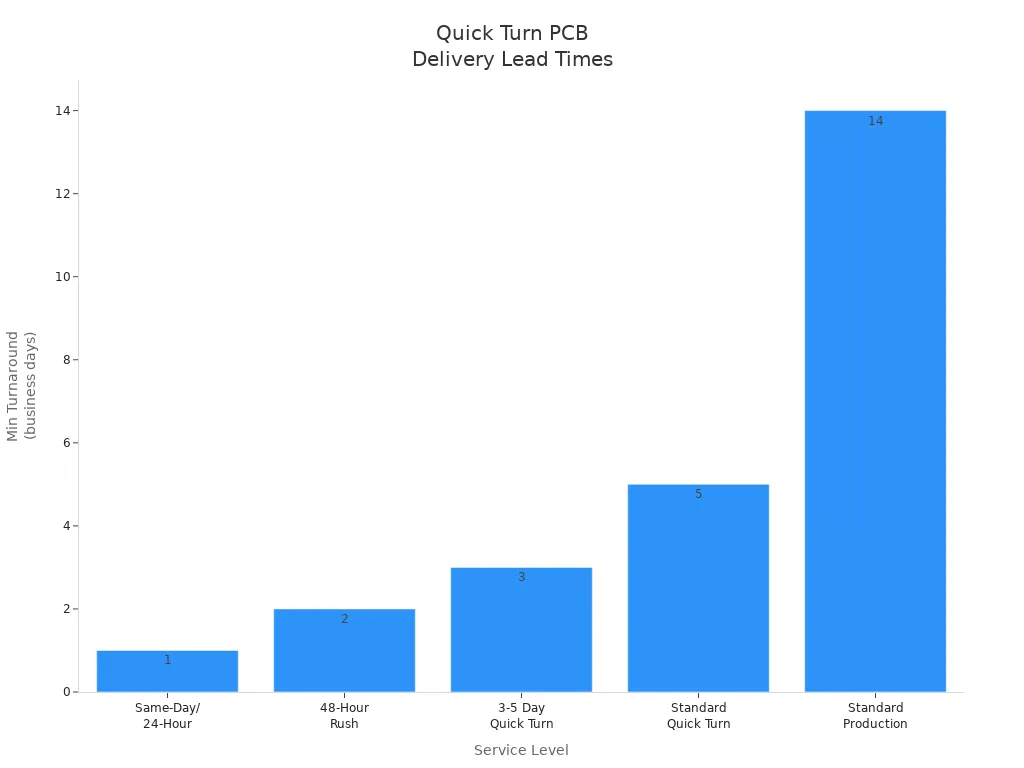
You can pick from many quick turn options. Simple quick turn pcb prototypes with 1–2 layers can be done in 24 hours. Multilayer quick turn pcbs take 2–5 days. Fast turn assembly for small batches can finish in 24–72 hours. The quick turn pcb process gives you choices for different technologies and project needs.
Quality and Delivery
You want your quick turn pcb to work right the first time. The quick turn pcb process uses strong quality checks at every step. Automated design rule checks and manufacturability analysis catch problems before making your quick turn pcb. Incoming parts get checked for quality and if they are real. AOI systems scan your quick turn pcbs for missing parts or solder issues. X-ray inspection finds hidden problems in multilayer quick turn pcbs. In-circuit and functional testing make sure your quick turn pcb matches your needs.
You also get extra tests like flying probe and boundary scan. Thermal imaging checks for heat problems. These steps help your quick turn pcbs meet high standards.
When your quick turn pcb passes all tests, the factory packs and ships it fast. You can pick fast shipping to get your quick turn pcbs even sooner. Most quick turn pcb orders arrive in 24 hours to 7 days, depending on how hard they are and the service you pick. This speed helps you get to market faster and stay ahead of others.
Note: The quick turn pcb process gives you speed, quality, and choices. You can trust your quick turn pcbs to work when you need them most.
Choosing Quick Turn PCB Provider
Picking the right quick turn pcb provider is very important. You should look at a few main things to get fast and reliable service. These things are lead time promises, quality checks, and customer help. You also need to see what technology they use and if they can meet your needs.
Lead Time Guarantees
You want your quick turn pcb to arrive on time. Good quick turn pcb makers promise when you will get your boards. They use new machines to make quick turn pcbs fast and keep them high quality. Simple prototype boards can ship in one or two days. Harder quick turn pcbs might take a few more days. Most quick turn orders finish in three to five days if you send all files and parts.
Look at how fast the provider finishes different quick turn jobs.
Ask if they can do rush orders if you need them fast.
Make sure they have good steps to keep wait times short.
Tip: Pick quick turn pcb makers who tell you about lead times and keep their word.
Quality Assurance
Your quick turn pcbs must work right the first time. Quality checks are very important. Find providers with ISO 9001 certificates. This means they follow strong rules for quality. Some quick turn pcb makers also have ITAR certificates for special projects. Good providers use both people and machines to check for problems early.
ISO 9001 means the provider follows world quality rules.
ITAR is needed for military quick turn pcbs.
Ask what checks and tests they do for each quick turn pcb.
Note: Quality checks protect your money and help you get to market faster.
Customer Support
Good customer help makes your quick turn pcb order easy. You need a provider who answers fast and fixes problems quickly. Look for quick turn pcb makers with many ways to contact them. On-call engineers can help with hard questions. Providers who care about customers answer fast and can handle last-minute changes.
Fast support teams help you meet tight deadlines.
Many ways to talk to support give you quick answers.
Technical help makes fixing hard quick turn pcb problems faster.
Good customer help keeps your quick turn project moving and helps you get to market faster.
Key factors to consider when choosing a quick turn pcb provider:
Factor | What to Look For |
|---|---|
Lead Time | Fast, reliable delivery for all quick turn pcbs |
Quality Control | Certifications and strong inspection processes |
Customer Service | Responsive support and technical assistance |
Pricing | Transparent, competitive costs |
Technical Capabilities | Ability to meet your design and technology needs |
You help your project succeed when you pick a quick turn pcb provider who meets these standards.
Maximizing Quick Turn Speed
Optimizing Design Files
You can boost quick turn speed by preparing your design files with care. When you use smart design choices, you help the quick turn pcb process move faster. Try to keep your boards simple and use standard options. This approach helps you avoid delays and get your quick turn pcb delivered on time.
Strategy | Benefit |
|---|---|
Minimize layer counts | Faster and more cost-effective production. |
Use standard board sizes | Reduces setup time and costs associated with non-standard sizes. |
Choose readily available components | Avoids long lead times and custom requirements, speeding up production. |
Standardized designs need less custom tooling, which cuts down on setup time.
DFM-optimized designs are less likely to have manufacturing defects, so you avoid rework.
Proper spacing and clear markings help the assembly team work at top speed.
Design for Manufacturability (DFM) is essential in quick turn pcb production. It shapes the speed, cost, and quality of your boards.
You can also use these tips to maximize quick turn speed:
Minimize the number of layers to 2-4 for faster production.
Use standard board sizes to avoid extra setup time.
Select readily available components to prevent delays.
Opt for wider traces and larger spacing to enhance manufacturability.
Prefer through-hole vias over blind and buried vias to reduce production time.
Use standard 1 oz copper for quicker processing.
Choose common surface finishes like HASL or ENIG for faster turnaround.
Clear Communication
You need clear communication to keep your quick turn pcb project on track. When you talk often with your provider, you avoid confusion and prevent delays. Set up one main contact and ask for regular updates. This helps you solve problems fast and keeps your quick turn pcb order moving.
Effective communication structures help you stick to your schedule. You can address issues right away, which is key for quick turn speed. When you share changes or questions early, your provider can adjust the quick turn processes without slowing down. Good teamwork means you reach your time-to-market goals.
Planning Iterations
You can plan your quick turn pcb iterations to get the most out of each cycle. When you work with your manufacturer early, you make your design easier to test and build. This step leads to a smooth move from prototype to product and saves time.
Rapid prototyping lets you try more versions and improve your design.
More iterations help you find the best fit for the market.
Each round of testing and feedback makes your quick turn pcb better.
Having time for more tests and changes means you can optimize your product. You get better performance and reach the market faster. Quick turn speed gives you the edge you need to win in a fast-moving industry.
Tip: Use non-destructive inline inspection methods like AOI, pick-and-place machines, and reflow ovens to keep your quick turn pcb quality high while moving at top speed.
By following these steps, you can maximize the speed of your quick turn pcb projects and reduce your time to market.
Real-World Quick Turn PCB Examples
Consumer Electronics Prototyping
Quick turn pcb makes a big difference in electronics you use every day. Companies use quick turn services to build prototypes and special designs very fast. You can send your design and get a working board in just a few days. This speed lets you test ideas, change things, and get feedback from users almost right away.
You can use quick turn pcb for small groups and short production runs.
Quick turn services help you try new features and fix problems quickly.
You can change your design fast and see how it works in real products.
Fast turn pcb services help you follow trends and stay ahead of other companies.
With quick turn pcb, you do not wait weeks for a prototype. You can test, improve, and launch your product much faster. This gives you a big advantage in the fast world of electronics.
Note: Quick turn pcb services are important for fast testing and making changes. You can bring your ideas to market faster and meet user needs right away.
Industrial Application Cycles
Quick turn pcb is also important in many industries. You need to keep up with fast changes in fields like medical devices, aerospace, and electronics. Quick turn services let you change your design and check it in just a few days.
Quick turn pcb prototyping helps you stay ahead in busy industries.
You can use quick turn to make your product better and fix problems early.
Shorter build and assembly times let you test and improve your design without waiting long.
Quick turn pcb lets you make prototypes fast, which speeds up your work.
You can launch products sooner and meet market needs with quick turn.
Quick turn pcb helps you find problems early and make your product better. This process cuts down your time-to-market and helps you deliver better products. When you use quick turn, you can handle changes and keep your projects moving.
Tip: Quick turn pcb gives you the power to adapt and win in industries where speed and quality are very important.
Quick turn pcb production helps you get your products out faster. You can save money and beat other companies. It makes design cycles go quicker and helps you stay ahead. You get to test designs fast and find problems early. Quick turn pcb production lets you get your boards delivered quickly. It works best if you check your designs and get materials fast. Using high-precision assembly helps a lot. You should look at your process and make it better for quick turn. Pick standard board sizes and make your design simple. Try finding quick turn pcb production providers or use ways to speed up your work. This keeps your projects moving forward.
FAQ
What is the typical turnaround for quick turn pcb projects?
Most quick turn pcb projects finish in 24 hours to 7 days. The time depends on how hard your design is. It also depends on what you need for pcb assembly and prototype assembly. Fast turnaround helps you keep your plans on schedule.
How does rapid prototyping improve pcb reliability?
Rapid prototyping lets you test pcb designs fast. You can spot and fix problems early. This makes your pcb more reliable. You get more chances to check and improve your design. You will have fewer problems when you build the final pcb.
What steps ensure quality control in pcb assembly?
Pick providers who use automated inspection and in-circuit testing. They should check quality at every step. These steps catch mistakes during prototype assembly and pcb assembly. Good quality control makes sure your boards work well and meet standards.
Can I get cost-effective options with fast turnaround times?
You can get quick turn pcb and prototype assembly for a good price. Many providers have flexible prices for different speeds and pcb assembly amounts. You get fast service without spending too much or losing quality.
What are turnkey assembly services and how do they help?
Turnkey assembly services do every part of your pcb project. You send your design, and they handle the rest. They take care of sourcing, prototype assembly, pcb assembly, and quality checks. This saves you time and makes your pcb more reliable. You can focus on design while experts do the work.
See Also
Key Actions for Efficient Turnkey PCB Assembly Success
Maximizing Savings with Quick Turn HDI PCBs in 2025
Ten Strategies to Reduce Expenses in Custom PCB Manufacturing
Enhancing PCB Production Yield with Online AOI Technology
Selecting a Reliable PCB Manufacturer for Your Business Needs
