How Rogers PCB Powers the Future of 5G and Artificial Intelligence
You need electronics you can trust for the future of 5G and AI. Rogers PCB is special because it sends signals fast and handles heat well. Many new devices like 5G base stations, AI hardware, IoT products, and smart cars use Rogers to work smoothly. Rogers PCB materials are better than regular PCB materials in important ways. You can see the difference in this table:
Metric | Rogers PCB Materials | Standard FR4 PCB Materials |
|---|---|---|
Dissipation Factor (%) | 0.004 | 0.02 |
Glass Transition Temperature (Tg) (°C) | ~280 | 130 to 180 |
Coefficient of Thermal Expansion (CTE)(ppm/°C) | 16 (X-Y), 70 (Z) | 15 (X-Y), 25 (Z) |
Thermal Conductivity (W/m-K) | 0.69 to 1.7 | 0.1 to 0.3 |
Cost | High | Low |
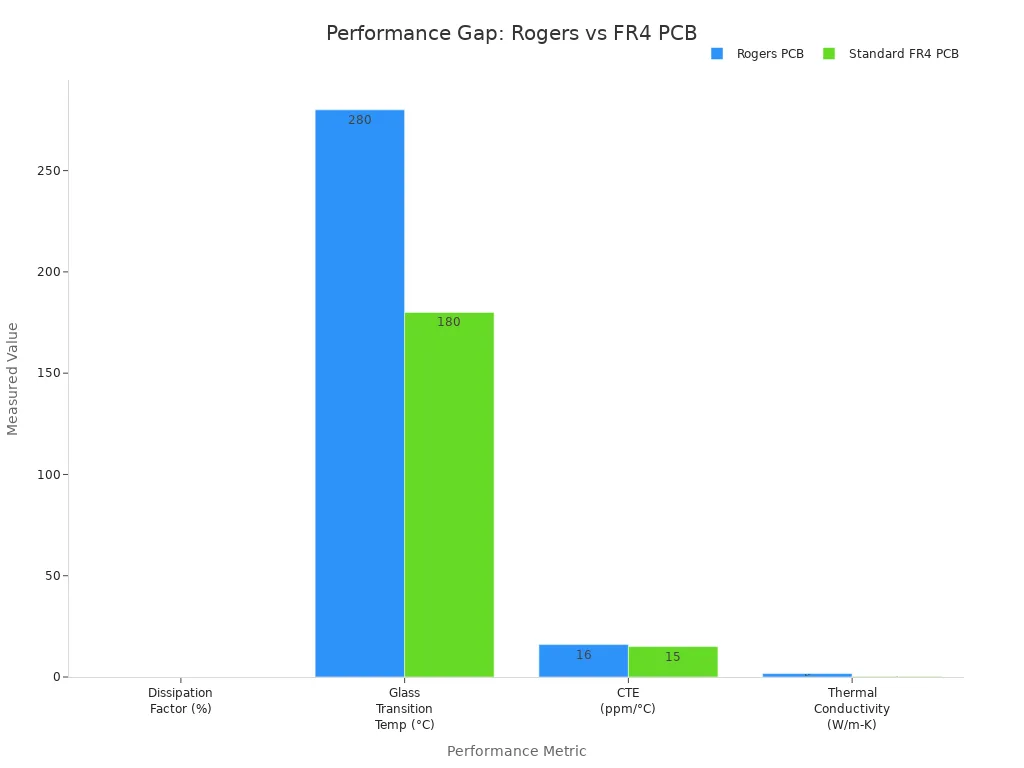
You can see how Rogers PCB materials help your devices stay cool, keep signals strong, and work fast. These things matter a lot in today’s electronics.
Key Takeaways
Rogers PCB materials work better than regular FR4. They help stop signal loss and control heat well. This makes them great for 5G and AI uses.
These materials can handle high-frequency jobs, up to 110 GHz. They help signals move fast and stay strong.
Rogers PCB has very good thermal stability. It stops devices from getting too hot. It keeps things working well in tough places like telecom and aerospace.
Picking the right Rogers PCB material is important. You need to think about frequency and heat needs. This helps devices work better and last longer.
Rogers PCB materials are made to lower dielectric loss. They keep signals clear and strong. This is important for high-density electronic systems.
Rogers PCB Material Properties
High-Frequency Signal Performance
Electronics need to work fast and send clear signals. Rogers PCB materials help devices work at high frequencies. These materials can handle up to 110 GHz. This is much higher than what regular PCB materials can do. The table below shows how some Rogers PCB materials compare:
Material | Maximum Frequency | Notes |
|---|---|---|
Rogers 4350B | Up to 40 GHz | Good for high-frequency uses. |
RT/duroid 5880 | Up to 110 GHz | Works well for satellite communication. |
Rogers PCB materials keep signal loss low, even at high frequencies. For example, RO4350B has less than 0.5 dB/inch loss at 10 GHz. Some Rogers PCB materials have only 1.5 dB/in loss at 77 GHz. This means your devices send and get signals quickly and reliably.
Rogers PCB materials help electronics work well for 5G, AI, and IoT. You get fast speeds and strong signals.
Dielectric and Impedance Control
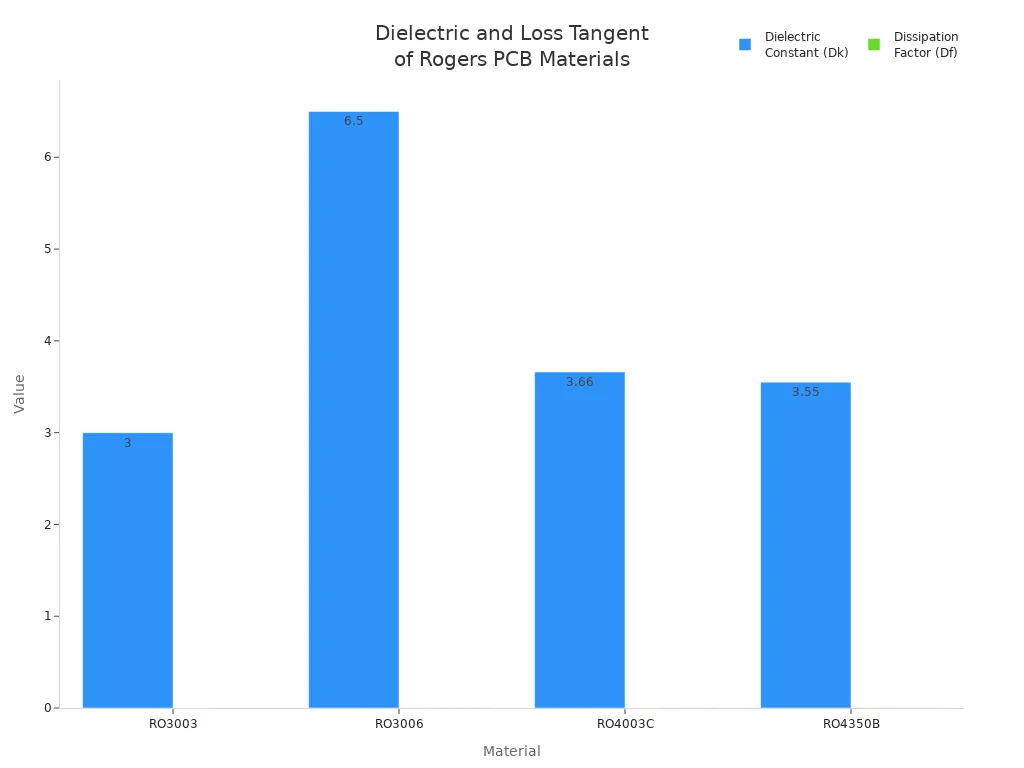
You want your PCB to control signals the right way. Rogers PCB materials have great dielectric properties and tight impedance control. The dielectric constant (Dk) can be from 2.2 to 10.2. You can pick the best one for your needs. The dissipation factor (Df) is always below 0.004. This is much lower than FR4, which is between 0.020 and 0.030. Low loss means your signals stay strong and clear.
Material | Dielectric Constant (Dk) | Dissipation Factor (Df) |
|---|---|---|
RO3003 | 3 | 0.001 |
RO3006 | 6.5 | 0.002 |
RO4003C | 3.66 | 0.0031 |
RO4350B | 3.55 | 0.0021 |
Rogers PCB materials give you many dielectric constant choices for better impedance control.
Lower insertion and transmission loss keeps signals strong.
The dielectric constant stays steady at different frequencies.
Rogers PCB materials stay stable over a wide range of frequencies, which is important for high-frequency uses.
You can trust Rogers PCB materials to have tight dielectric constant tolerances, often ±0.05. This helps stop impedance mismatches, signal reflections, and EMI problems. Your devices will work better and more reliably.
Thermal Stability in 5G and AI
Your electronics need to stay cool and stable, especially in tough places like 5G and AI. Rogers PCB materials have medium thermal conductivity. This is better than what regular PCB materials have. It helps your devices handle heat and not get too hot.
Material Type | Thermal Conductivity |
|---|---|
FR4 | Low |
Rogers | Medium |
Rogers PCB materials do well in thermal cycling tests. They keep their properties steady at different temperatures and frequencies. This is important for devices that run for a long time, like AI hardware and 5G base stations.
Rogers PCB materials handle thermal cycling better than regular PCB materials.
High thermal conductivity keeps circuits from overheating.
Dimensional stability in tough conditions makes Rogers PCB materials good for aerospace and telecommunications.
You can trust Rogers PCB materials to keep your devices working, even in hard conditions. Your electronics will last longer and work better.
Rogers PCB in 5G Applications
5G Base Stations and Networks
5G base stations need to work really well. Rogers PCB materials help them go fast and send clear signals. These materials can handle high frequencies, even over 24 GHz. You get less signal loss and better network coverage. Rogers PCB keeps electronics cool and steady, so they last longer. Here is how Rogers PCB helps your 5G base stations:
Improvement Aspect | Description |
|---|---|
Low Loss | Rogers materials like RO4835 keep signals strong and clear for 5G. |
Thermal Stability | High thermal conductivity stops overheating and keeps things reliable. |
Reduced Electromagnetic Interference | The even structure of Rogers materials lowers EMI and keeps signals clear. |
Enhanced Coverage | Less signal loss means signals travel farther in cities. |
Rogers PCB materials help you get faster data and less delay.
Your servers and electronics work well, even in busy places.
Rogers PCB lets 5G and AI talk to each other quickly.
Satellite and Global Communications
Satellites need to send signals far and clear. Rogers PCB materials have a low dielectric factor and do not soak up much water. This keeps electronics working in space and bad weather. Rogers PCB keeps signal loss low, even above 10 GHz. You get steady performance for fast circuits and antennas.
Advantage | Description |
|---|---|
Low Dielectric Factor | Keeps signals strong in fast circuits. |
Thermal Stability | Good thermal stability helps in tough places. |
Low Moisture Absorption | Stops signals from getting weak in wet weather. |
Rogers PCB materials have higher breakdown voltage, so devices do not fail.
You get steady performance in wet or stressful places.
Your electronics stay safe and strong for worldwide communication.
IoT and Autonomous Systems
You use IoT devices and smart cars every day. Rogers PCB materials help these devices work better. They manage power well and keep devices safe. Rogers PCB supports smart car systems, making cars safer and smarter.
Rogers PCB materials are important for electric and hybrid cars.
You get better energy use and power sharing.
Rogers PCB helps IoT devices and servers move data fast.
Your electronics stay steady, even when it gets hot or cold.
Feature | Rogers PCB Materials | Traditional PCB Materials (FR-4) |
|---|---|---|
Electrical Properties | Strong dielectric strength and good signals | Weaker dielectric strength and more loss |
Thermal Management | High thermal conductivity and low expansion | Not as good at handling heat |
Mechanical Stability | Stays the same size when hot | Changes size with temperature |
Signal Integrity | Lower dielectric constant and less signal loss | More signal loss and crosstalk |
Application Suitability | Great for fast, high-frequency uses | Only good for normal uses |
Rogers PCB materials give you the strong performance and trust you need for the future of 5G, IoT, and smart electronics.
Rogers PCB for AI Hardware
AI Accelerators and Edge Devices
You want your AI devices to be fast and cool. Rogers PCB materials help them work better. These materials manage heat well and keep signals strong. You see big improvements when you use them. For example, Rogers RO3000 can make radar and aerospace systems work 10 to 20 times better at 77GHz. Rogers RO4000 can make 5G amplifiers and AI cards work 3 to 5 times better.
Tier | Material | Performance Gain | Application |
|---|---|---|---|
1 | Rogers RO3000 | 10x - 20x | 77GHz radar, aerospace, core RF filters |
2 | Rogers RO4000 | 3x - 5x | 5G PAs, 112G AI accelerator cards |
You get better heat control, stronger signals, and great results in tight spaces. Rogers PCB materials make your electronics powerful and dependable.
Data Processing and Signal Integrity
You need your AI servers to handle data fast and without mistakes. Rogers PCB materials help computers work quickly by keeping dielectric loss low and impedance steady. These features stop phase distortion and keep signals clear. ENIG plating helps reduce skin effect in high-frequency parts. This lets servers and connections move data faster and with fewer errors.
Feature | Specification |
|---|---|
Dielectric Loss (Df) | < 0.005 |
Impedance Tolerance | ±5% |
Stable Dielectric Constants | Prevents phase distortion |
Plating | ENIG (Electroless Nickel Immersion Gold) |
Applications | AI servers, high-speed network switches, GPU accelerator cards |
Rogers PCB materials cut down crosstalk and electromagnetic interference. You get faster and steadier signals. A solid ground plane and good trace spacing protect your data lines. This keeps your signals safe and strong in your electronics.
Tip: Pick Rogers PCB materials with a steady dielectric environment to lower errors and keep your data safe.
Reliability in High-Density Systems
You want your AI server to last a long time. Rogers PCB materials are reliable, even in tough places. These materials show a mean time between failures over 10,000 hours and a failure rate below 100. Your servers work more than 99.999% of the time.
Metric | Definition | Military System Target |
|---|---|---|
MTBF | Average time between failures | > 10,000 hours |
FIT Rate | Failures per billion device hours | < 100 |
Availability | Percentage of time system is operational | > 99.999% |
Rogers PCB materials handle high power, humidity, and temperature changes. You get higher breakdown voltage, better heat control, and less expansion from heat. These features keep your electronics safe and steady, even in crowded AI systems. Your devices last longer and need less fixing.
Better heat control manages heat in small designs.
Strong build supports portable electronics.
Steady performance in humid places keeps things reliable.
Rogers PCB materials help you make fast, dense electronics that give strong performance and signal quality for the future.
Advantages of Rogers PCB Materials
Comparison with FR4
You want your electronics to be fast and last longer. Rogers PCB materials work better than standard FR4. They lose less signal, especially at high frequencies. This is important for 5G, AI, and servers. Rogers PCB materials handle heat well. They move heat away from circuits. This keeps devices cool and reliable. FR4 does not handle heat as well. It can cause problems in high-power uses.
Rogers PCB materials lose less electrical signal. This keeps signals strong.
You get less dielectric loss. Devices work more efficiently.
Rogers PCB materials have great thermal conductivity. They stop hotspots and help electronics last longer.
FR4 has limits with thermal conductivity and expansion. This makes heat management harder.
Rogers PCB materials can reach over 90 GHz. FR4 usually works between 1 and 3 GHz. Rogers PCB materials keep their dielectric constant steady at many frequencies. This gives you steady impedance and signal speed. Rogers PCB materials are used in telecommunications, radar, and high-reliability systems. These features make Rogers PCB materials the best for tough electronics.
Rogers PCB materials help your devices stay reliable and work well, even in hard conditions.
Practical Selection Tips
You need to pick the right Rogers PCB materials for your devices. Look at the frequency range and what your device needs. The table below shows which Rogers PCB materials fit different uses:
Frequency Range | Recommended Material | Key Features |
|---|---|---|
500 MHz - 40 GHz | RO4000 series | Balanced performance-to-cost ratio, good for standard PCB manufacturing. |
Up to 77 GHz | RO3000 series | Ultra-low loss, ideal for high-frequency applications. |
Above 20 GHz | RT/duroid | Best for demanding mmWave applications. |
Sub-6 GHz (600 MHz - 6 GHz) | RO4350B | Excellent performance at reasonable cost. |
Below 3 GHz | High-grade FR-4 | Cost-sensitive applications, Tg > 170°C, Df < 0.008. |
24-40 GHz mmWave | RO4003C or RO3003 | Minimizes insertion loss for long traces and complex routing. |
Above 40 GHz | PTFE | Ultimate low-loss performance, suitable for harsh environments. |
You should avoid common mistakes with Rogers PCB materials. Delamination can happen if moisture gets trapped. Store and handle your PCB materials the right way. Adhesion problems may happen if you do not prepare the surface well. Drilling issues can affect the PCB if you use the wrong tools.
Always check the frequency and heat needs of your devices.
Prepare surfaces carefully to stop adhesion problems.
Store Rogers PCB materials in dry places to prevent delamination.
Use proper drilling methods for clean holes.
Tip: Pick Rogers PCB materials that match your device’s frequency and heat needs. This helps your servers, interconnects, and electronics work better and last longer.
You can see that Rogers PCB makes electronics faster and helps them last longer. Experts think more companies will use Rogers PCB for 5G and AI. This is because Rogers PCB keeps signals strong and controls heat well. New things like nanocomposite materials and HDI technology make PCBs smaller and more dependable. You can count on Rogers to keep your devices ready for what comes next. As electronics get better, Rogers PCB will bring new ideas and strong results.
FAQ
What makes Rogers PCB better than FR4 for 5G?
You get lower signal loss and better heat control with Rogers PCB. These features help your 5G devices run faster and last longer.
Can you use Rogers PCB for AI hardware?
Yes. Rogers PCB supports high-speed data and keeps signals clear. You can trust it for AI servers, accelerators, and edge devices.
How do you choose the right Rogers PCB material?
Tip: Check your device’s frequency and heat needs. Pick a Rogers material that matches those requirements for best results.
Is Rogers PCB safe for use in harsh environments?
You can rely on Rogers PCB in tough places. It resists heat, moisture, and vibration. Your electronics stay stable and safe.
See Also
Exploring Rogers R4350B, R4003, And R5880 For RFPCB Use
Diverse Uses of Multilayer PCBs in Various Sectors
Integrating Rogers Materials With TG170 For Hybrid PCB Designs
Understanding RF Circuit Boards: Functionality And Purpose Explained
Compact, Durable, Intelligent: The Benefits of HDI Rigid Flex PCBs
