How to Select the Best Rogers PCB Surface Finish
To achieve optimal results with Rogers PCBs, selecting the appropriate Rogers PCB surface treatment is essential. Many engineers recommend finishes such as ENIG, OSP, or immersion silver for Rogers, particularly when working with high-frequency designs. The surface treatment significantly influences signal quality, adhesion, and the longevity of the board. For instance, using black oxide and micro-roughening enhances adhesion and minimizes signal loss. Notably, Rogers’ 2929 Bondply exhibits a 20% improvement in adhesion when paired with plasma etching, making it an excellent choice for RO3000 laminates.
Surface Treatment Method | Peel Strength (lb/in) | Notes |
|---|---|---|
Black Oxide | 8-10 | Creates a texture over 1 μm, aids adhesion |
Micro-Roughening | >1 μm | Enhances peel strength, crucial for signal quality |
Rogers' 2929 Bondply | 20% better adhesion | Ideal for RO3000 when using plasma etching |
Key Takeaways
Pick the best surface finish to make signals better and help the board last longer.
Use black oxide or micro-roughening to help things stick and stop signals from getting weak.
Think about ENIG or immersion silver for high-frequency designs to keep signals strong.
Test early prototypes for sticking problems to save money and make sure the board works well.
Choose a surface finish that fits your assembly steps and the place where the board will be used.
Why Rogers PCB Surface Treatment Matters
Signal Integrity and High-Frequency Performance
It is important to choose the right surface treatment for rogers pcbs. Rogers materials like PTFE and ceramic composites need special handling. These treatments help keep signals strong in high-frequency designs. If you do not care about surface quality, you might lose more signal. You could also see more conductor loss, dielectric loss, and reflection loss. Rough surfaces can cause impedance mismatches and more signal weakening. The table below shows how different factors affect performance:
Parameter | Description | Impact of Surface Treatment |
|---|---|---|
Return Loss (S₁₁) | Shows how well impedance matches; lower numbers mean better matching. | Rough surfaces make impedance mismatches worse, so S₁₁ gets higher. |
Insertion Loss (S₂₁) | Measures how much power passes through; numbers near 0 dB mean little loss. | Bad conductivity and rough surfaces cause more resistance, making S₂₁ worse. |
Skin Effect | At high frequencies, current moves near the surface, causing more resistance. | Rough surfaces make the skin effect stronger, so there is more signal loss. |
ENIG Process | This finish stops corrosion but adds contact resistance. | The nickel layer in ENIG changes the surface, which can hurt high-frequency performance. |
Adhesion and Peel Strength
Strong adhesion stops delamination in rogers pcbs. If adhesion is weak, delamination can happen and circuits may fail. Rogers materials can be hard to stick to because they have low surface energy. You can make adhesion better by using black oxide or micro-roughening. These treatments make the surface rougher, so copper sticks better to the laminate. The table below shows how treatments change peel strength and stop delamination:
Surface Treatment | Peel Strength (N/mm) | Temperature (°C) | Notes |
|---|---|---|---|
PTFE-ceramic composite (Rogers RO4000 series) with HVLP2-grade copper foil | 0.6 to 1.2 | N/A | Peel strength goes up with two treatments |
TLF220 substrate | 1.8 | 125 | Peel strength is higher than IEC 61249 minimum |
TLF220 substrate | 1.5 | 288 | Peel strength stays strong after heat shock |
Tip: Always look for adhesion problems when you make prototypes. Finding issues early saves money and keeps your boards working well.
Solderability and Reliability
You want your rogers pcbs to work well and last long. Surface finishes keep copper from rusting, which helps soldering and reliability. If you pick the wrong finish, you might get cold joints or bad soldering. This can cause delamination and make products fail. The right surface treatment also helps your board’s electrical and heat performance. Good adhesion stops delamination during soldering and in tough conditions. Always choose a finish that fits your assembly process and needs.
Surface treatments make performance better and keep electrical connections strong in high-frequency uses.
They stop copper from rusting and help with soldering.
The right finish stops adhesion problems and delamination, so your rogers pcbs stay high quality.
Key Criteria for Rogers PCB Surface Treatment Selection
Electrical Performance
When picking a rogers pcb surface treatment, check how it affects electrical performance. Rogers materials are good for high-frequency designs. You need to make sure signals stay strong and impedance stays steady. Look at insertion loss and reliability over time. These checks help your circuits work well and last longer.
Impedance consistency keeps signals clear and steady.
Insertion loss shows how much signal is lost.
Signal integrity means your board works as planned.
Long-term reliability keeps your circuits safe.
Adhesion and Surface Preparation
Adhesion helps stop delamination in rogers pcbs. Fixing adhesion issues early makes boards better and stops failures. You can use black oxide or micro-roughening to make adhesion stronger. These methods roughen the surface so copper sticks well to rogers laminates.
Surface Preparation Technique | Advantages | Description |
|---|---|---|
Black Oxide Treatment | High peel strength, thermal reliability | Chemicals clean the surface and make tiny oxide spots for better bonding. |
Oxide Replacement Technologies | Improved thermal reliability, stable surface profile | Etching makes adhesion better and saves energy. |
Always check for adhesion problems during manufacturing. Good adhesion stops delamination and keeps rogers pcbs working well.
Solderability and Assembly Compatibility
Pick a rogers pcb surface treatment that matches your assembly process. Good solderability stops delamination and makes strong joints. Rogers materials can be hard to work with, so you need a finish that fits your soldering method. Choose a treatment that keeps copper from rusting and works with your assembly line.
Tip: Test soldering on prototypes to find adhesion problems before making all boards.
Environmental Durability
Rogers materials handle moisture and temperature changes better than regular boards. RO4003C and RO4350B work well in high humidity and heat. Low moisture absorption keeps boards efficient and stops delamination. Use conformal coatings for extra protection in tough environments.
Environmental Factor | Impact on RO5870 | Mitigation Strategy |
|---|---|---|
Humidity & Moisture | Very low moisture absorption (~0.02%) | Use conformal coatings for harsh environments |
Temperature Variations | Stable dielectric properties | Make stack-up design better |
Chemical Exposure | PTFE resists most solvents and acids | Avoid strong cleaning solutions |
Cost and Application Fit
You need to balance cost and what your board needs. Rogers pcb surface treatments have different prices and performance. For high-frequency designs, you may need a more expensive finish. For simple boards, a basic treatment is fine. Always pick a surface treatment that fits your budget and needs.
Note: Choosing the right rogers pcb surface treatment makes boards better and stops delamination, saving money over time.
Rogers PCB Surface Treatment Options
ENIG (Electroless Nickel Immersion Gold)
ENIG is a surface treatment for Rogers PCBs. First, a nickel layer is made flat. Then, the board goes into a gold solution. Gold covers the board in a thin layer.
ENIG helps with soldering, stops rust, keeps the surface flat, lets wires stick, and saves money.
Problems include controlling thickness, nickel rust, short shelf life, weak heat resistance, and surface flaws.
ENIG is used in electronics and cars.
ENIG gives a strong surface for soldering on high-frequency Rogers PCBs.
OSP (Organic Solderability Preservative)
OSP is a common choice for Rogers PCBs. You clean copper, etch it, rinse, add OSP, rinse again, and dry.
OSP costs less, is good for the environment, keeps the surface flat, helps soldering, and is easy to fix.
OSP does not last long, is easy to damage, can only be heated a few times, and is hard to check by eye.
OSP is used in electronics, big factories, testing, and tiny parts.
OSP is great for fast projects and products that do not need to last long.
Immersion Silver
Immersion silver uses a chemical bath to put silver on copper.
Aspect | Details |
|---|---|
Process | Silver bath puts 0.1–0.3 micrometers of silver on copper. |
Benefits | Soldering is easy, conductivity is high, surface is flat, RoHS safe, and costs less. |
Drawbacks | Silver can tarnish, is easy to damage, does not last long, and is not good for tough places. |
Use Cases | Used in electronics, phones, cars (not main parts), and medical devices in safe places. |
Immersion silver makes soldering easy and keeps signals strong, so it is good for high-frequency Rogers boards.
Lead-Free HASL
Lead-free HASL is a popular surface treatment for Rogers.
Advantages | Disadvantages |
|---|---|
Soldering is easy | Surface can be bumpy |
Costs less | Heat can hurt the board |
RoHS safe | Not good for HDI |
Lasts a long time | Holes can get smaller |
Easy to fix | Needs more heat |
Quality check built in | Copper can wear away |
Easy to find | N/A |
Lead-free HASL is used for boards with holes, big parts, testing, and small batches.
Hard Gold
Hard gold treatment starts with cleaning, then nickel is added, gold is put on, checked, and cleaned again.
Hard gold lasts a long time, resists wear, conducts well, and stops rust.
It costs more, is not good for thick soldering, and needs extra steps.
Hard gold is used for edge connectors, keypads, and test spots on Rogers boards.
Electrolytic Tin Plating
Electrolytic tin plating makes Rogers PCBs easy to solder. Tin is added with electricity.
Tin plating helps soldering, costs less, and is easy to fix.
It does not stop rust well and can grow whiskers.
Tin plating is used in electronics and simple Rogers boards.
Acid Copper Processing
Acid copper processing is used in Rogers PCB making. It builds up copper and makes signals stronger.
It sticks well, makes peel strength better, and keeps signals reliable.
It is harder to do and costs more.
Acid copper is used for multilayer Rogers boards and high-frequency designs.
Picking the right Rogers PCB surface treatment helps your boards work well, last longer, and be made easily.
Comparing Surface Treatment Options for Rogers PCBs
Performance and Reliability
You should think about performance when picking surface treatments for rogers. High-frequency designs need low-loss and steady dielectric properties. Rogers materials like RO4003C and RO4350B keep signals clear. Immersion silver helps soldering and keeps signals strong. The table below shows how rogers and FR4 are different in important ways:
Parameter | RO4003C | Standard FR4 |
|---|---|---|
Dielectric Constant | 3.38 ± 0.05 | 4.2-4.8 |
Loss Tangent @ 10GHz | 0.0027 | ~0.02 |
Dk Stability vs Frequency | Excellent | Poor above 1 GHz |
Dk Stability vs Temperature | 40 ppm/°C | >200 ppm/°C |
Moisture Absorption | 0.04% | 0.10-0.20% |
Thermal Conductivity | 0.71 W/m/K | 0.1-0.5 W/m/K |
Cost | 3-5× FR4 | Baseline |
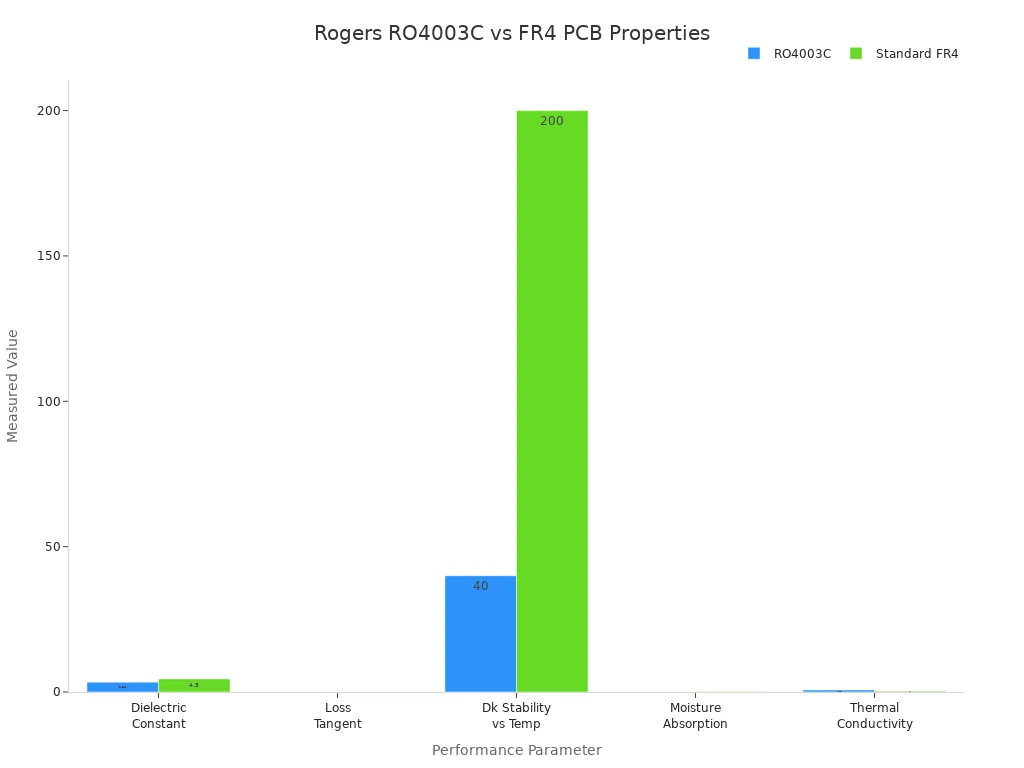
Immersion silver is great for high-performance boards. It gives strong signals and good soldering. Rogers pcbs handle moisture and heat changes well. This stops delamination and keeps boards working.
Adhesion and Peel Strength
Adhesion is very important for rogers. You need to stop delamination to protect circuits. Surface treatments like immersion silver, black oxide, and micro-roughening make adhesion better. These methods roughen the surface so copper sticks tightly. If adhesion is weak, delamination and bad quality can happen. Immersion silver helps copper stick and stops delamination. Rogers materials need careful surface prep to avoid problems.
Property | RO4003C | RO4350B |
|---|---|---|
Dielectric Constant (Dk) | 3.38 ± 0.05 | 3.48 ± 0.05 |
Loss Tangent @ 10GHz | 0.0027 | 0.0037 |
UL 94V-0 Rating | No | Yes |
Halogen-Free | Yes | No |
Thermal Conductivity | 0.71 W/m/K | 0.69 W/m/K |
You should check peel strength after each treatment. Immersion silver, immersion tin, and acid copper processing all help with adhesion and stop delamination.
Cost and Suitability
Cost is important when picking rogers surface treatments. Rogers costs more than FR4, but you get better performance and reliability. Immersion silver gives a good mix of cost and quality. Rogers is used for high-frequency and tough jobs. FR4 is used for simple boards and consumer electronics. Sometimes, you use both rogers and FR4 to save money and get good performance. You must pick the surface treatment that fits your project, not just the price.
Tip: Think about the whole board. Rogers gives you quality and stops delamination, but you need the right surface treatment for your design.
Practical Guide to Choosing Rogers PCB Surface Treatment
Step-by-Step Selection Flow
You can use easy steps to pick the right surface finish for your Rogers board. This helps you avoid mistakes and makes sure your board works well. Follow this checklist to help you decide:
Define Your Application
Find out if your board will use high-frequency signals, RF, or microwave circuits.
See if you need extra strength, like for cars or planes.
Assess Electrical Performance
Check if your design needs low signal loss or steady impedance.
For high-frequency boards, pick finishes that keep signals strong.
Evaluate Adhesion Needs
Decide if your board needs more peel strength.
Think about using black oxide or micro-roughening to help copper stick better.
Review Soldering and Assembly
Pick a finish that works with your soldering method, like wave, reflow, or hand soldering.
Make sure the finish helps make strong joints and stops rust.
Consider Environmental Factors
Think about water, temperature changes, and chemicals.
Choose finishes that protect your board in tough places.
Balance Cost and Production Volume
For test boards or small batches, you can use a cheaper finish.
For big orders or important boards, spend more for better reliability.
Tip: Always try your finish on a test board before making many boards. This helps you find problems early.
Here is a simple flowchart you can follow:
Start
  ↓
Is your application high-frequency or RF?
  → Yes: Pick low-loss finishes (immersion silver, ENIG)
  → No: Use cheaper options (OSP, HASL)
  ↓
Do you need high peel strength?
  → Yes: Try black oxide, micro-roughening, or 2929 Bondply with plasma etching
  ↓
Does your assembly need many solder cycles?
  → Yes: Do not use OSP; pick ENIG or immersion silver
  ↓
Is your environment tough (water, chemicals)?
  → Yes: Pick finishes that stop rust (immersion silver, ENIG)
  ↓
Finish your choice and test a prototype
Matching Surface Treatments to Applications
You should pick the surface finish that fits your Rogers board’s job. Each finish works best for certain uses. For example, immersion silver is great for high-frequency boards because it keeps signals strong and helps with soldering. The table below shows how different finishes fit common Rogers uses.
Surface Treatment Method | Description | Benefits |
|---|---|---|
Black Oxide or Micro-Roughening | Makes a texture over 1 μm | Makes peel strength 8-10 lb/in |
Rogers' 2929 Bondply with Plasma Etching | Used for RO3000 laminates | Gives 20% better adhesion |
Low-Profile Electrodeposited Copper | Use 1/2 oz to lower stress | Cuts down on defects |
For RO4000 laminates, you often use immersion silver or ENIG. These finishes keep the board flat and help high-frequency signals. Immersion silver is easy to solder and keeps signals strong, which is important for high-frequency boards. If you use RO3000 laminates, you can use Rogers' 2929 Bondply with plasma etching. This makes adhesion 20 percent better and helps stop delamination.
If you need high peel strength, use black oxide or micro-roughening. These make the surface rough so copper sticks well. For boards that face stress or lots of soldering, low-profile electrodeposited copper helps stop problems.
Always think about what your board needs most. For high-frequency jobs, immersion silver is a top pick. It gives good electrical performance and strong assembly. If you need a finish for regular electronics or test boards, OSP or lead-free HASL can save money. For edge connectors or test points, hard gold lasts a long time.
Note: You can make your board work better and last longer by picking the right surface finish for your Rogers PCB. Always check your technical needs before you choose.
You should think about three important things when picking rogers PCB surface treatments. These are adhesion, performance, and how well the board fits your needs. The table below explains why each one is important:
Key Factor | Why It Matters |
|---|---|
Adhesion | Getting the surface ready stops problems and makes boards last longer |
Performance | Rogers materials help keep signals strong and work for high-frequency uses |
Application Fit | Rogers boards do well in places with heat and shaking |
If your rogers design is tricky, talk to PCB experts. Skilled makers can help you stop delamination and build your board the right way. For more help, look at guides like "PCB Surface Finishes: Definitions, Comparisons, and Selection Strategies.
FAQ
What makes rogers PCB surface finishes different from standard FR4 finishes?
Rogers PCB surface finishes give better signals and less loss. They are good for high-frequency designs. These finishes also stop delamination and make adhesion stronger than FR4 finishes.
Can you use HASL on rogers PCBs for RF applications?
HASL can be used, but it is not the best for RF circuits. Rogers materials work better with immersion silver or ENIG finishes. These finishes keep the surface flat and help signals stay strong.
How do you improve adhesion on rogers laminates?
Adhesion gets better with black oxide or micro-roughening. These methods make the surface rough so copper sticks well. Good adhesion stops delamination and keeps the board working.
Which surface finish should you choose for high-frequency rogers designs?
Pick immersion silver or ENIG for high-frequency rogers designs. These finishes give low signal loss and good soldering. They protect copper and help the board work well.
Do rogers PCBs need special handling during assembly?
Yes, rogers PCBs must be handled carefully during assembly. The materials can be hurt by heat and chemicals. The right surface finish protects the board and helps soldering stay reliable.
See Also
Why Immersion Gold Is The Top Choice For Reliable PCBs
Integrating Rogers Material With TG170 In Hybrid PCB Designs
Exploring Rogers R4350B, R4003, And R5880 For RFPCB Use
