Why Engineers Are Choosing ENEPIG for Superior PCB Durability
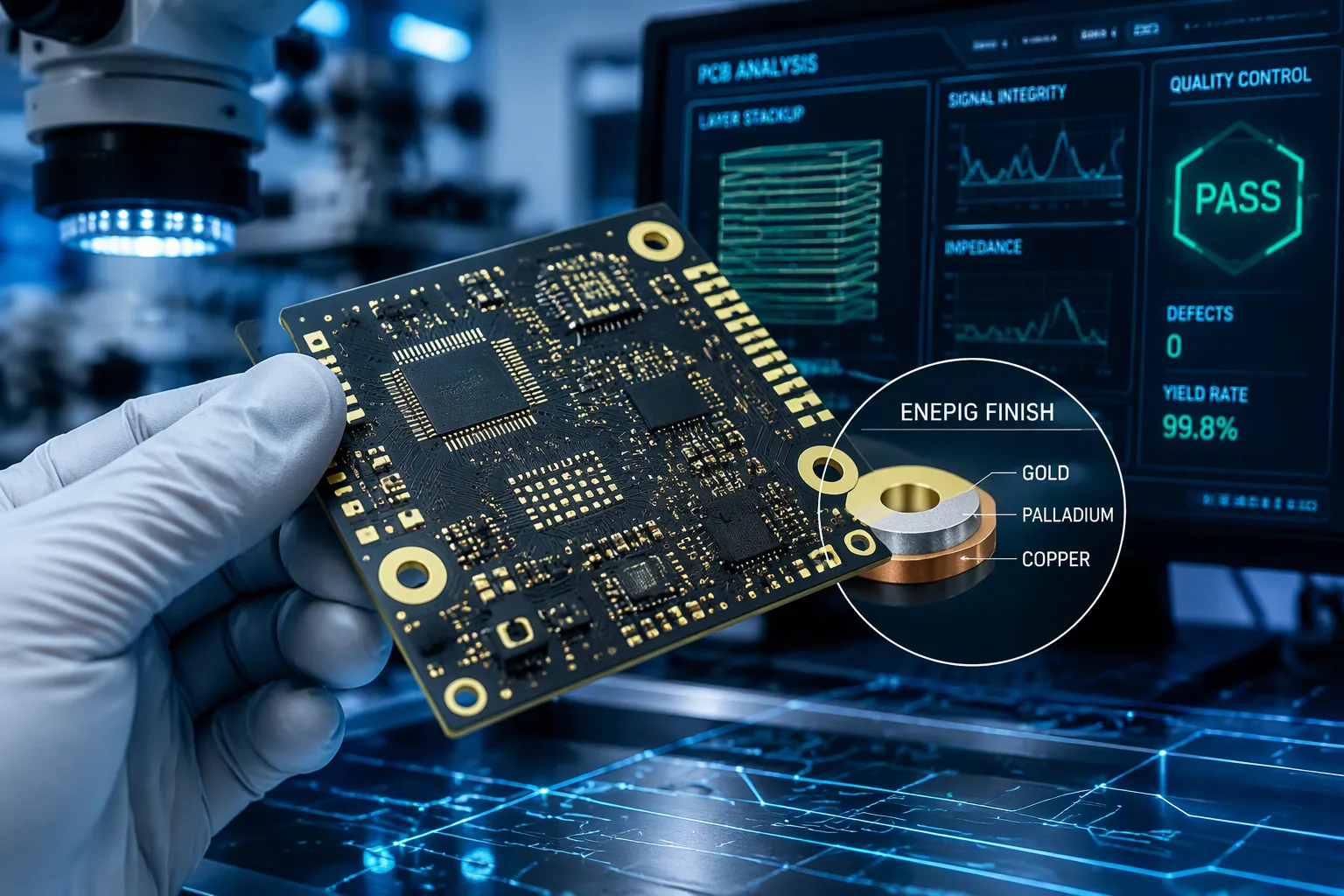
Why Engineers Are Choosing ENEPIG: it comes down to superior durability. Its palladium layer stops corrosion, prevents the black pad defect, and enables dependable wire bonding. This finish stacks electroless nickel, electroless palladium, and immersion gold to protect printed circuit boards over long service lives.
You face three practical questions. How does this finish block corrosion and black pad? Why does it support wire bonding and extended shelf life? Does the higher cost make sense for your demanding applications?
The answers matter for assembly capability, solder joint quality, and field performance. The durability story starts with ENEPIG's three-layer construction.
Key Takeaways
ENEPIG uses a palladium layer to prevent corrosion and black pad defects.
This finish supports reliable wire bonding for both gold and aluminum wires.
ENEPIG withstands up to 10 reflow cycles without significant degradation.
Sealed ENEPIG boards stay solderable for over 12 months in storage.
The palladium barrier reduces black pad failure rates by nearly 90% compared to ENIG.
ENEPIG costs 15-25% more than ENIG but lowers field failures and rework.
Specify ENEPIG for medical, automotive, and aerospace PCBs with harsh conditions.
Tight process control ensures ENEPIG delivers its full durability benefits.
Why Engineers Are Choosing ENEPIG for Superior PCB Durability
Engineers choose ENEPIG for superior PCB durability because its nickel, palladium, and gold structure prevents corrosion, blocks the black pad defect, supports wire bonding, and withstands repeated reflow cycles. This finish directly influences assembly capability, PCB shelf life, solder joint quality, cost, and performance. You get a surface finish that holds up under extreme temperature fluctuations.
The Triple-Layer Finish That Delivers Durability
The properties and composition of ENEPIG start with its three-layer stack. Each layer performs a distinct job. Together, they create a finish that protects copper pads, supports component attachment, and survives harsh environments.
Nickel: Solder Joint Strength and Barrier Protection
The nickel layer forms the foundation. It provides a hard, wear-resistant surface that supports strong, reliable solder joints. Nickel also acts as a diffusion barrier. It stops copper from migrating into the surface and keeps the pad stable during thermal cycling. A typical nickel thickness ranges from 3.0 to 6.0 μm. For soldering applications, you often see 3.0 to 5.0 μm. This layer gives the finish its mechanical strength.
Palladium: Oxidation Resistance and Black Pad Prevention
The electroless palladium layer is the critical addition. It sits between nickel and gold. This integrated palladium layer stops the immersion gold from attacking the nickel beneath it. In ENIG finishes, the gold bath corrodes the nickel surface and forms a brittle, non-solderable layer known as black pad. The palladium barrier eliminates this mechanism. Palladium also provides oxidation resistance. It keeps the surface clean and bondable over time. Thickness control matters here. Too little palladium increases copper-tin intermetallic thickness. Too much palladium increases brittleness of the palladium-tin alloy and reduces soldering strength. Typical palladium thickness ranges from 0.05 to 0.15 μm. For wire bonding, you may use 0.1 to 0.15 μm.
Gold: Stable Contact and Wear Protection
The gold layer preserves contact conductivity and provides wear resistance. It protects the palladium surface from oxidation during storage. Gold also delivers excellent electrical conductivity for gold fingers, connectors, and contact areas. The gold thickness is thin, typically 0.03 to 0.10 μm. For soldering, 0.03 to 0.05 μm is common. For wire bonding, 0.07 to 0.15 μm works better. This thin gold layer dissolves into the solder during reflow and exposes the palladium for bonding.
Why Palladium Is the Main Durability Differentiator
Palladium separates ENEPIG from every other finish. The advantages of ENEPIG come from this single layer. It prevents nickel corrosion, controls intermetallic growth, and raises solder joint mechanical strength. For fine pitch components, ENEPIG offers near-zero black pad risk and stable solder joints across multiple reflow cycles.
The data supports this. Black pad failure rates in poorly controlled ENIG manufacturing run 1 to 5%. ENEPIG reduces that rate by nearly 90%. Multiple reflow cycle degradation tells a similar story. ENIG degrades after 5 to 6 cycles. ENEPIG withstands up to 10 cycles without significant degradation. Wire bonding support also differs. ENIG offers limited support. ENEPIG supports both gold and aluminum wires, with bond pull strength exceeding 10 grams in many cases.
Metric | ENIG | ENEPIG |
|---|---|---|
Black pad failure rate (poorly controlled manufacturing) | 1–5% | Reduced by nearly 90% vs. ENIG |
Multiple reflow cycle degradation | Degrades after 5–6 cycles | Withstands up to 10 cycles without significant degradation |
Wire bonding support | Limited | Supports both gold and aluminum wires; bond pull strength exceeding 10 grams in many cases |
Root cause of failure | Immersion gold corrodes nickel layer, forming brittle, non-solderable surface (black pad) | Palladium barrier layer prevents gold from corroding underlying nickel |
ENEPIG as a Lead-Free Finish for High-Reliability PCBs
ENEPIG is a lead-free finish. That matters for regulatory compliance and for solder joint reliability. The finish performs exceptionally well under lead-free reflow and multiple thermal cycles. You can specify ENEPIG for PCBs that must survive harsh environments and repeated assembly steps.
The corrosion resistance of this finish extends to humidity, salt spray, and long-term environmental exposure. Both palladium and gold provide anti-corrosive protection. This dual protection explains why ENEPIG lasts longer than many other surface finishes.
Consider the thermal cycling data for competing finishes. After 1000 thermal cycles from -40°C to +125°C with SAC305 solder, OSP shows a 0.1–0.5% solder joint failure rate. HASL shows 0.3–0.8% with intermetallic growth concerns. Immersion silver shows 0.1–0.3%. ENIG shows 0.2–0.5% with Ni₃Sn₄ brittleness at thermal extremes. ENEPIG data is not directly listed in this source's thermal cycling table, but ENIG's baseline data shows the brittleness problem that palladium solves.
Finish | Reflow Cycles | Au Wire Bond | Al Wire Bond | Solder Joint Failure Rate (after 1000 thermal cycles, -40°C to +125°C, with SAC305) |
|---|---|---|---|---|
OSP | 1–2 | No | No | 0.1–0.5% |
HASL | 3–5 | No | No | 0.3–0.8% (IMC growth concern) |
ImAg | 2–3 | No | Yes | 0.1–0.3% |
ENIG | 5+ | No | Yes | 0.2–0.5% (Ni₃Sn₄ brittleness at extremes) |
The reliability advantages of ENEPIG make it a strong choice for demanding applications. You get a finish that resists oxidation, supports wire bonding, and maintains stable contact resistance through assembly and service. The palladium layer is the reason why engineers are choosing ENEPIG for superior PCB durability.
Corrosion Resistance: The Durability Core of ENEPIG
How ENEPIG Blocks Galvanic Corrosion
Galvanic corrosion starts when moisture bridges two dissimilar metals and drives an electrochemical reaction. Your copper pad sits beneath a stack of nickel, palladium, and gold. Each layer blocks that reaction at a different stage. The nickel layer acts as a barrier. It stops copper ions from migrating upward. The electroless palladium layer seals the nickel surface. It prevents the gold bath from attacking the nickel beneath it. The gold layer then shields the palladium from oxidation during storage and service.
This layered defense protects both the copper pad and the solder joint. You get a finish that resists humidity, salt spray, and long-term environmental exposure. The gold-palladium-nickel stack does not rely on a single protective mechanism. It combines barrier protection with noble-metal stability. That combination explains why ENEPIG fights corrosion better and lasts longer than many other PCB surface finishes.
Performance in Humidity, Salt Spray, and Thermal Cycling
Both palladium and gold provide anti-corrosive protection. That dual protection matters under real stress. Humidity tests show the finish holds stable contact resistance. Salt spray exposure does not break through the noble-metal surface. Thermal cycling tests push the finish further. ENEPIG has been evaluated across a primary thermal cycling range of -55°C to 125°C for 200 cycles. Additional thermal shock testing spans -65°C to 150°C for 100 cycles. Isothermal aging at a constant 125°C runs for 324 hours.
Test Condition | Thermal Cycling Range | Number of Cycles |
|---|---|---|
Primary thermal cycling | -55°C to 125°C | 200 cycles |
Additional thermal shock | -65°C to 150°C | 100 cycles |
Additional aging (isothermal) | 125°C (constant) | 324 hours |
These conditions simulate the harshest environments a PCB will face. The finish survives them without the nickel corrosion that plagues lesser stacks. That performance directly supports corrosion resistance and reliability in field service.
ENEPIG vs. ENIG: Why the Extra Palladium Layer Matters
The difference between ENEPIG and ENIG comes down to one layer. ENIG uses nickel and gold only. The immersion gold bath corrodes the nickel surface during deposition. That reaction forms black pad, a brittle and non-solderable defect. ENEPIG inserts a palladium barrier between the nickel and the gold. This barrier stops the corrosion mechanism entirely. Black pad failure rates in poorly controlled ENIG manufacturing run 1 to 5 percent. ENEPIG reduces that rate by nearly 90 percent.
The extra palladium layer also extends reflow endurance. ENIG degrades after 5 to 6 reflow cycles. ENEPIG withstands up to 10 cycles without significant degradation. That difference protects your assembly yield during complex builds. The durability advantage is not marginal. It changes which finish you can trust for high-reliability products.
Wire Bonding Reliability on ENEPIG Surfaces
The palladium layer creates a highly bondable, corrosion-resistant surface for wire attachment. The gold layer preserves contact conductivity over time. Together, these layers make ENEPIG a dependable choice for the enepig wire bonding process. You get a finish that supports both soldering and wire bonding without the surface degradation that weakens other finishes.
Gold and Aluminum Wire Bond Compatibility
ENEPIG supports both gold and aluminum wire bonding. This flexibility separates it from ENIG, which offers limited wire bonding support. The palladium surface accepts gold wire directly. For aluminum wire, the palladium layer provides a stable interface that resists oxidation during the bonding cycle.
The gold layer plays a distinct role here. It maintains contact conductivity after bonding. That conductivity stays stable through storage and service. You do not need to worry about oxide buildup degrading the bond interface over time. The nickel, palladium, and gold stack gives you a surface that works with either wire type in production.
Bond Strength and Long-Term Intermetallic Stability
Bond pull strength on ENEPIG exceeds 10 grams in many cases. That figure reflects the mechanical integrity of the bond interface. The palladium barrier controls intermetallic growth between the wire and the pad surface. This control prevents the brittle phases that weaken bonds over time.
Intermetallic stability matters for long-term reliability. Without the palladium layer, gold and nickel interact during thermal exposure. That interaction forms brittle compounds. The palladium barrier blocks this mechanism. Your bonds stay strong through thermal cycling and extended service. The result is superior wire bonding strengths that hold up under real operating conditions.
Why ENEPIG Improves First-Pass Bonding Yield
First-pass bonding yield depends on surface consistency. ENEPIG delivers a uniform, oxide-free surface across the entire panel. The palladium layer prevents nickel corrosion during storage. The gold layer protects the palladium from oxidation. You start every bonding run with a clean, bondable surface.
This consistency translates to fewer rejects and less rework. Production lines achieve stable wire bonding performance because the finish does not vary from lot to lot. The palladium thickness for wire bonding typically ranges from 0.1 to 0.15 μm. Gold thickness for wire bonding runs 0.07 to 0.15 μm. These controlled ranges support repeatable bonding results. You get a finish that performs the same way on the first bond and the thousandth bond.
Long Shelf Life and Reflow Endurance
Shelf life and reflow endurance together define the durability of a surface finish. ENEPIG resists surface oxidation and contamination during storage, then survives multiple assembly steps without degrading. These two qualities make it a reliable choice for complex builds.
How ENEPIG Extends PCB Shelf Life
ENEPIG keeps pads solderable because the palladium layer stops nickel corrosion and the gold layer prevents palladium from oxidizing. The finish does not form the surface oxides that kill solderability. This is why sealed PCBs retain acceptable wetting for 12+ months, according to HT Global Circuits.
Extended storage life matters in production planning. You can hold finished boards and still start assembly with confidence. One industry summary puts the advantage plainly:
With multiple protective layers, ENEPIG prevents oxidation and corrosion, extending the shelf life of your PCB. Some studies suggest these boards can remain solderable for over 12 months under proper storage conditions.
Compare shelf-life metrics across common finishes:
Surface Finish | Shelf Life | Reflow Cycles |
|---|---|---|
ENEPIG | >12 months | 4–6 |
ENIG | >12 months | 4–6 |
HASL | >12 months | 4–6 |
OSP | 6 months (controlled storage); 3 months (humid) | 2–3 |
Hard Gold | >24 months | Not for general reflow |
OSP requires strict humidity control. The finish does not. The noble-metal surface preserves solderability through routine warehouse conditions.
Surviving Multiple Lead-Free Reflow Cycles
Complex assemblies often pass through reflow more than once. You may attach a connector, add a shield, then reflow again. Each pass stresses the pad surface and the intermetallic layers beneath it. ENEPIG handles 4–6 lead-free reflow cycles. OSP yields only 2–3 cycles before solderability drops.
During each reflow, solder wets the palladium surface quickly. The nickel layer maintains a stable intermetallic interface. This structure prevents brittle copper-tin compounds that weaken the joint.
The layered structure explains this endurance. The nickel barrier prevents copper diffusion. The palladium layer controls intermetallic growth at the solder interface. As a result, each reflow produces consistent and reliable solder joints. That consistency directly supports solder joint reliability across repeated thermal exposure.
Stable Contact Resistance Through Assembly and Service
Stable contact resistance matters beyond soldering. Gold fingers, connectors, and test points need a consistent surface through assembly and in the field. The finish delivers that stability. The gold layer preserves low contact resistance; the palladium layer prevents the oxidation that would raise resistance over time.
This stability suits demanding, high-reliability products. A board that survives reflow but drifts in contact resistance can fail during service. It avoids that risk. You get a finish that performs electrically today and years later. That long-term performance is why engineers trust this stack for devices with long warranty periods and harsh operating conditions.
ENIG vs. ENEPIG in Semiconductors: Comparing PCB Finish Options
ENIG vs. ENEPIG in Semiconductors: Black Pad and Corrosion Risks
The comparison between ENIG and ENEPIG in semiconductors starts with one failure mode: black pad. In an ENIG pcb finish, the immersion gold bath attacks the nickel surface during deposition. That attack causes nickel hyper-corrosion, which appears as spike-like defects or fissures in the nickel deposit. A PCB fabricator traced solderability defects on ENIG-processed circuits to its own process errors, which caused this hyper-corrosion inside the nickel deposit. The result is a brittle, non-solderable surface.
ENEPIG solves this problem with a physical barrier. The palladium layer sits between the nickel and the gold. It shields the nickel from the gold bath entirely. Black pad risk drops to zero. ENIG shows a 1-2% failure rate in poorly controlled chemical baths and up to 5% solder joint failure in extreme conditions. ENEPIG reduces solder joint failure risk to near zero under similar conditions.
Wire bonding tells the same story. ENIG is considered poor or unreliable for wire bonding. ENEPIG supports gold, copper, and silver wire bonding because it provides strong adhesion and long-term bonding stability. You get a finish that works for COB and wire bonding applications where ENIG fails.
ENEPIG vs. Immersion Tin, Immersion Silver, and OSP
The comparison extends beyond ENIG. Immersion silver offers moderate corrosion resistance. It tarnishes through silver sulfide formation in sulfur environments and carries electromigration risk in high humidity. Immersion tin shows moderate corrosion resistance as well. Copper-tin intermetallic growth degrades its performance over time, and tin whisker risk remains. OSP provides limited corrosion protection. Its organic coating degrades with handling and environmental exposure.
Solderability, corrosion resistance and wire bonding performance separate these finishes further. Immersion silver wets well but shows micro-voiding with some flux chemistries. Immersion tin works for soldering but cannot handle multiple reflow cycles. OSP forms direct copper-tin intermetallics and performs reliably for a single assembly pass. Only ENEPIG combines excellent corrosion resistance with excellent solderability and full wire bonding support.
The palladium layer makes the difference. It dissolves in solder to form reliable Sn-Pd-Ni intermetallic joints. These joints outperform ENIG connections. The palladium also limits intermetallic growth at the joint interface, which supports robust lead-free assembly.
Contact Resistance and Shelf Life Differences
Shelf life data reveals the practical gap between finishes. ENEPIG delivers 12+ months of solderability shelf life. Immersion silver reaches 6 months. Immersion tin reaches 6 months. OSP varies by vendor and grade, with Entek Cu-56 rated at 3-6 months and Entek Plus-HT rated at 6-12 months.
Surface Finish | Corrosion Resistance | Solderability | Shelf Life |
|---|---|---|---|
ENEPIG | Excellent — palladium barrier prevents nickel corrosion | Excellent — reliable Sn-Pd-Ni intermetallic joints | 12+ months |
Immersion Silver | Moderate — tarnishing and electromigration risk | Good — micro-voiding with some fluxes | 6 months |
Immersion Tin | Moderate — intermetallic growth, whisker risk | Good — not for multiple reflow | 6 months |
OSP | Limited — minimal protection | Good — direct copper-tin intermetallics | 3-6 months |
Contact resistance stays stable on ENEPIG through assembly and service. The gold layer preserves conductivity. The palladium layer prevents the oxidation that would raise resistance over time. Other finishes cannot match this combination of solderability and wire bonding support with long-term electrical stability.
The enig and enepig pcb finish processes differ in one critical way. ENIG relies on nickel and gold alone. ENEPIG adds palladium between them. That single layer protects the nickel surface and preserves the finish's long-term durability. The PCB surface finish with ENEPIG is very thin, between 0.05μm and 0.1μm, which makes assembly and soldering simple and more reliable than ENIG. ENEPIG also resists tarnishing, which extends its shelf life well beyond competing options.
For semiconductor PCBs, this reliability advantage matters. You need a finish that survives thermal cycling, supports wire bonding, and maintains stable contact resistance. ENEPIG delivers all three. The electroless nickel immersion gold process cannot match it for demanding applications.
Cost Considerations and Applications for ENEPIG
Total Cost of Ownership: Price vs. Field Failure Cost
You pay more for ENEPIG than for ENIG. That premium is real, and you should understand it before you specify the finish. The palladium barrier adds a process step and a material cost. The advantages and disadvantages of ENEPIG both trace back to that single layer.
ENEPIG inserts a 0.05–0.1 µm electroless palladium barrier between the nickel and gold. This makes the finish gold-wire-bondable and essentially immune to black pad, at roughly 15–25% higher cost than ENIG.
Unit price tells only part of the story. Total cost of ownership includes shelf life, rework cycles, field failure risk, and wire bonding yield. A finish that survives 12+ months of storage and 4–6 reflow cycles reduces scrap and rework. A finish that prevents black pad eliminates an entire failure mode. Those savings often outweigh the per-board premium in high-reliability products.
Board complexity changes the absolute adder, not the logic. Consider these representative figures:
Board Type | ENIG Adder | ENEPIG Adder | Cost Premium |
|---|---|---|---|
Simple 2L (100×100mm) | ~$0.40/board | ~$0.55/board | ~37.5% |
6L HDI (150×100mm) | ~$1.80/board | ~$2.30/board | ~27.8% |
12L complex (200×150mm) | ~$4.50/board | ~$5.80/board | ~28.9% |
ENEPIG requires careful, precise manufacturing. Bath chemistry, palladium thickness, and gold thickness all demand tight control. The PCB fabricator's process control matters as much as the material stack. A poorly controlled line erases the reliability gains you paid for.
Medical, Automotive, and Aerospace Applications
High-reliability industries specify ENEPIG for reasons that go beyond cost. Medical devices need stable contact resistance through years of service. Automotive electronics face thermal cycling from -55°C to 125°C and beyond. Aerospace systems must survive thermal shock from -65°C to 150°C. ENEPIG handles these conditions because the palladium layer blocks the nickel corrosion that weakens other finishes.
Wire bonding capability separates ENEPIG from ENIG in these markets. ENIG offers limited wire bonding support. ENEPIG supports both gold and aluminum wires, with bond pull strength exceeding 10 grams in many cases. That capability matters for mixed packaging technologies, where you solder some components and wire bond others on the same board.
Miniaturization adds another driver. Dense vias, thin PCBs, and fine-pitch components demand a finish that wets reliably and resists oxidation. ENEPIG meets those requirements. It also satisfies military and medical applications that need high density and long-term reliability.
When to Specify ENEPIG for Superior PCB Durability
You should specify ENEPIG when your design includes wire bonding or mixed bond-and-solder pads. The finish improves bondability and mitigates black pad concerns. That single criterion eliminates ENIG from consideration for many advanced assemblies.
Several other criteria point to ENEPIG:
Black pad mitigation: the palladium layer prevents nickel contamination from migrating into the gold layer.
Wire bonding capability: highly reliable for gold and aluminum wire.
Mixed packaging technologies: suitable for boards using different packaging methods.
High-reliability industries: satisfies military, aerospace, and medical requirements.
Solderability and reflow: preferred for good solderability and many reflow cycles.
Miniaturization: meets thinness and dense via requirements.
Demanding environments: provides a higher reliability process for harsh conditions.
This is why engineers are choosing ENEPIG for superior PCB durability. The finish costs more upfront. It returns that investment through fewer field failures, less rework, and longer product life. Choose ENEPIG when your application cannot tolerate a finish that degrades.
ENEPIG delivers superior PCB durability because its palladium layer prevents corrosion and black pad defects. That same layer supports dependable wire bonding and long shelf life. You get a finish that protects copper pads through harsh environments and repeated assembly cycles.
The higher unit cost pays for itself. You avoid field failures, reduce rework, and extend product reliability in demanding applications. Choose ENEPIG for medical, automotive, aerospace, and other high-reliability PCBs. This is why engineers are choosing ENEPIG for boards that cannot tolerate degradation.
FAQ
Does ENEPIG cost more than ENIG?
Yes. The palladium barrier adds a process step and material cost, making ENEPIG roughly 15–25% more expensive than ENIG. You offset that premium through longer shelf life, fewer rework cycles, and lower field failure risk in high-reliability products.
How does ENEPIG prevent black pad?
The palladium layer sits between the nickel and the gold. It shields the nickel surface from the immersion gold bath. That barrier stops the hyper-corrosion reaction that forms brittle, non-solderable black pad. ENEPIG reduces black pad failure rates by nearly 90% compared to poorly controlled ENIG.
Can I wire bond to an ENEPIG surface?
Yes. ENEPIG supports both gold and aluminum wire bonding. Bond pull strength exceeds 10 grams in many cases. The palladium layer provides a stable, oxide-free interface, and the gold layer preserves contact conductivity over time.
How long does ENEPIG stay solderable in storage?
Sealed ENEPIG boards retain acceptable wetting for more than 12 months under proper storage conditions. The palladium layer blocks nickel corrosion, and the gold layer prevents palladium oxidation. You can hold finished boards and start assembly with confidence.
How many reflow cycles can ENEPIG survive?
ENEPIG withstands up to 10 lead-free reflow cycles without significant degradation. ENIG degrades after 5 to 6 cycles. That endurance protects your assembly yield during complex builds that require multiple passes through reflow.
What palladium thickness should I specify?
Typical palladium thickness ranges from 0.05 to 0.15 μm. For wire bonding, specify 0.1 to 0.15 μm. Too little palladium increases copper-tin intermetallic thickness. Too much palladium increases brittleness and reduces soldering strength.
When should I choose ENEPIG over other finishes?
Specify ENEPIG when your design needs wire bonding, mixed bond-and-solder pads, or black pad mitigation. It also suits medical, automotive, and aerospace PCBs that must survive thermal cycling from -55°C to 125°C and repeated assembly steps.
Does ENEPIG require special process control?
Yes. Bath chemistry, palladium thickness, and gold thickness all demand tight control. Your fabricator's process control matters as much as the material stack. A poorly controlled line erases the reliability gains you paid for.
