Why Engineers Choose Rogers PCB for High-Frequency Communication

You pick Rogers PCB for high-frequency communication because it works better, loses less energy, and is very reliable. Choosing the right material is very important for high-frequency uses. Rogers PCB helps keep signals clear, stays steady with heat, and controls impedance well. Engineers like Rogers PCB because it has a low loss tangent (under 0.005) and a good dielectric constant range (2.2 to 3.6). These features help keep signals strong and reduce signal loss. When sending high-frequency signals, you get insertion loss under 0.7 dB per inch at 10 GHz and return loss over -10 dB. This means there are fewer signal reflections and strong high-frequency performance.
At 10 GHz, ENIG surface finishes can make signals lose 0.2 to 0.5 dB per inch, but immersion silver can lower the loss by up to 20%.
Rogers PCB always meets the needs of high-frequency uses in communication, radar, and advanced electronics.
Key Takeaways
Rogers PCB works well for high-frequency communication. It helps stop signal loss. It keeps signals clear and strong.
Its low dielectric constant and loss tangent help it work better. It is better than FR4 for RF, microwave, and 5G uses.
Rogers PCB materials stay steady when it gets hot or cold. This makes sure it works well in tough places.
It gives exact impedance control. This is very important for radar, antennas, and advanced communication systems.
Rogers PCB costs more and is harder to make. But it is the best for circuits that need high performance and last a long time.
Rogers PCB Material Overview
Rogers Materials for High-Frequency
You use Rogers PCB when you need strong performance at high frequencies. Rogers PCB materials are special because they have low dielectric loss. They also have a steady dielectric constant. These things make them great for high-frequency jobs like RF, microwave, and fast electronics. There are different series to pick from. Each one is made for a certain use. The table below lists the most common Rogers PCB materials and what they are used for:
Rogers PCB Series | Characteristics | Applications |
|---|---|---|
RO4000 Series | Low dielectric loss, stable dielectric constant | Power amplifiers, antennas, RF/microwave circuits |
RO3000 Series | Excellent dielectric properties | Automotive radar, satellite applications |
RT/duroid Series | High-power and space-grade applications | Military and aerospace applications |
TC Series | Controlled thickness, reliable RF performance | High-speed electronic products |
Other high-speed materials | Diverse characteristics | 5G infrastructure, radar boards, microwave circuits |
You can find Rogers PCB in antennas, RF front-end modules, radar boards, and 5G systems. These materials help you get good results in high-frequency work.
Unique Properties of Rogers PCB
Rogers PCB materials have many benefits over regular PCB materials. They have a lower dielectric constant, usually from 2.2 to 3.5. This helps keep signals clear and lowers signal loss. FR4 materials have a dielectric constant from 4.0 to 4.7. This can make signals less clear in high-frequency uses.
Rogers PCB also has a low loss tangent, sometimes as low as 0.002. This means signals lose less energy, even at high frequencies. Rogers PCB materials keep their electrical properties steady, even when it is hot or cold. This makes sure your designs work well, even in tough places.
Rogers PCB gives you:
Low loss tangent and dielectric constant for high-frequency jobs.
A steady dielectric constant at different frequencies and temperatures.
Low dissipation factor to keep signals strong from transmitter to antenna.
Good thermal conductivity and strong shape stability.
Tip: If you pick Rogers PCB for your high-frequency designs, you help your signals stay clear and lower the chance of signal loss or problems.
Advantages of Rogers PCB
Low Loss and Signal Integrity
You need clear signals and low loss for high-frequency jobs. Rogers PCB helps with both. The material has a low loss tangent, usually under 0.003. This means signals lose less energy and stay strong. It is important for keeping signals clear in rf and microwave systems. When you use Rogers PCB, your signals stay strong, even at microwave frequencies.
Here is a table showing loss tangent values:
Material | Loss Tangent (Dissipation Factor) |
|---|---|
Rogers | ~0.004% |
FR-4 | ~0.02% |
You can see Rogers PCB has a lower loss tangent than FR-4. This helps you lose less energy in high-frequency circuits. Rogers PCB also keeps its dielectric constant and loss tangent steady. These features help your signals stay clear and strong. You can use Rogers PCB in rf systems, microwave systems, and fast data transmission. You get reliable performance in 5g and new communication technologies.
Rogers PCB materials show:
Low loss tangent for less signal loss.
Steady dielectric constant for clear signals.
Low dissipation factor for strong signal integrity.
Low signal loss in long antenna feed lines and power amplifiers.
Note: Rogers PCB gives you low loss and strong signal integrity for tough high-frequency jobs.
Thermal Stability
You want your circuits to work well when temperatures change. Rogers PCB is great for thermal stability. The material has a low thermal expansion coefficient. This means it does not expand much when heated. Your circuits stay steady and reliable, even in high-frequency places.
Rogers PCB also has high thermal conductivity. It spreads heat fast and stops hotspots. This protects your board and parts from heat damage. You get long-lasting reliability in communication devices, especially in outdoor base stations and car sensors. Rogers 4400 and 4000 series laminates handle high heat without breaking down. You can trust your circuits to last longer and work better.
Rogers PCB thermal advantages:
Handles heat in high power circuits.
Keeps performance steady in changing temperatures.
Supports long-term reliability for high-frequency jobs.
Tip: Pick Rogers PCB for microwave systems and rf and microwave systems that face quick temperature changes. You will see fewer failures and steadier performance.
Impedance Control
You need exact impedance control for high-frequency and fast communication. Rogers PCB gives you this control. The material’s steady dielectric constant lets you design circuits with exact impedance values. This is important for radar, antenna, and 5g and new communication technologies.
Here is a table comparing RF performance and best use:
Comparison Item | Rogers PCB Materials | Low-Loss FR4 | Ceramic PCB Materials |
|---|---|---|---|
RF performance | Strong and steady | Moderate | Strong in RF and thermal jobs |
Best use | RF, microwave, radar, antenna, 5G | Fast digital, lower RF need | RF power, laser, medical, aerospace |
You can see Rogers PCB is best for rf and microwave systems. The material supports controlled impedance design, which keeps signal transmission steady. Rogers RO4350B, for example, has lower dielectric loss and better Dk stability than regular FR-4. You get more predictable electrical performance, which is important for phased array radar and satellite communication.
Rogers PCB supports:
Less signal loss and better frequency stability.
Steady impedance for complex multilayer PCB designs.
Reliable performance in high-frequency jobs.
Callout: Use Rogers PCB when you need exact impedance control and low signal loss in your high-frequency circuits.
Rogers PCB vs FR4
Electrical Performance Comparison
When you look at Rogers PCB and FR4, you see big differences. Rogers PCB uses materials with a low dielectric constant and low loss tangent. This helps keep signals clear in high-frequency jobs. FR4 has a higher dielectric constant and higher loss tangent. You may see more signal loss and reflections with FR4 in high-frequency circuits.
Rogers PCB gives you:
Clearer signals for high-frequency communication.
Less signal loss, even above 1 GHz.
Steady impedance, which is important for radar and RF circuits.
FR4 often causes:
More signal problems at high frequencies.
Higher signal loss and spreading.
Less steady performance in high-frequency jobs.
You can see the main differences in this table:
Feature | Rogers PCB | FR4 PCB |
|---|---|---|
Dielectric Constant | Low | Higher |
Loss Tangent | Low | Higher |
Signal Integrity | Superior, minimizes reflections | Prone to signal loss |
Impedance Stability | Improved, ideal for RF circuits | Poor performance at high frequencies |
High-Frequency Use | Preferred for RF and microwave | Suitable for low-frequency circuits |
Rogers PCB works best in high-frequency jobs like radar, antennas, and advanced communication systems. You get clearer signals and more reliable data.
Cost and Manufacturing
You need to think about cost and how the boards are made when you pick between Rogers PCB and FR4. Rogers PCB costs more because it uses special materials and processes. The price for Rogers substrates like RO4350B or 5880 can be $50 to $200 per square meter. This is three to five times more than regular FR4. If you have a tight budget, FR4 might be better.
Rogers PCB needs:
Plasma etching to help copper stick.
Careful layer alignment because the size can change.
Precise drilling to stop resin from pulling back.
FR4 offers:
Regular surface preparation.
Steady lamination and easier alignment.
Fewer drilling problems.
Challenge | Rogers PCB | FR4 PCB |
|---|---|---|
Surface Preparation | Needs plasma etching | Standard chemicals work |
Layer Alignment | Can shift during lamination | More stable |
Drilling Precision | Needs careful control | Fewer issues |
You should pick Rogers PCB for high-frequency jobs where performance is most important. For easier jobs, FR4 is cheaper and simpler.
Applications in High-Frequency Devices
Telecommunications
Rogers PCB is used in many telecommunication devices. These devices need to work well at high frequencies. Routers, switches, and radio frequency circuits use Rogers materials. They help send data without problems. These devices need low signal loss and steady impedance. This keeps communication clear. Rogers PCB helps 5G networks by stopping signals from getting weak. It also keeps connections strong. When you use Rogers PCB in 5G base stations, data moves faster. You also get less delay. This means people get better coverage and more reliable service. This is true even in busy cities. Rogers PCB also helps satellites send signals far away.
Common telecommunications devices using Rogers PCB:
Routers and switches
Radio frequency circuits
Satellite communication hardware
Tip: Rogers PCB helps your high-frequency devices work well. It does this by lowering signal loss and helping with fast data.
Radar Systems
Rogers PCB is important for radar systems. Radar needs to control signals very well. It needs materials with a low dielectric constant and low loss tangent. This keeps signals clear. Rogers PCB uses PTFE and special laminates. These help stop signal loss in high-frequency radar. You find these materials in military and airplane radar. They are used where performance must not fail. Rogers PCB stays steady when temperatures change. This helps radar work in hot or cold places. Rogers materials are strong. They help radar systems in tough places. You see Rogers PCB in car radar, weather radar, and air traffic control. These jobs need steady impedance and low signal loss. This helps radar find things accurately.
Benefits of Rogers PCB in radar:
Keeps impedance steady
Handles lots of power and heat
Works well in hard conditions
Aerospace and Automotive
Rogers PCB is used in airplanes and cars for high-frequency jobs. These jobs include radar, satellite communication, and sensors. Rogers PCB helps radar in planes and satellites. It keeps signals clear. In car radar, you need materials that can take heat and shaking. Rogers PCB gives you the steady and strong performance you need. It is good for advanced driver-assistance and crash avoidance. You also find Rogers PCB in electronic warfare and avionics. Here, high-frequency performance is very important.
Key uses in aerospace and automotive:
Radar for navigation and safety
Satellite communication for worldwide coverage
Sensors for real-time information
Note: Rogers PCB lets you build high-frequency devices that work well, even in the hardest places.
Considerations for Engineers
Cost Factors
If you pick Rogers PCB for high-frequency projects, it costs more. Rogers laminates use special materials like PTFE and ceramics. These materials are more expensive than FR4. Making Rogers PCB needs special machines and careful steps. This makes production take longer and cost more. You also need to think about storage and handling. Rogers materials can be sensitive to moisture and heat.
Here are some main cost factors to remember:
Rogers PCB materials and special laminates cost more money.
PTFE-based Rogers need special steps, which raise costs.
Picking the right material for your frequency can be hard.
Small batches make setup costs go up.
Surface finishes, copper types, and RF tests change the final price.
Cost Factor | Why It Affects Price | Cost Control Suggestion |
|---|---|---|
Material grade | Rogers PCB materials cost more | Match material to real RF demand |
Layer count | More layers mean more complexity | Keep stack-up simple |
Impedance tolerance | Tight control needs more process steps | Use realistic tolerances |
Surface finish | ENIG or silver adds cost | Choose based on RF and assembly needs |
Quantity | Small batches cost more per board | Plan prototypes and batches together |
Note: You can save money by picking the right Rogers PCB material for your real high-frequency needs and planning your production runs well.
Manufacturing Challenges
You will face special problems when making Rogers PCB for high-frequency designs. Delamination can happen if moisture gets trapped and turns to vapor when hot. Bad copper-laminate bonding can cause parts to come apart. Drilling is hard because ceramic fillers can smear and make rough holes.
Other problems include:
Getting Rogers materials can be tough, especially for military or medical jobs needing ITAR rules.
Changes in copper weight and thickness can change price and performance.
You may need strict quality checks and certificates for aerospace or defense jobs.
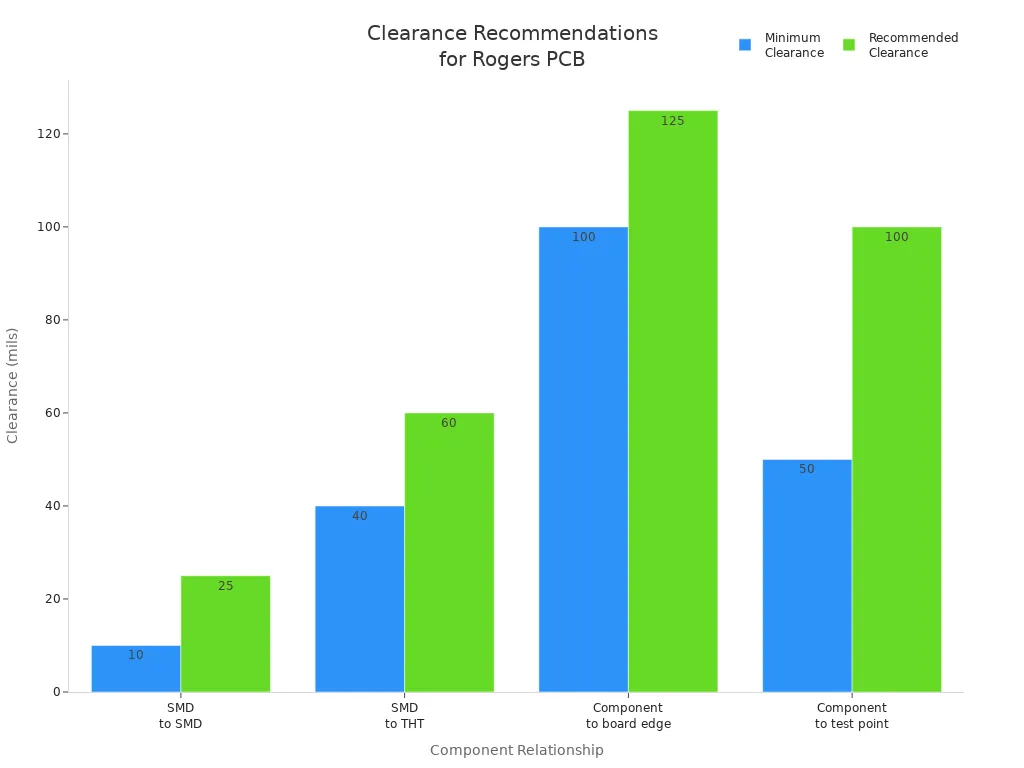
Tip: Work with your supplier to get the right Rogers PCB material and meet all quality rules.
Design Tips
You can make your Rogers PCB work better for high-frequency jobs by using some good steps. Start with a good stackup. Put signal traces between solid ground or power planes to cut noise. Pick materials with a low dielectric constant to keep signals fast and avoid timing problems. Keep trace widths and spacing the same to stop signal loss and crosstalk.
Here are some easy tips:
Use simulation tools to check how signals move and find impedance problems.
Keep ground planes close to signal layers for clearer signals.
Check every footprint with the manufacturer datasheet.
Keep solder mask dams at least 4 mils between pads.
Tent vias on the assembly side to stop solder from moving.
Design Tip | Explanation |
|---|---|
Proper Stackup Design | Put traces between ground or power planes to cut noise. |
Material Selection | Use Rogers with a steady low dielectric constant for strong signals. |
Trace Width and Spacing | Keep values right to stop loss and crosstalk. |
Effective Grounding Strategies | Keep ground planes whole and close to signal layers. |
Callout: If you follow these design tips, your Rogers PCB will give strong high-frequency performance in tough communication systems.
You pick Rogers PCB for high-frequency projects because it keeps signals strong and clear. It also loses less energy and works well for a long time. Rogers PCB helps advanced communication, radar, and car systems work better. The table below shows how Rogers PCB helps different industries:
Application Area | Performance Benefits | Key Features |
|---|---|---|
Telecommunications | Needed for fast networks and quick data | Low signal loss, good transmission |
Aerospace/Military | Works well for radar and satellite communication | Handles heat, stays strong |
Medical Equipment | Gives clear images in high-frequency devices | Stays steady in tough conditions |
Automotive | Helps smart cars stay safe and connected | Low dielectric loss, handles heat well |
With Rogers PCB, you get these benefits:
Signals stay clear in high-frequency designs
Less crosstalk and interference
Lasts in tough places
Works for small, multilayer circuits
You need to think about the higher price and harder making process. Picking the right material helps your high-frequency devices work their best.
FAQ
What makes Rogers PCB better for high-frequency circuits?
Rogers PCB lets signals stay strong and clear. It helps lower signal loss and keeps impedance steady. This means your designs work well, even at high frequencies. Your circuits can be trusted in tough communication systems.
Can you use Rogers PCB for multilayer designs?
You can use Rogers PCB for multilayer boards. It supports complex stackups and keeps properties stable. You get reliable performance in advanced RF, microwave, and 5G jobs.
Is Rogers PCB difficult to manufacture?
Making Rogers PCB can be tricky. The material needs special care, precise drilling, and careful lamination. Work with your PCB supplier to make sure you get good quality and avoid problems.
How does Rogers PCB handle temperature changes?
Rogers PCB stays steady when temperatures change. It resists expansion and keeps its properties the same. Your circuits will work well in hot or cold places.
See Also
Exploring Manufacturing and Design Aspects of High Frequency PCBs
Key Properties and Uses of Rogers Materials in RFPCB Design
Reasons Engineers Prefer VIPPO for Complex PCB Designs
Choosing PCB Materials for Effective Communication Devices
Identifying Optimal Materials for High-Speed PCB Development
