Rogers PCB for Satellite Communication Devices
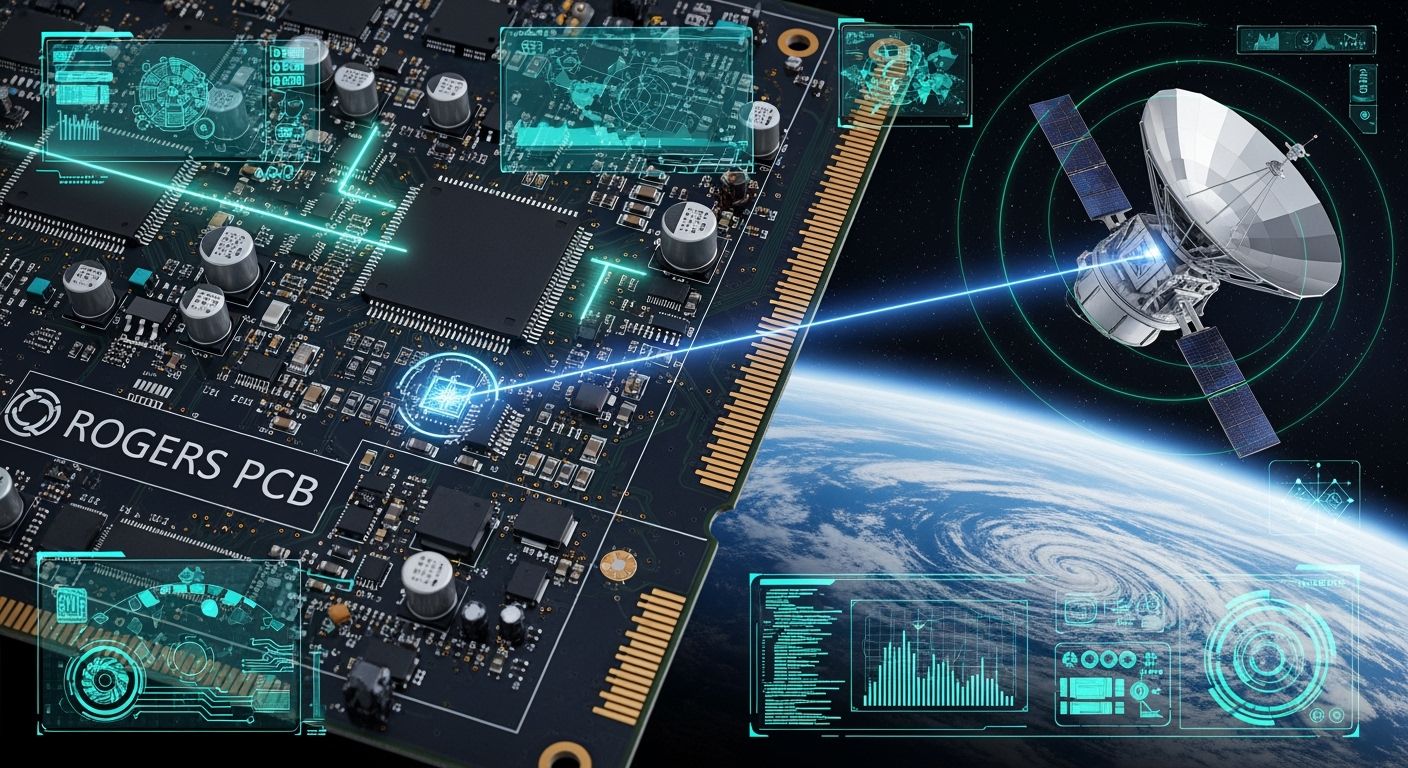
You need materials that can handle high-frequency signals. These materials must keep losses low. This is important when making satellite communication devices. Rogers PCB materials have special benefits for these tough environments.
You get very little loss at high frequencies. This helps send clear signals in satellite communication.
Rogers PCB materials have strong thermal stability. They also have low dielectric loss. This makes your devices work well even in hard conditions.
You see these materials used in RF, microwave, and aerospace systems. This shows they are important in satellite and 5G technology.
Key Takeaways
Rogers PCB materials help stop signal loss. This keeps communication clear in satellite devices. These materials stay strong in hot or cold places. This lets devices work well in extreme temperatures. Rogers PCBs are better than FR-4. They resist water better and lose less energy. Using Rogers PCB materials helps devices last longer. It also makes them work better in high-frequency uses. Good planning and picking the right material are important. This helps get the most from Rogers PCBs in communication technology.
Key Properties for Satellite Communication Devices
High-Frequency Performance
You need materials that can handle high-frequency signals. Rogers PCB materials like RO3003 and RT5880 help with this. These materials work well in Ka-band and Ku-band. These bands are important for satellite communication devices. They have great dielectric properties.
RO3003 has a dielectric constant of 3.0. Its dissipation factor is 0.0010.
RT5880 has a dielectric constant of 2.2. Its dissipation factor is 0.0009.
Both materials lower insertion loss. They help signals move well in high-frequency uses.
You depend on these properties to keep signals strong. High-frequency PCB layouts help signals stay clear. You avoid problems like crosstalk and impedance mismatches. This is needed for microwave PCB and satellite communication.
Low Signal Loss and Reliability
You want your devices to lose little signal. Rogers PCB materials have a low loss tangent. This means less energy is lost when signals move. Other materials, like FR4, have higher loss tangent values. Rogers PCB materials let signals go farther with less weakening.
RO3003G2 and RO5880 have loss tangents as low as 0.0013 to 0.0021. FR4 materials have higher loss tangents. This can cause more signal loss. You get efficient signal transmission and longer signal range. You also get strong thermal and mechanical stability. This helps your devices work well in tough places.
Note: Low loss factors help save energy when signals move. You stop signal distortion or communication failure by lowering losses.
You can check reliability metrics for Rogers PCB materials in satellite communication devices:
Metric | Description |
|---|---|
Signal Integrity | Makes sure signals lose little and stay steady. This is important for reliable communication. |
High Frequency Performance | Has low dielectric loss. This keeps signals stable at high frequencies. |
Thermal Management | Has high thermal conductivity. This helps get rid of heat in satellite uses. |
Reduced Signal Loss | Made to lower signal loss at high frequencies. It works better than regular materials. |
Impedance Stability | Keeps dielectric constant steady for good signal transmission. |
Low Loss Characteristics | Lets signals move well with low loss. |
Wide Frequency Range | Works well across many frequencies. This boosts performance. |
Thermal Stability and Durability
You need materials that stay steady when temperatures change. Rogers PCB materials keep their electrical properties even when it gets hot or cold. This is important for durability in space.
Rogers PCB materials have thermal conductivity from 1.0 to 2.0 W/m·K. This helps get rid of heat well.
Materials like RT/duroid 5880 stay reliable in tough conditions. These are found in aerospace uses.
You see great thermal and electrical performance. This helps keep size steady in hot places.
Good heat removal stops overheating. This makes these materials good for satellite communication systems.
Tip: Great thermal stability keeps devices working well in hot places. This is important for long satellite missions.
You also need materials that can handle tough environments. Rogers PCB materials are made for:
Environmental Requirement | Description |
|---|---|
Low Outgassing | Stops contamination in space. |
Radiation Resistance | Protects against space radiation. |
Stable Performance in Extreme Temperatures | Keeps devices reliable when temperatures change. |
You avoid common failures by using Rogers PCB materials. You stop pad lifting and delamination with special plasma treatment and reverse-treated copper foil. You lower plated through-hole cracking by using drill-smear removal and strong plating chemistry. Careful thermal stress testing helps you find micro-cracking early.
You count on these key properties to build reliable satellite communication devices. You get high-frequency communication, low signal loss, and strong durability. These features help you keep performance and integrity in tough environments.
Advantages of Rogers PCB Materials
Comparison with FR-4 and Other Materials
It is important to pick the right material for high-frequency communication. Rogers PCB materials are better than FR-4 and other common materials. You notice these benefits when making satellite communication devices or using microwave PCB.
Aspect | Rogers PCB Materials | FR-4 PCB Materials |
|---|---|---|
Frequency Range | Up to 500 MHz | Up to 10 MHz |
Moisture Absorption | 0.02 to 0.08 percent | 0.1 to 0.2 percent |
Dielectric Constant | 2.5 to 11 | Approximately 4.5 |
Thermal Conductivity | 0.5 to 0.95 W/mK | Nearly 0.3 W/mK |
Impedance Stability | Higher | Lower |
Rogers PCB materials let you use a wider frequency range. They absorb less moisture, so they stay strong in tough places. The dielectric constant stays steady, which is good for high-frequency uses. You also get better thermal conductivity, so heat is managed well and devices stay reliable.
Tip: Rogers PCB materials help lower signal loss and boost performance in satellite communication and 5G technology.
Rogers PCB materials give you low signal loss and low loss tangent. FR-4 materials cause more signal loss, which can make your device weaker. Rogers PCB materials keep signals strong, even in advanced microwave PCB uses.
Benefit | Rogers RO3035 | Standard FR-4 |
|---|---|---|
Electrical Performance | Low dielectric constant, low loss | Higher signal loss |
Mechanical Stability | Low CTE, reliable PTHs | Higher CTE, less reliable PTHs |
Thermal Management | Excellent thermal stability | Poor thermal management |
Propagation Consistency | Uniform dielectric constant | Variable dielectric properties |
Loss at High Frequencies | Extremely low dissipation factor (~0.0019) | Higher dissipation factor |
Rogers PCB materials use a PTFE base. This gives you low dielectric constant and less signal loss. Ceramic fillers keep the dielectric constant steady when temperature and frequency change. Low Z-axis CTE makes the material reliable during heating and cooling. These features make Rogers PCB materials great for satellite communication devices and high-frequency communication.
Impact on Device Performance and Longevity
You want your devices to last longer and work better. Rogers PCB materials help you reach this goal. You get great dielectric properties, good thermal management, and high dimensional stability. These features lower signal loss and keep devices reliable.
Feature | Rogers 4830 PCB | Standard Materials |
|---|---|---|
Dielectric Properties | Superior dielectric properties | Inferior dielectric properties |
Thermal Management | Excellent thermal management | Limited thermal management |
Dimensional Stability | High dimensional stability | Lower dimensional stability |
Resistance to Temperature | High resistance to temperature changes | Low resistance to temperature changes |
Space Radiation Resistance | High resistance to space radiation | Low resistance to space radiation |
Rogers 4830 PCB is great at managing heat because of its thermal conductivity.
Good heat removal lowers operating temperatures.
This makes systems more reliable and last longer.
Rogers PCB materials help manage heat better. This lowers signal loss and keeps devices steady. You also get high resistance to temperature changes and space radiation, which is important for satellite communication devices.
Rogers laminates, like Rogers 4830 PCB, give you great electrical performance with little signal loss. This matters a lot in RF and microwave PCB uses where signal integrity is important. The high dielectric constant and low loss tangent of Rogers PCB materials make sure high-frequency signals are sent clearly. You can trust these materials to keep devices reliable and help them last longer.
Rogers RO3035 has special properties that make it good for high-frequency uses like satellite communication and 5G technology. Its low loss and steady dielectric properties help keep signals strong. This is important for advanced communication systems.
Property | Description |
|---|---|
Low Dielectric Loss | Keeps radiated power, making antennas work better and stronger. |
Stable Dielectric Constant | Makes sure devices work well across different frequencies for MIMO operation. |
Robust Thermal Properties | Lowers heat, so you can have denser arrays without overheating problems. |
Rogers PCB materials are important in the telecom industry. They help you build devices that work well in 5G technology and satellite communication. You get low signal loss, steady performance, and better efficiency.
Aspect | Detail |
|---|---|
Substrate Material | RT/Duroid 5880 |
Dielectric Constant | 2.2 |
Frequency Range | 0.7 GHz to 3.5 GHz |
Benefits | Smaller size, better performance, and efficiency in RF and microwave parts |
Application | Needed for 5G technology and satellite communication |
Rogers PCB materials help lower signal loss and make devices work better. You get smaller, more efficient devices that last longer. You also see better results in high-frequency communication and microwave PCB uses.
Note: Picking Rogers PCB materials helps keep signals strong and lowers signal loss. You build devices that work well and last longer in tough places.
Applications in 5G Technology and Satellite Communication
Real-World Use Cases
Rogers PCB materials are used in many advanced systems. Satellite ground terminals use RT/duroid 5880 for strong performance. This material keeps signal loss low and stays stable for a long time in space. In 5G technology, RO4835 helps with high-frequency communication. It has a steady dielectric constant and low loss tangent. This means signals stay clear and do not lose strength.
Application Area | Material Used | Key Specifications |
|---|---|---|
Satellite Communications | Rogers RT/duroid 5880 | TML: <0.1%, Porosity: <0.01%, No performance degradation after 3,000 hours in vacuum |
5G Communications | Rogers RO4835 | Dk=3.48±0.05 @10 GHz, Df=0.0037 @28 GHz, 40% cost increase vs. standard materials, but significantly lower BER |
These materials are also found in microwave PCB applications. They help antennas send signals with less loss. Devices last longer and work better in hard places. You get reliable performance for satellite communication and 5G systems.
Tip: Using Rogers PCB materials helps you make devices that keep signal loss low and work well at high frequencies.
Design Considerations for Engineers
You must plan carefully when using Rogers PCB materials. First, decide the frequency and power levels for your device. Pick materials that fit your needs. For sub-6 GHz, use moderate dielectric constant grades. For mmWave bands, choose materials with very low loss tangent.
Use field solvers to check insertion loss. Try to keep it under 0.5 dB per inch at your design frequency.
Pick Rogers grades that work with normal fabrication methods. Change for vias if needed.
Choose materials with low passive intermodulation for antennas. This helps the spectrum output.
Keep RF paths at 50-ohm microstrip or stripline. Add ground planes to stop crosstalk.
Put thermal vias near power amplifiers. This helps remove heat and lowers signal loss.
You can save money by using hybrid stack-ups. This keeps signal integrity high and costs lower. Rogers PCB materials give you low signal loss, steady frequency performance, and strong thermal stability. Your devices work well in satellite and high-frequency communication.
Feature | Rogers PCB Materials | Traditional FR4 |
|---|---|---|
Dissipation Factor (Df) | 0.001 to 0.003 (low loss) | 0.020 (higher loss) |
Thermal Stability | Low Coefficient of Thermal Expansion (CTE) | Higher CTE |
Frequency Stability | Stable Dk across wide frequency spectrum | Significant Dk shifts |
Cost Optimization | Hybrid stack-ups reduce costs | Pure FR4 boards |
Signal Integrity | Maintains signal strength in high-frequency | May cause signal loss |
By following these steps, you get less signal loss and better performance. Rogers PCB materials help you build strong satellite communication devices and microwave PCB applications. You keep signal loss low and your projects work well.
Challenges and Solutions
Manufacturing and Cost Factors
When you use Rogers PCB materials, you face some problems. These materials help lower signal loss. But they need special care when making them.
Rogers laminates can crack or break easily. You must handle them with care.
Some laminates soak up water. This can cause trouble. You need to dry them the right way.
Rogers laminates are hard to drill. Drill bits wear out fast. You need special tools and set the drill right.
Rogers materials cost a lot more than FR-4. They use pricey materials and need more steps to make.
Sometimes, it is hard to get these materials. Special mixes mean you may wait longer for them.
PTFE-based Rogers materials can cost 8 to 12 times more than FR-4. Extra steps like plasma desmear add to the price. You can save money by mixing Rogers layers with FR-4. This can cut costs by 30-50% and still work well. People use this in aerospace and defense where low signal loss is very important.
Challenge | Solution |
|---|---|
Complex manufacturing process | Use special machines and watch temperature and pressure closely. |
Surface preparation for copper | Use plasma etching to get holes ready for copper plating. |
Precision drilling and plating | Set drill tools right and keep them sharp to stop problems. |
Note: You can save money and keep good performance by using hybrid stack-ups. This keeps signal loss low and helps your budget.
Tips for Implementation
You can follow some easy steps to use Rogers PCB materials well.
Make a clear plan before you start. This helps you avoid mistakes and delays.
Write down all the details about your board layers. This makes it easier to build and pick materials.
Group your PCB layout into clear sections. This helps you design better and lose less signal.
Make sure return current paths are good. This keeps impedance low in fast designs.
Use the 3W Rule. This stops tracks from causing problems and lowers signal loss.
Use the 20H Rule. This keeps power and ground layers from interfering.
Find out what frequency your device will use. Pick the right Rogers material for your job. If your device gets hot, choose materials with high thermal conductivity. Think about your budget and try Rogers 4350B for good quality and price. Check for water absorption and stress if your device will be in tough places.
Tip: Good planning and notes help you avoid errors and keep signal loss low. You can make strong devices for aerospace and defense.
Rogers PCB materials are very important in satellite communication devices and 5G technology. These materials help keep signals strong. They make devices work well and stay reliable. The table below shows the main benefits:
Advantage | Description |
|---|---|
Signal Integrity | Rogers PCB keeps signals strong. This is needed for 5G and satellite communication. |
Low Loss | It lowers signal loss. This helps devices work better with high-frequency signals. |
Thermal Stability | The materials stay steady when temperatures change. This is important for satellites. |
Impedance Control | Exact impedance control is needed for radar and advanced communication systems. |
Enhanced Data Speed | In 5G base stations, it lets data move faster and lowers delays. |
Reliable Coverage | It gives better coverage, even in crowded places. |
You can use these strategies to get the best results:
Actionable Strategies | Description |
|---|---|
Market Segmentation | Find areas with high potential. This helps use resources well and target good segments. |
Innovation Focus | Make products better and cheaper by using new ideas and technology. |
Risk Monitoring | Watch for rule changes and money problems. This helps avoid risks. |
Tip: Ask experts or do more research before you start your project. This helps you choose the right Rogers PCB material for your needs.
FAQ
What makes Rogers PCB materials ideal for satellite communication devices?
Rogers PCB materials let signals stay strong and clear. They work well at high frequencies. Devices using them can work in space without problems. These features help keep connections steady.
How do Rogers PCB materials improve thermal management?
Rogers PCB materials move heat away fast. This keeps your device cool. Electronics stay safe during long missions. This is important in aerospace and defense.
Can you use Rogers PCB materials in telecommunications and 5g technology?
Yes, Rogers PCB materials work in these areas. They handle high-frequency signals well. Signal integrity stays strong. Devices perform better in advanced systems.
Are Rogers PCB materials difficult to manufacture?
Making Rogers PCB materials can be tricky. You need special tools and careful steps. Following strict rules helps avoid mistakes. This lowers problems during manufacturing.
How do Rogers PCB materials compare to FR-4 in harsh environments?
Rogers PCB materials resist moisture and heat changes well. They keep their properties steady. Devices last longer and work better in tough places.
See Also
Exploring Rogers R4350B, R4003, And R5880 For RFPCB Use
Integrating Rogers Materials With TG170 For Hybrid PCB Designs
Choosing PCB Materials For Effective Communication Device Solutions
Designing High Frequency PCBs: Key Manufacturing And RF Insights
Diverse Applications Of Multilayer PCBs In Various Industries
