RoHS & REACH Compliance for PCB Quality
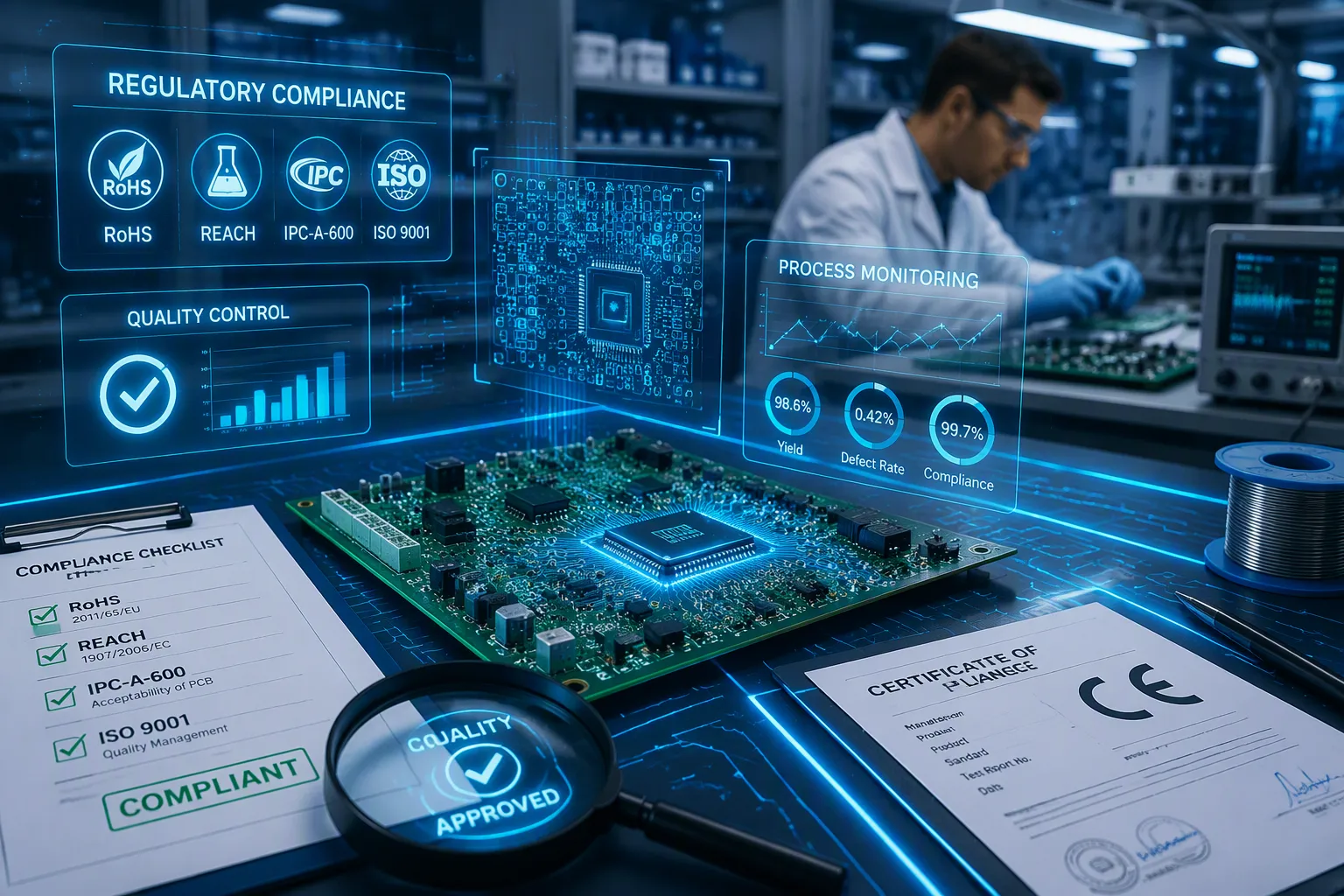
You need to understand RoHS and REACH for PCB quality. These EU rules are key for product safety and protecting the environment. They also let you sell legally in the market. Without following them, you could face fines and lose market access.
RoHS bans certain dangerous substances in electronic products. REACH is a wider rule that covers chemical safety in all materials. Both directly affect how you design and build your PCBs. They change your choice of materials, how you solder, and what supply chain paperwork you need. You must also keep records of all material declarations.
This article makes RoHS and REACH compliance easier to grasp. It explains how they differ and gives you practical steps. You will learn how to meet these rules and follow industry standards for your PCB design and production. This know-how helps you keep product quality high and avoid expensive recalls.
Key Takeaways
RoHS bans ten specific dangerous chemicals in electronics.
REACH covers many chemicals in all industries, not just electronics.
A PCB can pass RoHS tests, but it might still fail to follow REACH reporting duties.
Pick materials that have no lead and no halogens to follow both rules.
Ask suppliers for both RoHS and REACH papers for each part.
RoHS: A Substance Ban for Electronics
Scope and Restricted Substances
RoHS means Restriction of Hazardous Substances. The EU made this rule in 2003 to limit dangerous materials in electronic products. The rule applies to every single material inside a PCB. Each solder joint, coating, and plastic piece must meet RoHS limits.
The first RoHS rule banned six dangerous substances. These were lead, mercury, cadmium, hexavalent chromium, PBBs, and PBDEs. Under RoHS 3, the EU added four phthalates in 2015. Enforcement began on July 22, 2019. The table below shows the banned substances and how they were used in PCBs.
Banned Substance | Historical Use in PCB Manufacturing |
|---|---|
Lead (Pb) | Traditional tin-lead solder (e.g., Sn63Pb37) for component attachment |
Mercury (Hg) | Switches, relays, and lamps in older electronic assemblies |
Cadmium (Cd) | Plating on connectors and contacts for corrosion resistance |
Hexavalent Chromium (Cr6+) | Surface coatings for corrosion protection on PCB finishes |
Polybrominated Biphenyls (PBBs) | Flame retardant additives in PCB laminates and plastic housings |
Polybrominated Diphenyl Ethers (PBDEs) | Flame retardant additives in PCB substrates and cable insulation |
Lead was once common in solder because it conducted electricity well and melted at low heat. But lead can wash from circuit boards into soil and water. This can harm the brain and slow development. Mercury hurts the nervous system and builds up in fish and other water life. These health dangers pushed the EU to ban these substances.
The maximum limits are very strict. Cadmium cannot go over 100 ppm. Lead, mercury, hexavalent chromium, PBBs, PBDEs, and the four phthalates all have a limit of 1000 ppm. These limits apply to each single material. You must follow RoHS rules when picking materials. This makes meeting the rules a careful process.
Steps for Achieving RoHS Compliance
You need a clear plan to meet RoHS rules. Start by checking your documents. Ask your suppliers for a declaration of conformity. These papers show that materials meet the limits.
Next, run tests. Use X-ray fluorescence (XRF) analyzers to screen for metals. For the added phthalates, you need solvent extraction and then GC-MS analysis. Labs also use ICP-AES to measure restricted substances. These tests confirm that banned materials stay within safe limits.
Auditing suppliers is another step. Look at how they make products and check their quality controls. Look for ISO certificates or audit reports. This helps you confirm they still meet the rules.
Finally, watch for rule changes. Follow updates from the European Chemicals Agency. Keep an eye on expiring exemptions or new bans. Get a new declaration of conformity for each product batch. This keeps your products compliant over time.
Many adhesive and material suppliers now offer compliant options. This makes buying easier. Keep a tracking system that checks the status of each part. Store technical files and test reports for audits. Put CE marking on equipment that meets RoHS rules.
REACH: A Broader Chemical Framework
REACH stands for Registration, Evaluation, Authorisation, and Restriction of Chemicals. This EU rule covers all chemical substances, not just those in electronics. It applies to any substance made or brought into the EU at one tonne or more each year. The rule covers substances on their own, in mixtures, and sometimes in finished products. This wide reach means REACH affects every industry, including PCB making.
The SVHC Candidate List and PCB Materials
The SVHC Candidate List points out Substances of Very High Concern. These substances can hurt human health or the environment. The European Chemicals Agency (ECHA) updates this list twice a year. This steady schedule helps makers plan their compliance work across complex supply chains.
Several SVHCs show up in common PCB materials. Lead appears in old solder connections. DEHP shows up in PVC cable insulation. HBCDD works as a flame retardant in laminates. Bisphenol A forms part of epoxy resin in board bases. Each substance has its own reason for SVHC status, from harming reproduction to upsetting hormones.
You must check your materials against this list. The 0.1% weight limit triggers your duties. When an SVHC goes over this limit in one article, you must act. This applies to each part inside a complex product, not the whole product combined.
Ensuring Reach Compliance in the Supply Chain
Getting reach compliance takes a step-by-step plan. Start by finding which substances exist in your production materials. Review both the Candidate List and Annex XVII limits. Decide if you make or bring in any substance at one tonne per year or more. This amount triggers registration duties under the rule.
You must share SVHC information down the supply chain. Article 33 requires you to tell buyers when an SVHC goes over 0.1% by weight. You must give the substance name and safe use details. You also need to answer consumer questions within 45 days. The SCIP database notice applies before you put products on the EU market.
Ask your suppliers for specific papers. Request a REACH/SVHC statement tied to the exact part number and version. A finish statement links compliance to ENIG, silver, or other surfaces. An assembly material statement covers solder, flux, and adhesives. Check each statement fully instead of assuming compliance.
Regular checks keep your supply chain honest. Keep updated Material Safety Data Sheets. Get accurate Full Material Declarations from every supplier. Treat any material change or Candidate List update as a reason for new statements. These steps protect you from dangerous substances entering your products without your knowledge.
The authorization process under REACH regulation lets authorities ban substances with risks they cannot manage. They can also limit use or make it allowed only with permission. This system gives you clear rules for swapping dangerous chemicals with safer options.
RoHS vs. REACH: Key Differences and Overlaps
Comparing Regulatory Scope and Substance Limits
You may ask how these two EU rules differ in real life. RoHS applies only to electrical and electronic equipment. REACH covers many more industries. This main difference shapes everything else about these rules.
The table below shows the key contrasts you need to understand.
Aspect | RoHS | REACH |
|---|---|---|
Regulatory Scope | Applies only to electrical and electronic equipment (EEE) | Covers a wide range of chemicals across many industries, not limited to EEE |
Number of Restricted Substances | 10 specific harmful substances (e.g., lead, mercury, cadmium, four phthalates) | Over 235 substances on the Candidate List of SVHCs, with over 60 on the Authorisation List |
Thresholds | Concentration limits: 0.1% for most substances (e.g., lead), 0.01% for cadmium; enforced at 1000 ppm | Requires reporting for substances on the SVHC Candidate List when present above 0.1% by weight; no fixed list of banned substances but authorization may be needed |
RoHS gives you a clear, fixed list of banned materials. You know exactly what to avoid. REACH works differently. It manages chemical risk through registration and evaluation. The Candidate List grows constantly. You must track new additions twice each year.
The enforcement approach differs too. RoHS sets hard concentration limits. You test finished products against these numbers. REACH requires communication and authorization. You report SVHC presence above 0.1% by weight. You share this information down your supply chain.
How RoHS and REACH Work Together for PCB Quality
These two regulations complement each other despite their differences. Both control dangerous chemicals. Both demand supply chain tracking. Both apply to your PCB manufacturing process. You cannot ignore either one.
Consider this scenario. Your PCB passes all RoHS tests. The ten restricted substances stay below their limits. Yet the same board might contain a substance on the REACH Candidate List. This substance does not appear on the RoHS ban list. Your product meets RoHS standards but fails REACH reporting duties. This situation happens more often than you might think.
The overlap between these regulations matters for your compliance work. Ten substances appear on both lists. Lead, cadmium, mercury, hexavalent chromium, PBB, PBDE, DEHP, BBP, DBP, and DIBP all fall under both frameworks. You must check each substance against both sets of rules.
Your compliance strategy should treat these regulations as partners. RoHS gives you specific substance bans with clear thresholds. REACH regulation pushes you toward broader chemical safety thinking. The reach regulation also demands ongoing vigilance as the Candidate List expands. Together they create a complete safety net for your products.
The practical takeaway is simple. You need dual compliance checks for every material. Ask suppliers for both RoHS declarations and REACH statements. Verify each part against both substance lists. This dual approach protects your pcb quality and your market access.
Remember that compliance with one regulation does not guarantee compliance with the other. The reach regulation requires different documentation than RoHS. You must maintain separate records for each framework. Your supply chain partners need clear instructions about both sets of requirements.
The EU designed these rules to work together. RoHS bans specific hazardous substances in electronics. REACH manages chemical risk across all products. You benefit from understanding both systems. This knowledge helps you avoid costly mistakes and keeps your products safe for consumers and the environment.
Practical Impact on PCB Design and Manufacturing
Material Selection and Design for Compliance
Your design choices directly affect your ability to meet RoHS and REACH rules. Every material you select must pass both substance bans and broader safety standards. You must replace traditional options with compliant alternatives. These choices impact your pcb quality and long-term reliability.
Lead-free finishes create one major challenge. Pure tin plating presents a significant whisker risk in high-reliability applications. Tin whiskers are tiny conductive strands that can grow from pure tin surfaces and cause short circuits. The iNEMI Tin Whisker User Group consensus states that no finish is whisker-free. You must apply mitigation practices for your pcb design. You can reduce risk by selecting alternative finishes like NiPdAu, matte tin, tin-bismuth, or hot-dip tin with SnAgCu. You can also use techniques like nickel underlay, annealing, fusing, and conformal coating. Their effectiveness varies, so you must evaluate each option for your specific design. Combining appropriate finishes and mitigation strategies significantly reduces whisker incidence.
Halogen-free laminates remove brominated flame retardants. They provide different performance properties compared to traditional FR-4.
Property | Halogen-Free Laminate | Traditional FR-4 |
|---|---|---|
Tensile Strength | Up to 300 MPa | Comparable (typical ~300 MPa) |
Dielectric Constant (Dk) at 1 GHz | As low as 3.5 | 4.0 or higher |
Moisture Absorption | <0.1% | 0.2% |
Cost Premium | 10-20% higher | Baseline |
Curing Temperature/Time | 200°C for 90 min | 180°C for 60 min |
Halogen-free laminates offer lower moisture absorption and a lower dielectric constant. This helps with signal integrity at high frequencies. These materials are more rigid. You may see up to 25% shorter drill life during fabrication. They require higher reflow temperatures around 260°C compared to 240°C for leaded processes. These factors affect your design for compliance and manufacturing choices.
You must also consider testing needs for your assemblies. Use X-ray fluorescence analyzers to screen for metals and restricted substances. For the four phthalates under the RoHS directive, use solvent extraction and GC-MS analysis. These testing steps confirm all banned materials stay within safe limits. Testing against these standards protects your product from non-compliance. You must request full material declarations from every supplier. These documents list every substance in each part. You can then verify compliance against both substance lists. Many suppliers now offer pre-certified materials that simplify this process.
Partnering with Manufacturers for RoHS and REACH Compliance
You cannot achieve compliance alone. You must work closely with your PCB manufacturer and component suppliers. Request a declaration of conformity from each supplier. This document confirms their materials meet the electronic safety requirements. Ask for a REACH/SVHC statement tied to the exact part number and version. A finish statement links compliance to your specific surface finish. An assembly material statement covers solder, flux, and adhesives. Check each statement fully instead of assuming everything is fine. Treat any material change as a reason for new statements. This approach helps you achieve rohs compliance and reach compliance across your supply chain. Regular audits of supplier facilities confirm their processes remain consistent.
The REACH regulation requires communication. Article 33 of the REACH regulation requires you to notify buyers when an SVHC exceeds 0.1% by weight. You must give the substance name and safe use details. You also need to answer consumer requests within 45 days. These safety rules ensure transparency across the supply chain.
Your supply chain partners need clear guidelines about both sets of rules. Share your compliance deadlines with them. Request updated documents when the EU updates the Candidate List or RoHS exemptions change. This proactive approach helps you maintain conformity and avoid costly redesigns. Your design and manufacturing teams must work together. Early design decisions affect your ability to meet safety needs. By selecting compliant materials and partnering with informed suppliers, you build reliability into every board. The EU requires you to keep thorough records for audits and future inspections.
RoHS and REACH compliance protects your pcb quality and your market position. The EU electronics market exceeds $500 billion annually. Non-compliance risks fines up to €100,000 per incident. A single recall can cost $10 million. These numbers show why conformity matters.
RoHS bans ten specific substances in electronics. REACH regulation manages chemical safety across all industries. You need both checks for every material. RoHS compliance alone does not guarantee reach compliance.
Start early. Integrate compliance checks into your design phase. Maintain meticulous documentation for every part. Follow updated guidelines from ECHA. Communicate openly with suppliers. This approach reduces risk, ensures safety, and keeps your products selling across Europe.
FAQ
What happens if my PCB fails RoHS testing?
You will face serious problems. Customs officials can stop your shipment at EU borders. Regulators may fine you up to €100,000 for each incident. You might have to recall products that were already sold. Your reputation will suffer damage. Many companies lose retail contracts after compliance failures.
How often does the REACH Candidate List change?
The European Chemicals Agency updates this list twice each year. You must check for new additions on a regular basis. Each update may add substances found in your PCB materials. Set calendar reminders for January and June. Review your supplier statements after every update to stay compliant.
Do RoHS and REACH require separate documentation?
Yes, you need distinct records for each regulation. RoHS compliance requires test reports and declarations of conformity. REACH demands SVHC statements and supply chain communication records. Store both sets of documents separately. Your auditors will expect organized files for each framework.
Can a PCB be RoHS compliant but fail REACH requirements?
Yes, this happens often. Your board may pass all ten RoHS substance limits. Yet it could contain an SVHC on the REACH Candidate List above 0.1% by weight. You must check materials against both substance lists on their own to ensure full compliance.
See Also
Grasping RoHS Rules for Circuit Board Production
Why RoHS Adherence Matters in Today's PCB Fabrication
Industrial Rigid Circuit Boards: Materials, Methods, and Quality Criteria
