High TG PCB for Automotive & Industrial Applications
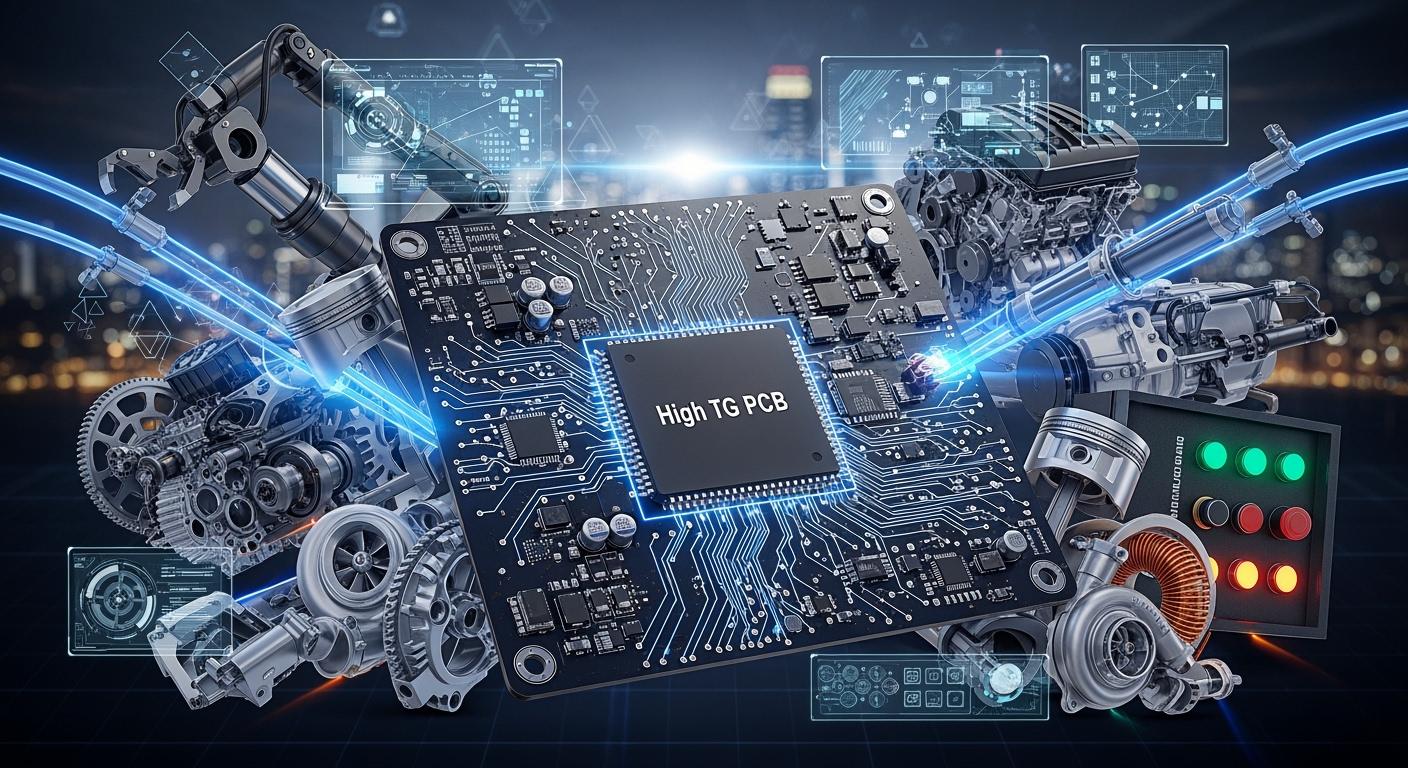
You work in tough places like cars and factories. High tg pcb is special because it can handle heat up to 170°C or more. This means your pcb can take more heat and stress than normal ones. You can check glass transition temperature with tools like Differential Scanning Calorimetry, Dynamic Mechanical Analysis, or Thermomechanical Analysis. Regular pcb does not work well in very hard conditions. If you pick high tg pcb, you get strong and steady performance for important jobs.
Key Takeaways
High TG PCBs can handle heat over 170°C. This makes them good for cars and factories.
Using high TG PCBs lowers the chance of problems. They help stop things like delamination and warping. This keeps them working well in tough places.
These boards are strong and stable in heat. This means they last longer and need fewer fixes.
Always look at the glass transition temperature (Tg). Check other details to make sure your PCB fits your needs.
High TG PCBs cost more at first. But they save money later by needing less fixing and fewer new parts.
High TG PCB Properties
What Is Glass Transition Temperature?
You should know about glass transition temperature, or Tg, when using fr-4 boards. Tg is the temperature where fr-4 changes from hard to soft. If the heat goes above Tg, fr-4 can bend or twist. This might cause problems like layers coming apart or cracks in your pcb. High tg pcb means the Tg is much higher than normal. Most regular fr-4 boards have a Tg between 130°C and 140°C. High tg fr-4 pcb types have Tg values of 170°C, 180°C, or even more. Some very high-temperature pcbs can have Tg values over 190°C.
Here is a table that shows the Tg ranges for different pcb types:
PCB Type | Tg Range (°C) |
|---|---|
Standard FR-4 | 130 - 140 |
Medium Tg | 150 - 160 |
High Tg | 170 - 180 |
Ultra High Tg | 190 - 200+ |
Extreme Tg | > 250 |
You can also see the difference in Tg values in this chart:
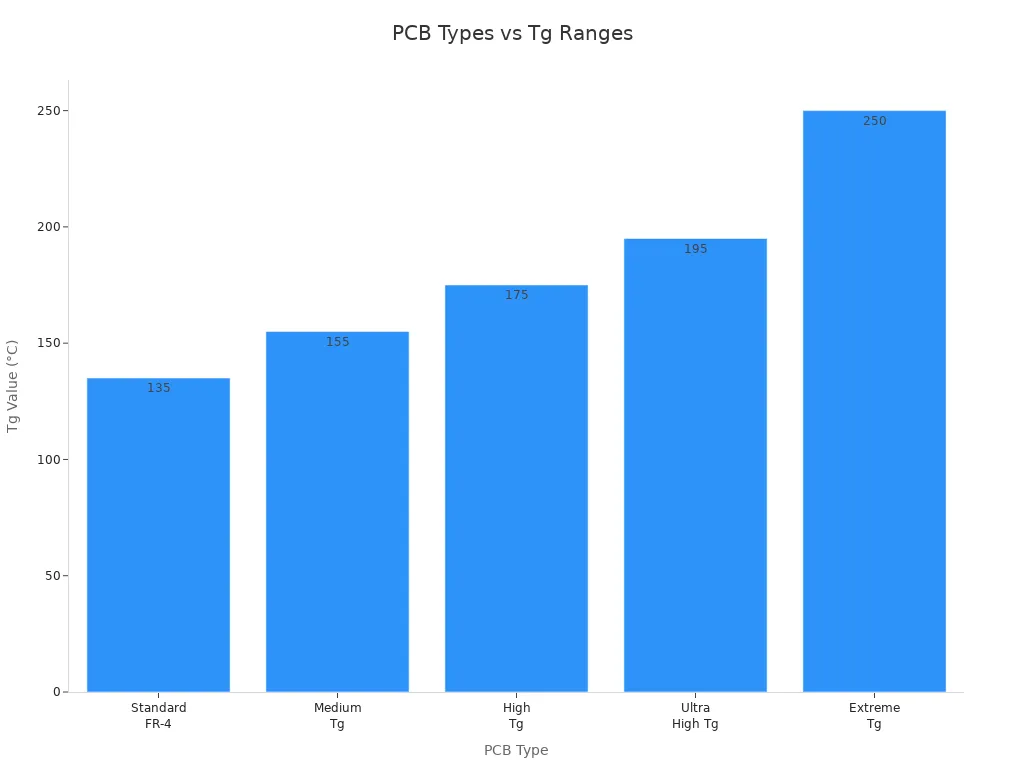
When you use high tg fr-4 pcb, it works better in high heat. The fr-4 stays strong and does not get soft or lose its shape, even when it is hot.
Material Characteristics
High tg pcb material has special features that help your pcb work well under stress. These materials help your pcb last longer and work better in hard places. Here are some important characteristics of high tg pcb material:
Characteristic | Contribution to Performance in High-Temperature Environments |
|---|---|
Higher Glass Transition Temperature (Tg) | Keeps the fr-4 stable at high heat, so it does not soften. |
Superior Thermal Stability | Holds up under thermal stress, so your pcb does not break down. |
Enhanced Mechanical Properties | Gives strength and durability, so your pcb does not fail easily. |
Excellent Electrical Characteristics | Keeps signals clear and reliable, even when it is hot. |
Increased Reliability Factors | Makes your pcb last longer and work the same every time. |
You can trust high tg fr-4 pcb to keep its shape and work well, even when the temperature is above 170°C. The materials used for high tg pcb manufacturing also help protect against chemicals. This means your pcb will not get ruined by harsh chemicals or water. High-temperature pcbs keep their electrical and mechanical strength, so you do not have to worry about sudden problems.
Suitability for Harsh Environments
You often work in tough places like cars and factories. High tg fr-4 pcb is great because it can handle these hard conditions. When you use high-temperature pcbs, you lower the chance of problems like bending, layers coming apart, or electrical trouble. The fr-4 in high tg pcb stands up to heat, shaking, and chemicals better than regular boards.
Common failure problems in high-temperature environments include:
Failure Mechanism | Description | Mitigation Strategy |
|---|---|---|
Delamination | Layers separate because of heat. | High tg fr-4 pcb improves thermal stability. |
Warping | Board bends and parts do not fit right. | Stronger mechanical properties help prevent this. |
Electrical insulation degradation | Insulation breaks down, causing shorts. | High tg fr-4 pcb keeps insulation strong. |
PTH barrel cracking | Holes crack from expansion and contraction. | High tg fr-4 pcb keeps its shape and size. |
You can see real results in the field. For example, one car company started using high tg fr-4 pcb and their circuits lasted 20-30% longer. They saved a lot of money each year because their boards did not break as much. High tg pcb also stands up to shaking and keeps signals clear, even when machines move. You get fewer breakdowns and spend less on repairs.
Tip: Always check that your high tg fr-4 pcb meets IPC standards. Tests like heating and cooling, checking small sections, and solder tests help make sure your board will last in tough places.
When you pick high tg fr-4 pcb, you get a board that can handle heat, stress, and chemicals. Your electronics stay safe and work well, even in the hardest jobs.
High TG PCB in Automotive Applications
Automotive Requirements
Cars need electronics that work well for a long time. Most car parts must last 10 to 12 years. These parts face heat, wet air, and shaking. Regular boards can break early from these things. High tg pcb can take more heat, so your circuits stay safe.
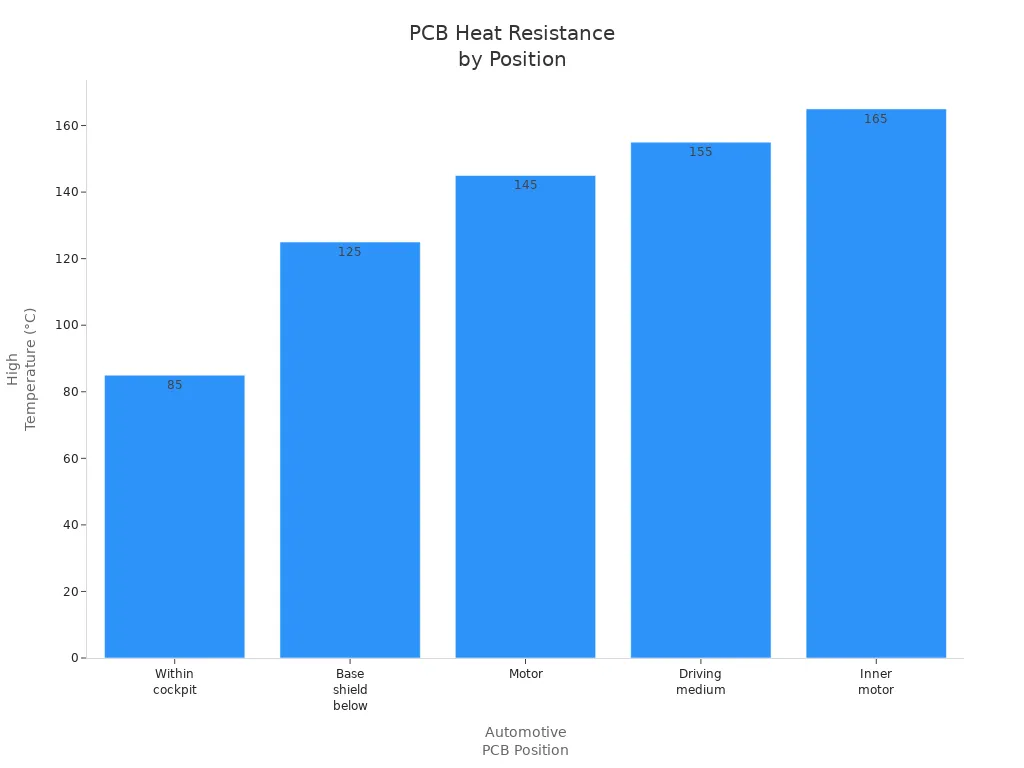
Different car parts use different pcb grades. Each spot in a car has its own heat range. Here is a table that shows the heat needs for each area:
Positions | Grade | Low Temperature | High Temperature |
|---|---|---|---|
Within cockpit | A | -40°C | 85°C |
Base shield below | B | -40°C | 125°C |
Motor | C | -40°C | 145°C |
Driving medium | D | -40°C | 155°C |
Inner motor | E | -40°C | 165°C |
You can see these heat limits in the chart below:
To make sure your pcb lasts, you should use tests like the Thermal Cycling Test, Thermal Shock Test, and Temperature-Humidity Bias Test. These tests help you check if your board can survive the real world.
Note: Car pcbs must keep working when the engine is hot or the weather changes fast. High tg pcb helps you meet these tough needs.
Use Cases in Vehicles
You can find high tg pcb in many car parts. These boards work where heat and shaking are common. Here are some examples:
On-board computers run many car systems.
Engine controllers, called ECUs, help the engine work right.
Sensors watch heat, speed, and other things.
Dashboards show info to the driver.
You pick high tg pcb for these jobs because it can take big heat changes and strong shaking. High tg materials have a Tg of 170°C or more. This keeps your board steady during heat cycles. The board does not bend or break when the heat goes up and down.
High tg materials also help your pcb stay cool. They keep the board working at least 25°C below the glass transition temperature. This stops the board from getting soft or failing when the engine or other parts get hot.
Performance Benefits
When you use high tg pcb in cars, you get better results and longer life. These boards have strong heat stability and keep their shape under stress. Here is a table that compares high tg pcb with regular boards:
Feature | High Tg PCBs | Standard PCBs |
|---|---|---|
Thermal Stability | Better thermal stability | Standard thermal properties |
Application Suitability | Suitable for high-stress areas | Less suitable for high-stress |
Cost Efficiency | Cost-effective for high-frequency | Generally lower cost |
High tg pcb lowers the chance of bending and insulation problems. You avoid cracks and material wear, especially in engine controllers where heat can go over 125°C. Regular boards often fail here because they cannot take the heat.
You get more reliable electronics in your car. Using high tg pcb helps you lower breakdowns and save on repairs. Your car works better, and you spend less time fixing things.
Tip: Always pick high tg pcb for engine controllers and other tough car systems. This gives you the best mix of safety, performance, and value.
High TG PCB for Industrial Use
Industrial Challenges
When you use pcb in factories, you face many problems. These places can be very hard on your boards. Here are some of the main problems:
Very hot or cold temperatures, from -40°C to 85°C, can make parts expand and sometimes break.
Machines shake and move a lot, which can make parts loose or crack the solder.
Wet air or water can cause rust and damage, leading to short circuits.
Motors and power systems can mess up signals and cause mistakes.
You need something strong for these tough places. High tg pcb gives you more strength and makes your boards last longer.
Common Applications
You see high tg pcb used in many factory jobs. These boards work well where normal boards might not. Some common uses are:
Power electronics like inverters and motor drives, where lots of heat is made.
Factory machines and robots that run all day and shake a lot.
Oil and gas jobs, where boards must fight off water and chemicals.
Aerospace and defense electronics, like airplane controls and missile systems, which need to work in very hard places.
Phone and internet stations that must work in any weather.
You count on high tg pcb to keep your machines working, even when things get rough.
Advantages Over Standard PCBs
High tg pcb is better than normal boards for factory use. Your electronics last longer and stay strong. Here are some main benefits:
High tg pcb can handle lots of heat without bending or getting weak.
These boards keep their shape, so you see less bending and fewer breaks.
They do not crack as much because they do not expand as much with heat.
High tg materials stop layers from coming apart and keep wires in place, even when it is hot.
You save money because you fix things less and your boards last longer.
Tip: Buying high tg pcb may cost more at first, but you save money later because you do not have to fix or replace boards as often.
You can trust high tg pcb to work well, even in your hardest factory jobs.
High TG vs. Standard PCB
Property Comparison
You should know how pcb materials act in different jobs. High TG boards use special stuff that makes them stronger and more stable. Standard boards are fine for easy jobs, but they do not last long in hard places. Here is a table that shows the main differences:
Property | High TG PCB | Standard PCB |
|---|---|---|
Glass Transition Temperature (Tg) | Exceeds 170°C | Typically 130-140°C |
Mechanical Strength | Higher | Lower |
Adhesion | Superior | Moderate |
Water Absorption | Lower | Higher |
Dimensional Stability | Excellent | Moderate |
Thermal Decomposition | Better performance at high temps | Lower performance |
Thermal Expansion | Low | Higher |
Applications | High power density, automotive | General electronics |
High TG materials are better when you need boards that can take heat. They last longer before layers come apart and do not grow much when hot. These boards also have strong plated through holes and good strength. You use them where heat and stress are big problems.
Performance in Extreme Conditions
When you use pcb in tough places, you want it to keep working. High TG boards stay strong and work right in heat or shaking. You see this in cars and planes, where machines get hot and move fast.
High TG boards have a higher glass transition temperature, so they last longer under heat.
They show better mechanical stability, which means fewer cracks or breaks.
These boards help prevent signal loss and keep insulation strong, even when the temperature rises.
You can trust them to work when standard boards might fail.
Tip: Pick high TG materials if your pcb faces heat or stress. This helps your electronics stay safe and work well.
You feel better knowing your machines will keep running, even in the hardest places.
Selecting High TG PCB
Temperature and Reliability
You need to check some features if you want your pcb to last in tough places. Look for these important things:
Glass Transition Temperature (Tg): This shows when the resin gets soft. A higher Tg keeps your board safer from heat.
Coefficient of Thermal Expansion (CTE): Low and steady CTE keeps your vias strong. It helps your board stay reliable.
Decomposition Temperature (Td): This stops the board from breaking during hot soldering.
T288: This tells you how well the laminate stays together at high heat.
Conductive Anodic Filament (CAF) Resistance: This protects your circuits from inside problems.
Dielectric Constant and Loss Tangent: These keep your signals clear, even when the board is hot.
Moisture Absorption: Low moisture means less risk of layers coming apart during soldering.
Tip: Always match the board’s Tg and Td to your highest working temperature. This helps your pcb stay strong and safe.
Cost and Supplier Choice
High-performance boards cost more than regular ones. The price is higher because the materials are better and last longer. When you pick a supplier, ask if they have experience with tough boards. Make sure they follow safety rules and can show test results. Some suppliers use safer materials for the planet, like polyimide or LCP. These do not have harmful flame retardants. These boards also use less energy to make and create less waste.
Here is a table to help you compare what matters:
Property | Importance |
|---|---|
Cost | Impacts your budget for large projects |
Material Composition | Safer materials mean less harm to the planet |
Supplier Experience | Good suppliers give you better quality |
Environmental Impact | Less waste and lower energy use |
Manufacturing and Design Tips
You can make your pcb stronger by following some easy steps. Pick parts that can handle high heat, like industrial or military-grade components. Handle the board carefully when drilling and cutting. Use sharp tools and slow speeds to stop the board from coming apart. Always follow the right times and temperatures when making the board.
Try these design ideas:
Use copper planes and thermal vias to move heat away.
Make the board thicker to stop it from bending.
Change trace widths and spacing to keep signals clear.
Remember: Good design and careful work help your pcb last longer and work better.
You need strong and steady pcb for hard car and factory work. These boards last longer and do not break easily. They can handle heat and stay in shape. Here is a table that shows why these things are good:
Benefit | Why It Matters |
|---|---|
Dimensional Stability | Stops the board from bending or failing |
Thermal Stress Resistance | Handles hot and cold without problems |
Extended Lifespan | Saves money on fixing or changing boards |
When picking a pcb, look at things like glass transition temperature, how well it moves heat, and if it can stop fire. Watch for new ideas, like green materials and smart tech, to keep your boards up to date.
FAQ
What does "High TG" mean in a PCB?
"High TG" means the board can handle higher temperatures before it gets soft. You use these boards when your electronics face heat above 170°C. High TG keeps your circuits safe and strong.
When should you choose a High TG PCB?
You should pick a High TG PCB if your device works in hot places, like cars or factories. These boards last longer and resist damage from heat, shaking, and chemicals.
Can High TG PCBs improve reliability?
Yes! High TG PCBs help your electronics last longer. They stop cracks, bending, and layer separation. You get fewer breakdowns and save money on repairs.
Are High TG PCBs more expensive?
High TG PCBs usually cost more than standard boards. You pay more at first, but you save money later because you fix or replace boards less often.
How do you check if a PCB is High TG?
You can check the datasheet for the Tg value. Look for numbers like 170°C or higher. If you see these, you know you have a High TG PCB.
See Also
Exceptional High TG FR4 PCBs for Extreme Temperature Use
Diverse Applications of Multilayer PCBs in Various Sectors
Seven Essential Steps for Quality Heavy Copper PCB Assembly
Understanding High-Speed PCBs and Their Importance
Comprehensive Guide to Heavy Copper Multilayer PCB Production
