PCB Material Cost Control With Stable Inventory

You pay a lot for PCB manufacturing. PCB material cost control is crucial, as material costs, like Copper Clad Laminate, can account for 30% to 40% of your total expenses. In some cases, they can even reach 66%. To keep your business strong, you must focus on controlling PCB material costs. In PCBA production, maintaining a steady inventory is just as important as managing price. By keeping extra critical materials on hand, you can prevent production from halting. Effective PCB inventory management aids in balancing storage costs with the risk of work stoppages. With the right amount of inventory, you waste less and save money. These strategies ensure your PCBA line continues to operate smoothly and helps you achieve your goals.
You gain these benefits in PCBA when you:
Prevent production from halting with steady inventory.
Reduce waste by managing materials effectively.
Balance storage costs with a reliable supply.
Key Takeaways
Keep PCB material costs low by having a steady inventory. This stops work from stopping and cuts down on waste.
Use tools like Material Requirements Planning (MRP) to guess what materials you need. These tools help you keep the right amount of inventory.
Try ABC analysis to help manage your inventory. Pay more attention to important items to save time and money.
Use the Economic Order Quantity (EOQ) formula to find the best order size. This helps balance the cost of ordering and storing materials.
Check your inventory and suppliers often. This helps you adjust to changes and keep PCB production running well.
Setting PCB Inventory Levels
You must pick the right amount of inventory for your custom pcb. This helps you stop shortages and keeps your pcba line working. You also save money by not keeping too much material. Good pcb inventory management uses facts and numbers to help you decide. These ways help you keep enough stock and save money.
Data-Driven Inventory Planning
You can use data to plan your custom pcb materials. This way uses real numbers, not guesses. First, you collect data about orders, how fast you make things, and how long suppliers take. Material Requirements Planning (MRP) systems help you know what you need and when. MRP makes sure you have enough material for pcba but not too much. You can also use special systems that use tools like the CPLEX optimization engine. These tools make plans using your real and future orders. This helps you use your materials well and stop slowdowns.
You can use these data-driven ways for custom pcb inventory:
Material Requirements Planning (MRP) for guessing demand and planning.
Optimization engines to make big plans and schedules.
Inventory control systems that watch supplier work and material use.
When you use these tools, you keep your custom pcb inventory just right. You do not have too little or too much. You also save money and keep your pcba line moving.
ABC Analysis in PCB Inventory Management
ABC analysis helps you pay attention to the most important custom pcb materials. You put your inventory into three groups: A, B, and C. Category A items are not many but cost the most. Category B items are in the middle for number and value. Category C items are many but do not cost much.
Item Category | Percentage of Items | Percentage of Value |
|---|---|---|
A | 20% | 80% |
B | 30% | 15% |
C | 50% | 5% |
A small electronics store used ABC analysis for their custom pcb inventory. They checked sales data every month. They bought A-items every week, B-items every two weeks, and C-items every three months. This helped them save 25% on ordering costs. You can use this way for your custom pcb materials. You spend more time on A-items. You check B-items less. You look at C-items only when needed. This way saves you time and money.
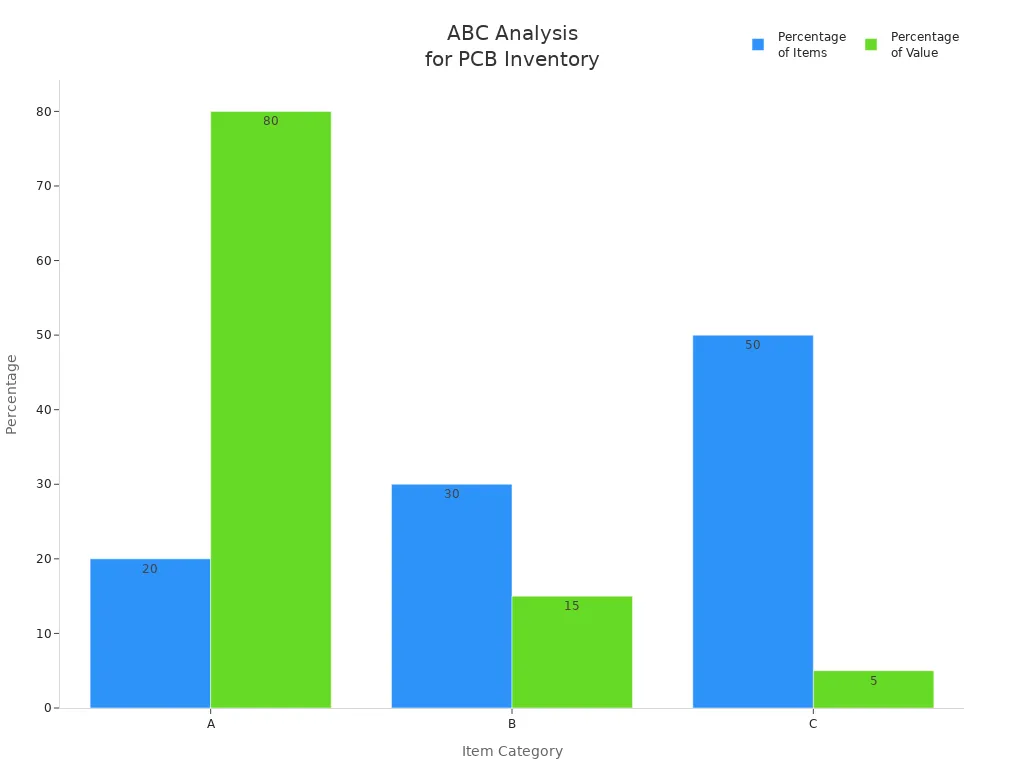
When you use ABC analysis, you make your custom pcb inventory work better. You focus where it matters most. You also save money and keep your pcba production steady.
Economic Order Quantity (EOQ) for PCB Materials
You can use the Economic Order Quantity (EOQ) formula to know how much material to buy for your custom pcb. EOQ helps you find the best order size. This size keeps your buying and storing costs low. You use EOQ to stop running out of material and to avoid having too much.
The EOQ formula looks like this:
EOQ = √((2 × Demand × Order Cost) / Holding Cost)
You start by finding out how much custom pcb material you need. Then you check how much it costs to order and store material. You put these numbers in the formula. The answer tells you how much to order each time.
EOQ works best when your custom pcb demand stays the same. If your demand changes a lot, you may need to change your order size. You can use EOQ with your MRP system for even better results. This helps you keep your custom pcb inventory just right.
Tip: Check your EOQ numbers every three months. Changes in demand or costs can change your results. Checking often helps you keep your custom pcb inventory working well.
Balancing Stock Availability With Cost Efficiency
You face many problems when you try to keep enough stock and save money in custom pcb production. You need to stop having too much inventory, stop old material from going bad, and make sure your guesses are right. You can use better guessing tools and warehouse tricks to stop having too much. You match engineering changes with your inventory use. You also check your stock every three months.
Challenge | Solution |
|---|---|
Managing excess inventory | Better guessing and warehouse tricks |
Preventing obsolescence | Match engineering changes and check every three months |
Ensuring accurate forecasting | Use AI guessing and connect tracking tools with ERP systems |
Problems in the world supply chain can also change your custom pcb inventory plans. You may wait longer for shipping, pay more, and have fewer supplier choices. You can fix this by using more suppliers and using two sources for important custom pcb materials. You can also keep more safety stock for key items and use demand-based restocking for others. This mix helps you stay ready and keep your pcba line working.
To make your custom pcb inventory plans stronger:
Use suppliers from different places.
Use two sources for important materials.
Keep more safety stock for key custom pcb items.
Use demand-based restocking for less important materials.
Check shipping and make sure you have space.
You can use these steps to keep your custom pcb inventory steady. You also save money and help your pcba production run smoothly.
PCB Material Cost Control Strategies
Identifying PCB Cost Drivers
You should know what makes pcb cost more. Picking different materials changes the price. Some materials, like FR4, are cheaper. Others, like RO4350B, cost more because they work better for high-frequency jobs. If the substrate is thicker, the pcb costs more. Copper foil thickness matters too. Most copper is 35μm thick. High-power pcba needs thicker copper, which costs more. Special laminates for EMI shielding or thermal management also raise the price.
Main pcb cost drivers in material sourcing:
The material you pick changes the price.
High-frequency materials cost more money.
Thicker substrates make pcb cost go up.
Copper foil thickness changes the price.
Special laminates make pcb cost higher.
You need to think about these things when you buy materials. If you pick the right material, you can control pcb cost and keep pcba cost low. This also helps your inventory stay steady. When you pay attention to these cost drivers, you make better choices when buying materials and parts.
Minimizing PCB Layer Count for Cost Savings
You can save money by using fewer layers in your pcb design. Studies show that using less layers can save 20-30% on pcb cost. Fewer layers mean you use less material. You also spend less on labor for building and checking the pcb. Simple pcb designs make pcba easier and faster.
Tip: Talk with your engineering team about your pcb design. Try to use fewer layers but keep good performance. This helps you reach your pcb material cost control goals.
You save a lot of money when you use simple pcb designs. It also makes inventory management easier. Using less material means you spend less on storage and moving things. You keep pcba cost low and make your work smoother.
Total Cost of Ownership in PCB Sourcing
You should look at more than just the price when you buy materials. Total Cost of Ownership (TCO) helps you see all the costs in pcb sourcing. TCO includes both direct and hidden costs. You can avoid mistakes by not picking suppliers who seem cheap but have hidden costs. TCO helps you make smart choices when buying materials and parts.
Aspect | Impact on Sourcing Decisions |
|---|---|
Comprehensive Financial View | Shows all costs, so you can make better choices. |
Avoiding Low Upfront Costs | Stops you from picking suppliers with hidden costs. |
Enhanced Supply Chain Efficiency | Helps you make choices that improve your supply chain. |
Long-term Profitability | Focuses on growing your business for a long time. |
TCO helps you find hidden costs from bad quality or late deliveries. You see more than just the price. You pick suppliers who help you save money over time. This makes pcb material cost control stronger. You build a supply chain that keeps your pcba production steady and your inventory reliable.
Note: Always check TCO when you look at buying options. This helps you avoid mistakes in pcb inventory management, like not using data or not checking inventory. Checking often and talking with suppliers keeps your inventory right and your pcba line running.
You make better choices when you use TCO. You control pcb cost, buy smarter, and help your business grow. You also keep your inventory steady and your pcba cost low.
Storage Best Practices for PCB Materials
Preventing Loss and Damage
You must keep your pcb materials safe from harm. Good storage helps your pcba line keep working. It also helps you control costs and inventory. You can use special coatings to protect your pcb from damage. The table below shows how each coating works:
Coating Material | Performance Ranking | Key Findings |
|---|---|---|
Epoxy Coatings | 1 | Best at stopping PCB damage on surfaces. |
Polyurethane Coatings | 2 | Works moderately well against PCB harm. |
Latex Paint | 3 | Less effective than epoxy and polyurethane. |
Petroleum-based Paint | 4 | Worst at protecting PCBs. |
Pick the best coating to lower the risk of damage. Check the seals on storage boxes often. Fix or replace any broken seals right away. This keeps out water and dust. Use drying agents like silica gel to keep the air dry. Change these agents often because they stop working over time. Use tools to watch the temperature and humidity. This stops water from hurting your pcb materials.
Tip: Storing things well lowers loss and keeps your pcba price steady.
Ensuring Material Quality and Traceability
You must keep your pcb materials safe and easy to find. This helps you follow rules and keep your pcba inventory strong. Many industries have strict rules for material management. The table below lists some common standards:
Compliance Framework | Description |
|---|---|
ISO 13485 | Needed for medical devices. Focuses on risk and product safety. |
AS9100 | Used in aerospace. Controls process and traceability. |
ITAR and Export Control | Protects data and defense products. |
IPC Standards (Class II and III) | Sets rules for high-reliability electronics. |
You need to follow these rules to avoid shipment and cost problems. Keep good records so you can track each pcb material. Use barcode systems or digital logs for better inventory management. This makes it easy to find and check materials. You protect your business from mistakes and keep your pcba cost under control.
Note: Following standards keeps your inventory safe and your management strong.
Technology in PCB Inventory Management
Real-Time Tracking Solutions
You can use real-time tracking to see your pcb and pcba inventory at any moment. This technology helps you know where every material sits in your warehouse. You scan barcodes or use RFID tags to update your system right away. This makes it easy to find missing items and stop mix-ups. You also lower the risk of running out of important material. When you track your pcb and pcba inventory in real time, you react fast to changes in demand or supply.
Many companies want to know if this technology is worth the price. You can measure the return on investment by looking at how much you spend and how much you save each year. For example, if you invest $10,000 in a new system and save $30,000 in one year, your return is 200%. For every dollar you spend, you get two dollars back.
Description | Example | Calculation |
|---|---|---|
Investment in Optimization | $10,000 | - |
Annual Savings | $30,000 | - |
ROI Calculation | - | ROI = [($30,000 - $10,000) / $10,000] x 100 = 200% |
ROI Interpretation | For every dollar spent, the return is $2 | - |
You see the value of real-time tracking when you keep your pcb and pcba inventory steady and your material price low.
Forecasting Tools for PCB Demand
You can use forecasting tools to guess how much pcb and pcba material you will need. These tools look at past data and spot trends. You get better at planning your inventory and avoid buying too much or too little. Good forecasting helps you keep your price under control and your pcba line running.
Some forecasting tools use smart software to check sales, orders, and market changes. You can set alerts when your material gets low. You also see when the price of pcb or pcba material might go up. This helps you buy at the right time and save money. With strong forecasting, you make better choices for your inventory and keep your management simple.
Tip: Try different forecasting tools to see which one fits your pcb and pcba needs best. This keeps your material price steady and your inventory strong.
Managing Obsolescence and Excess Inventory
Identifying At-Risk PCB Materials
You need to find which pcb materials might become outdated. This helps you keep your inventory steady. It also keeps your pcba production safe. Start by talking with your suppliers. They can share news about new trends and changes. You should check the lifecycle status of each material. If a component is almost done, you must plan ahead.
You can follow these steps to spot at-risk pcb materials:
Look at the Estimated Annual Usage (EAU) for each pcb material. Compare it to how fast you use the part. Also check how many makers still produce it.
See how losing a material affects your system. If a key pcb part stops working, your pcba line may stop.
Use flexible technologies like FPGA. These help you change when a component changes or disappears.
You can also work with suppliers to get many kinds of pcb materials. Make plans for emergencies. You might keep extra important parts or sign long-term supply deals. Keep checking the lifecycle of important materials. This helps you stay ready and avoid sudden shortages.
Tip: Talking with suppliers and checking material status often helps you manage obsolescence.
Reducing Surplus and Waste
You can save money and space by cutting extra inventory. Too much pcb material leads to waste and higher storage costs. You need smart management to keep your inventory balanced.
Try these ways to cut surplus:
Use forecasting tools to guess how much pcb material you need for pcba production.
Set clear reorder points for each material. This stops you from buying too much.
Check your inventory often. Remove old or unused pcb materials before they expire.
Work with suppliers to return or recycle extra materials.
Action | Benefit |
|---|---|
Forecasting demand | Less surplus, steady inventory |
Setting reorder points | Stops overbuying |
Regular reviews | Removes expired materials |
Supplier collaboration | Returns or recycles waste |
You keep your inventory healthy by following these steps. You also lower your cost and make your management stronger. Cutting extra inventory helps your pcba line run smoothly and keeps your business growing.
Lean and Just-In-Time PCB Inventory
Lean Inventory Principles for PCB
You can make your pcb production better by using lean inventory principles. These ideas help you cut waste and keep your material flow smooth. You start by mapping out each step in your process. This shows you which steps add value and which do not. You can then remove steps that waste time or material.
Value stream mapping helps you see where you lose time or material.
Just-in-time production lets you match your pcb output to what customers need.
Continuous improvement, or Kaizen, means you look for small ways to get better every day.
Pull systems let you make pcb only when someone asks for it, so you do not build up extra inventory.
Visual management uses signs and charts to show how your pcb line is doing.
When you use these lean ideas, you keep your material levels low and your inventory under control. You also make your pcb line faster and more reliable.
Just-In-Time Delivery in PCB Manufacturing
Just-in-time inventory helps you get material only when you need it. This method keeps your storage space open and your costs down. You do not tie up money in extra inventory. You also lower the risk of material going bad before you use it.
Benefit | Description |
|---|---|
Lower Costs | You pay less to store material and keep inventory. |
Reduce Working Capital | You use less money for buying and holding material. |
Lower Holding Costs | You need less space for storing pcb material. |
Lower Cash Investment | You keep more cash free for other needs. |
Improve Quality | You focus on good pcb, so you have fewer defects. |
Improved Efficiency | You do not waste time or space on extra material. |
Waste Reduction | You do not order more than you need for your pcb line. |
Greater Productivity | You make more pcb with less effort and less material. |
You see many gains from just-in-time inventory. You cut inventory costs, reduce waste, and improve your cash flow. Your pcb production becomes more flexible. You can react fast to changes in demand. This makes your material management strong and keeps your business ready for growth.
Warehouse Organization and Workflow
Optimizing Storage Layout for PCB Materials
You can make your warehouse better by planning where things go. Put the most-used materials close to where people work. This helps you grab items quickly and check inventory easily. Label every shelf and bin so you know what is inside. Use color codes for different pcb materials. This makes it easy to spot what you need.
Keep heavy materials on the lower shelves. Put lighter pcb materials higher up. This keeps your team safe and stops things from breaking. Make a map of your warehouse to show where each material is. Change the map if you move things around. A good layout saves time and helps you control inventory.
Tip: Look at your storage layout every few months. Even small changes can help your warehouse work better.
Streamlining Material Handling
You can make your warehouse better by moving materials in simple ways. Use carts or trolleys to take pcb materials to the production line. This helps stop drops and damage. Make clear paths in your warehouse. Mark these paths so your team knows where to walk and move things.
Teach your team the best ways to handle pcb materials. Show them how to lift and carry items safely. Use checklists to track each step when handling materials. This helps you keep inventory right and manage things well.
Step | Benefit |
|---|---|
Use carts/trolleys | Faster, safer movement |
Mark warehouse paths | Fewer mistakes |
Train your team | Less damage, better care |
Use checklists | Accurate inventory |
You keep your warehouse working well by following these steps. Good material handling saves money and keeps your pcb inventory in good shape.
Continuous Improvement in PCB Inventory Management
Key Performance Indicators (KPIs) for PCB Inventory
You need to watch the right numbers to see how your pcb inventory is doing. Key Performance Indicators, or KPIs, help you measure how things are going and find ways to get better. Some KPIs you can use are inventory turnover rate, stock accuracy, and material usage efficiency. Inventory turnover rate tells you how fast you use and replace materials. Stock accuracy shows if your records match what you really have. Material usage efficiency lets you see if you are wasting less material when making pcb.
KPI Name | What It Measures | Why It Matters |
|---|---|---|
Inventory Turnover Rate | How quickly you use inventory | Shows efficiency |
Stock Accuracy | Match between records and stock | Prevents shortages |
Material Usage Efficiency | Waste during pcb production | Reduces cost |
Tip: Make clear goals for each KPI. Check them every month to keep your pcb inventory working well.
Regular Review and Adjustment
You should check your pcb inventory often to find ways to make it better. Start by looking at your KPIs. Watch for patterns that show problems or good results. If your inventory turnover is low, you might need to change how you order materials. If you see a lot of waste, you should work on handling materials better. You can ask your team for ideas to fix problems in inventory management.
Here is a checklist for regular review:
Check inventory levels and see if they meet your goals.
Look at how much material you use and waste.
Update your records to make sure they are correct.
Ask your team for ways to improve.
You can use these steps to keep getting better. Change your process when you find problems. Try new ideas to make your pcb inventory stronger. Small changes can help a lot over time. This builds a system that keeps your materials moving and your costs down.
Note: Getting better all the time helps you stay ahead in pcb production. You keep your inventory healthy and your management strong.
You can keep pcb material cost low and your inventory steady by following simple steps. Try these ideas:
Use fewer pcb layers and pick standard sizes.
Do not make designs too complex and choose common parts.
Use the whole panel and do not change designs too much.
Plan pcb orders in bigger amounts and do not rush shipping.
Talk with manufacturers and look at different prices.
If you follow these pcb material and inventory tips, your production will be more reliable and your work will run better. Check your pcb inventory often so you can keep getting better.
FAQ
What is the best way to keep pcb material costs low?
You should plan with real data and pick standard materials. Work with suppliers you trust. Check your inventory often. This stops waste and keeps pcb costs low.
How do you prevent pcb material shortages?
Set safety stock levels and use real-time tracking tools. Make sure your supplier is reliable. Plan for possible delays. These steps help your pcb line keep running.
Why does pcb inventory turnover matter?
Inventory turnover tells how fast you use and replace pcb materials. High turnover means you manage stock well. Low turnover can cause waste and higher costs.
How can you reduce waste in pcb inventory?
Use forecasting tools and set clear reorder points. Take out old pcb materials before they expire. Work with suppliers to recycle or return extra stock.
What tools help you manage pcb inventory?
You can use MRP systems, barcode tracking, and forecasting software. These tools help you track pcb materials, plan orders, and keep inventory steady.
See Also
Effective Ways to Reduce Expenses in Custom PCB Creation
Best Approaches to Lower Back Drilling Costs for HDI PCBs
Understanding the Process of PCB Manufacturing
Comprehensive Guide to Rigid PCB Production and Standards
Essential Techniques for Achieving Quality Control in PCB Production
