Unlocking Fast PCB Production with High TG FR4 Materials in 2026
You need fast PCB production to stay ahead in 2026. High TG FR4 materials help you finish work on time. They handle heat and stress better than regular materials. Your choice of material can mean success or delay. Many industries use High TG FR4 for strong and long-lasting products.
More people want these materials now.
Medical electronics, industrial automation, and car systems use them more each year.
Halogen-free substrates are becoming the new normal.
Having high-performance materials ready cuts wait times and makes your project more reliable.
Key Takeaways
High TG FR4 materials help PCBs work better by handling more heat. This makes them reliable in tough places.
Using High TG FR4 laminates that are already in stock makes production faster. It helps finish projects on time without waiting.
Picking the right High TG FR4 means thinking about how hot it gets, how it works with signals, and if it meets rules.
High TG FR4 is used more now in cars and medical devices. It is important for new PCB uses.
To avoid problems, make sure to manage heat well and control impedance. This keeps signals strong in fast PCB designs.
High TG FR4 Material Basics
What Is High TG FR4?
It is important to know how High TG FR4 is not like regular materials. High TG FR4 is a special flame-retardant epoxy laminate. It has a much higher glass transition temperature, called Tg, than normal FR4. Tg is the temperature where the material goes from hard to bendy. Regular FR4 has a Tg of about 130 to 140°C. High TG FR4 can take heat from 170°C to over 200°C. This means your pcb will not bend or get weak when it gets hot. High TG FR4 also fights off chemicals and stays strong under pressure. These things make it a great pick for printed circuit board materials in tough places.
Key Properties and Tg Values
You can look at the table below to see how standard and High TG FR4 are different:
Property | Standard FR-4 | High Tg FR-4 (≥170°C) | Key Advantage for High Tg |
|---|---|---|---|
Glass Transition (Tg) | 130–140°C | 170–180°C+ | Higher safe operating temperature and multiple reflow capability |
Decomposition Temperature (Td) | 310–320°C | ≥340°C | Survives lead-free soldering peaks (240–260°C) with margin |
T288 (Time to Delamination at 288°C) | ~5 minutes | 15+ minutes | Superior resistance to thermal shock and delamination |
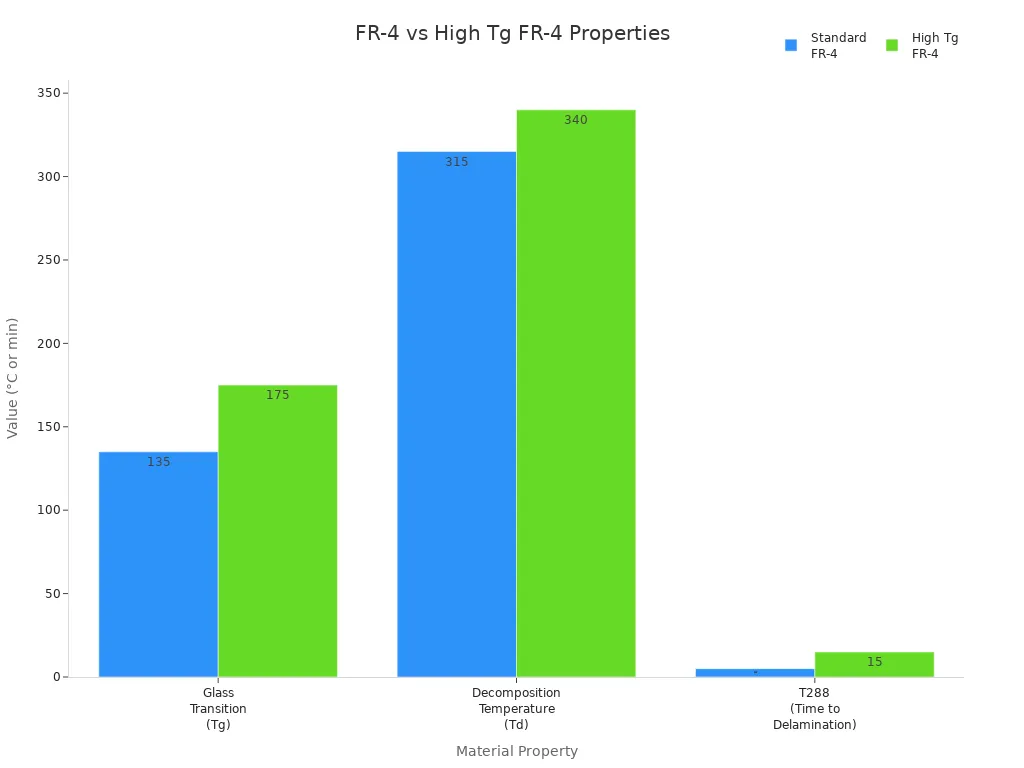
You will often see materials like Shengyi S1165 and Kingboard KB6167G used for High TG FR4. These materials follow strict industry rules, like IPC-4101 /126 or /129, which need a Tg of at least 170°C. This makes sure your pcb can handle high heat during making and use.
Applications in PCB Manufacturing
High TG FR4 is used in many industries that need strong and steady performance. Some examples are:
Aerospace: Electronics must work in very hot and cold places.
Automotive: Electric cars and power units make a lot of heat.
Medical: Machines like CT and MRI scanners must always work well.
Telecommunications: 5G base stations and antennas get very hot.
Industrial: Factory machines and control systems need to stay stable.
You can count on High TG FR4 to keep your pcb safe and working in these hard jobs. Its ability to handle heat, stay strong, and be reliable makes it the best choice for advanced uses.
High TG FR4 and Fast PCB Production
Thermal Performance and Reliability
Printed circuit boards must handle heat and stress. High TG FR4 materials help with this. Their glass transition temperature is between 170 and 180 degrees Celsius. This high Tg keeps boards strong when they get hot. The low coefficient of thermal expansion is under 70 ppm per degree Celsius. This helps your pcb stay stable during fast pcb production. You can use these materials with lead-free soldering. Lead-free soldering can reach up to 260 degrees Celsius. Your printed circuit boards will not bend or break during these hard steps.
High TG FR4 is better than standard options. You can see the differences in the table below:
Property | High TG FR4 | Standard FR4 |
|---|---|---|
Thermal Stability | Superior, extended Td | Lower thermal stability |
Mechanical Strength | Enhanced, higher modulus | Standard strength |
Warpage Resistance | Reduced warpage | Higher warpage risk |
Dimensional Stability | Improved, critical for fine-pitch | Standard stability |
Chemical Resistance | Better against cleaning solvents | Standard resistance |
Field Life | Extended in high-stress environments | Shorter lifespan |
You should use high TG FR4 for boards that get hot and cold a lot. These materials are also good for designs with many BGA packages or high-current traces. You get better size stability, less bending, and longer use time. This makes your printed circuit boards work better in fast and tough jobs.
Manufacturability and Process Stability
Fast pcb production needs materials that can handle quick changes. High TG FR4 gives you high heat resistance and strong PTH reliability. The low Z-axis expansion means your board will not break or come apart during heat. You can trust these materials for multilayer and HDI printed circuit boards. They keep their shape and strength during fast pcb production.
High TG FR4 gives you:
High thermal shock resistance
Great thermal stress resistance
More stability for complex pcb designs
You will see fewer problems and more good boards in your pcb making. High TG FR4 lowers Z-axis expansion stress. This helps stop via cracking and delamination. This is important for printed circuit boards that get hot and cold many times. Your making process is smoother, and you get boards you can trust.
Stocked Materials and Lead Time Reduction
You want to finish your projects fast. Using stocked high TG FR4 laminate helps you save time. When you pick materials that are ready, you do not wait for special orders. This makes fast pcb production quicker and helps you meet deadlines.
Here is how high TG FR4 helps with fast prototyping and short runs:
Feature | Description |
|---|---|
Thermal Stability | High TG FR4 materials provide excellent thermal stability for fast pcb production. |
Mechanical Strength | These materials ensure reliability during rapid prototyping. |
Quick Turnaround | High TG FR4 supports fast production cycles while maintaining quality. |
You can trust high TG FR4 laminate to keep your printed circuit boards strong and steady. This is true even when you need to work fast. Stocked materials help you avoid waiting and keep your work on track. Your boards will work well in tough places and fast jobs.
Tip: Always ask your supplier if high TG FR4 materials are in stock. This helps you plan your fast pcb production and avoid delays.
Selecting High TG FR4 for PCB Projects
Selection Criteria for Applications
You must pick the right High TG FR4 for your pcb. First, think about what your board will go through. Here are some things to think about:
Operating temperature range: Choose a material that can take the heat your device will have.
Frequency performance: Pick materials with low dissipation factor for fast circuits. This keeps signals clear.
Cost considerations: Try to balance your money and what you need. High TG FR4 costs more, but it works better in hard jobs.
Compliance and certifications: Make sure your material follows rules like IPC and UL. This keeps your board safe and reliable.
You should also check your material’s quality before using it. Look at certificates, check the material, and test things like thickness and solderability.
Availability, Cost, and Supplier Factors
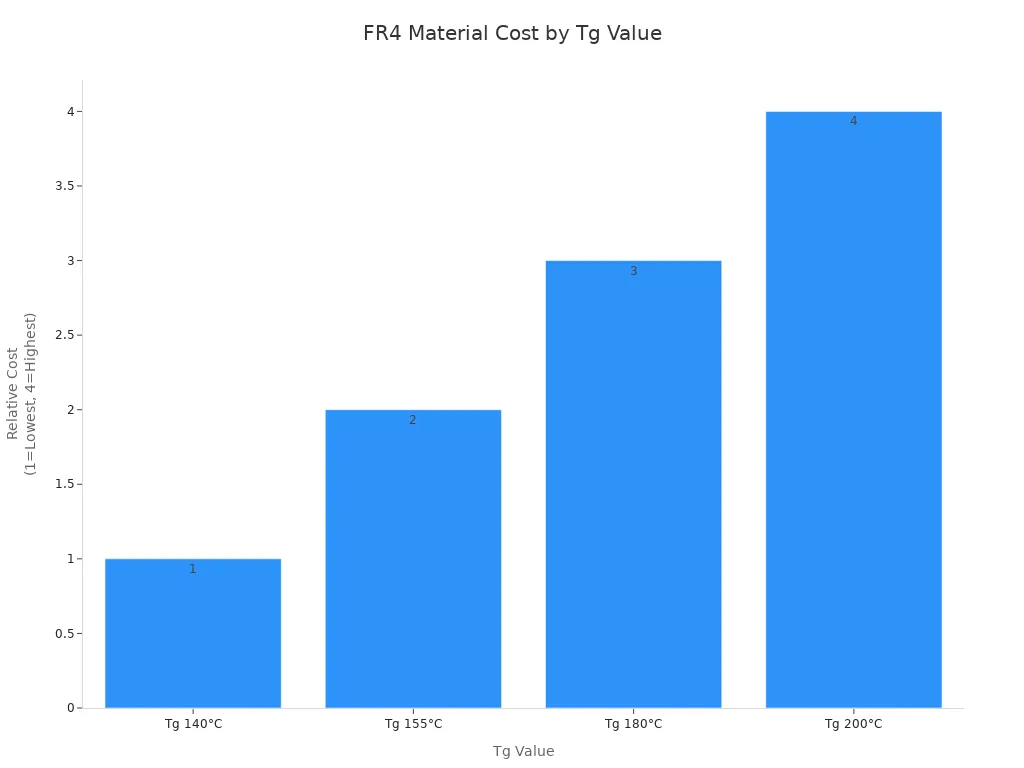
You want to finish your pcb on time and not spend too much. It is important to have materials in stock. High TG FR4 is easier to find now, but higher Tg means higher prices. See this table to compare costs:
Tg Value | Description | Cost Comparison |
|---|---|---|
Tg 140°C | Used in consumer electronics | Lowest cost |
Tg 155°C | Better for industrial use | Moderate cost |
Tg 180°C | For high-performance applications | Higher cost |
Tg 200°C | For aerospace and military | Highest cost |
You should talk to suppliers early. This helps you get the right material and control costs. Some good suppliers are WellPCB, TTM Technologies, and Unimicron Technology. They give good service and fast shipping.
Compatibility with Modern PCB Needs
Modern electronics need special features. High TG FR4 works with microvias, dense BGA routing, and controlled impedance. These are important for HDI designs. Many projects now need halogen-free materials. High TG FR4 can do this if you pick the right kind. Look for materials that follow IPC-4101E and IEC 61249-2-21 rules. This makes sure your board is safe and follows the rules.
Tip: Always check if your High TG FR4 is halogen-free and certified. This helps your project follow new industry and environmental rules.
Practical Tips and Common Pitfalls
Sourcing and Usage Challenges
You might have some problems when getting High TG FR4 for your pcb. The table below lists the main problems and what they mean for you:
Challenge | Description |
|---|---|
Higher Material and Processing Costs | High TG materials cost more. They need special tools and handle heat better. |
Processing Complexity and Brittleness | High TG materials are harder and break easier. This makes drilling and cutting tough. |
Lamination and Thermal Stress | You must control lamination closely to stop defects. This is very important for multilayer boards. |
Thermal Management in Soldering | Soldering gets very hot and can stress the material. You need to use careful methods. |
You also need to watch out for price changes and new green rules. Other materials and new rules can change your choices and costs.
Mistakes to Avoid in Fast PCB Production
There are some mistakes you should not make with High TG FR4. Many people forget about signal quality and heat control. If you do not control impedance, signals can bounce back. This is bad for fast designs. Not watching heat can make things too hot, especially with lead-free soldering. These mistakes can make your pcb less reliable and hurt its dielectric properties.
Best Practices for Reliable Results
You can follow these steps to get good results with High TG FR4:
Pick materials with a glass transition temperature over 180°C for better strength.
Use materials with low thermal expansion to lower stress.
Use thicker copper to help move heat away.
Put thermal vias near hot parts to move heat out.
Add heat sinks or fans to cool important spots.
Make sure air can move well over heat sinks to stop hot spots.
Use wide power traces to carry more current and spread heat.
For even better results, pick materials with a decomposition temperature of 340°C or more. Check that your materials meet IPC rules for reliability. Change your press cycles and drilling for the harder resin. Always test your materials for heat and dielectric properties before making lots of boards.
Tip: Good planning and testing help you avoid mistakes and keep your pcb work on track.
You get faster and stronger PCBs with High TG FR4. These materials make your boards tough and help them last longer. They also protect your boards from chemicals and heat. You stay ahead by picking good materials and making sure they are in stock.
More people want high-performance materials each year.
Being eco-friendly is more important now.
Checking your materials often helps you follow new rules.
Work with trusted suppliers and learn about new High TG FR4 features. This keeps your supply chain safe and your projects running well in 2026.
FAQ
What makes High TG FR4 laminate material better for fast pcb production?
High TG FR4 laminate material is good at handling heat. It does not get weak when the temperature changes fast. You can trust it to keep your pcb strong. It helps you finish your work faster and keeps your boards safe.
How do you choose the right laminate material for your project?
Think about how hot your pcb will get. Check if the material is strong and fights off chemicals. Ask your supplier if they have it in stock. Make sure the material follows the rules. Pick one that fits your needs and your budget.
Can you use stocked laminate for urgent pcb orders?
Yes, you can use stocked laminate for quick jobs. You do not have to wait for special orders. Stocked materials let you start making boards right away. You get strong laminate for fast pcb delivery.
Are all laminate materials halogen-free?
Some laminate materials are not halogen-free. You need to look at the label and ask your supplier. Many new materials do not have halogen. Picking the right one keeps your pcb safe and follows the rules.
What problems can happen with laminate material during production?
You might see problems like breaking, bending, or layers coming apart. These things can happen if you do not handle the material right. Use good materials, check what you have, and follow the best steps. Good laminate helps you stop problems and keeps your pcb strong.
See Also
Top Materials for Designing High-Speed Printed Circuit Boards
High TG FR4 PCBs: Exceptional Performance in Extreme Conditions
Understanding High-Speed Printed Circuit Boards and Their Benefits
Using Horizontal Copper Sinking Technology in PCB Manufacturing
Guide to Production Techniques for Heavy Copper Multilayer PCBs
