High-TG PCB Manufacturing Process Requirements

A high Tg laminate has a glass transition temperature above 170°C. Standard FR-4 is much lower, at about 130–150°C. This difference matters on the factory floor. Above Tg, the resin softens. The coefficient of thermal expansion rises sharply. Dimensional stability, drill quality, and layer registration all get worse.
Manufacturers cannot just swap laminate and run the same process. They must re-tune lamination, drilling, plating, imaging, solder mask, and inspection. A High-TG PCB is built to handle temperatures above 170°C. It must survive fabrication, assembly, reflow, repair, storage, and field use. Each stage puts different thermal demands on the board. Process control therefore becomes a system-wide concern.
Key Takeaways
Choose a high-Tg laminate that has a Tg 20-25°C above the highest temperature it will be used at.
Before laminating, heat the materials to 120-150°C to remove moisture and stop gaps.
Use slower drilling speeds and stronger desmear to work with tough high-Tg resins.
Use thermal cycling and IPC standards to check reliability during manufacturing and real-world use.
Expect to pay more for materials and processing; order several prototypes to get a lower price for each board.
High-TG PCB Material Selection
Material selection is the base of every High-TG PCB project. The laminate choice shapes how the board acts during building and in the field. Selection means more than picking a Tg number. Designers must weigh thermal limits, dimensional stability, moisture resistance, and mechanical strength as a group. Each high-Tg material has its own suggested manufacturing process. Supplier guidance stops costly mismatches.
Tg Values And Thermal Limits
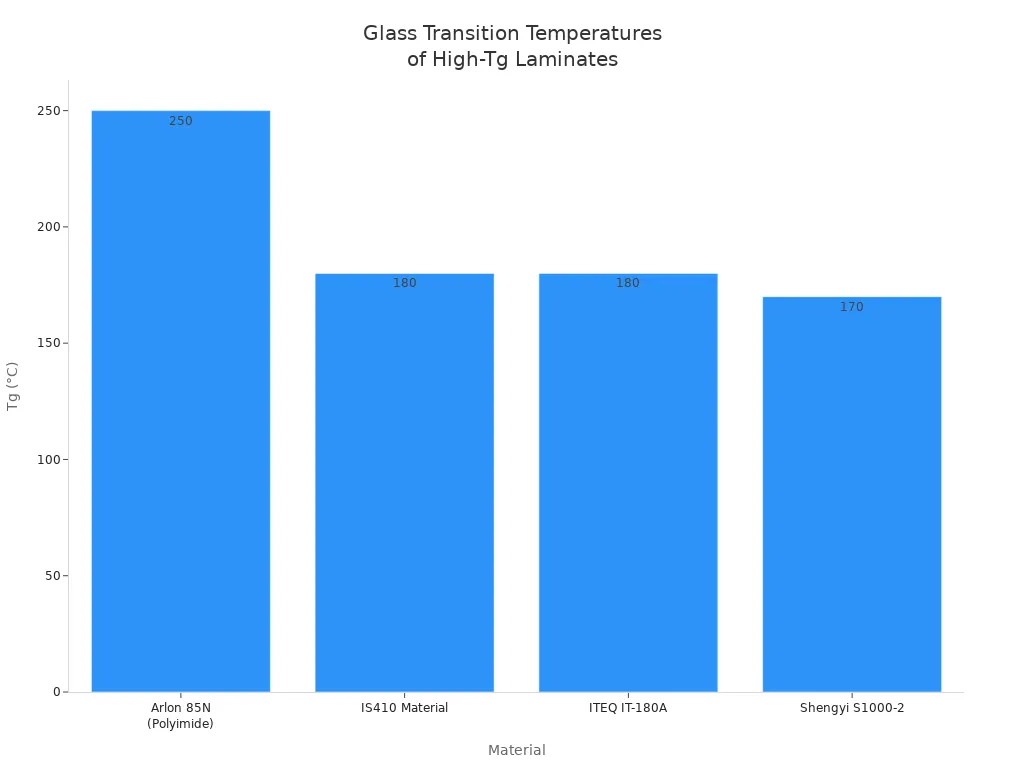
Glass transition temperature marks the point where resin softens and the board loses stiffness. Standard FR-4 gives a Tg of 130-150°C. High-Tg laminates begin at 170°C and reach 180°C or higher. IPC-4101 requires glass transition temperatures above 170°C for high-Tg classification and sets Z-axis CTE limits below 3.5% for the 50°C to 260°C range.
The Tg rating of the substrate should be 20-25°C higher than the maximum operating temperature.
Running near or above Tg speeds up several failure modes:
Delamination between layers
Z-axis expansion causing barrel cracking in plated through-holes
Warping and dimensional instability affecting component alignment
Deterioration of electrical insulation properties
Designers should aim for thermal load 25°C below Tg. For a Tg of 180°C, operating temperatures stay below 155°C.
Material | Typical Tg | Main Application | Key Advantage |
|---|---|---|---|
170-180°C | Industrial, LED, power electronics | Balanced cost and reliability | |
Shengyi S1000H | 170°C | Automotive, telecom, industrial | Good cost-performance ratio |
Isola 370HR | 180°C | Networking, aerospace, industrial | Strong CAF resistance |
Rogers RO4350B | 280°C+ | RF, microwave, 5G systems | High thermal stability |
Properties shift across Tg grades:
Property | TG150 | TG170 | TG180 |
|---|---|---|---|
Glass Transition (DSC) | 150-155°C | 170-175°C | 180-185°C |
Decomposition Temp (Td) | 320-340°C | 340-360°C | 350-380°C |
CTE Z-axis (above Tg) | 200-250 ppm/°C | 180-220 ppm/°C | 160-200 ppm/°C |
T288 (minutes) | 15-25 | 30-45 | 45-60+ |
Typical Cost Premium | +5-10% | +15-25% | +30-50% |
Three additional parameters matter:
Td measures resin decomposition temperature. A TG170 material with Td of 310°C may perform worse in lead-free assembly than a TG150 material with Td of 340°C. Td should be at least 330°C.
T288 measures laminate endurance at 288°C before delamination. Minimum T288 is 15 minutes per IPC-4101. Recommended values are 30 minutes for double-sided SMT and 45 minutes for rework.
Lead-free reflow survival differs by grade. TG135 survives 2-3 cycles. TG150 survives 4-6 cycles. TG170 survives 8-12 cycles. TG180 survives 15+ cycles at 260°C peak.
CTE, Moisture, And Mechanical Properties
Coefficient of thermal expansion decides how much a board grows when heated. Going just 10°C past the Tg of standard FR-4 raises its CTE by 300%. This growth risks via failures and barrel cracking. High-Tg materials cut Z-axis expansion by about 30% compared to standard FR-4.
Property | Standard FR-4 | High-Tg FR-4 | Recommended for Multilayer |
|---|---|---|---|
In-plane CTE (XY) | 14-17 ppm/°C | Reduced | Target 6-8 ppm/°C for silicon matching |
Z-axis CTE | 50-70 ppm/°C (above Tg) | Reduced | CTE differential below 3 ppm/°C |
Design guidelines recommend maintaining CTE differentials below 3 ppm/°C for critical interfaces. Advanced applications use modified epoxy systems to reach CTE values near 6-8 ppm/°C.
Moisture absorption gets worse before reflow. High-Tg laminates give a higher decomposition temperature than standard FR-4. This lowers charring risk during rework or repair. A High-TG PCB can extend operational lifetime by 2-3 times in demanding automotive under-hood applications.
Failure rates drop by 40-60% in accelerated aging protocols. High-Tg materials show superior thermal shock performance. These gains come from tighter CTE values and higher thermal stability.
Material selection balances Tg, CTE, moisture absorption, and strength against cost. Isola 370HR works for automotive and industrial applications. Aerospace and defense require TG180+ materials like IS680 or Megtron 6.
Lamination And Bake-Out Control
Lamination presses stacked prepreg and copper into one solid board. High-Tg resins need tighter control at this step than standard FR-4. Heat, pressure, and time must all work together. If any one of them drifts a little, you get voids, delamination, or warped panels later.
Temperature, Pressure, And Cycle Profiles
A higher Tg pushes the lamination temperature window upward. High-Tg FR-4 usually peaks near 200°C, and it dwells there for 60–120 minutes. The press preheats the stack to 100–120°C before full pressure. Heating ramps run at 2–5°C per minute. This slow climb helps resin flow evenly and cuts trapped air. Cooling stays controlled at 2–3°C per minute to limit internal stress.
Pressure application follows the same careful approach. Operators raise pressure in steps, timed with the temperature ramp, to stop too much resin from squeezing out. Phenolic-cured high-Tg grades (Tg 175–180°C) need 400–550 psi, which is higher than standard FR-4. They also need a longer dwell at 185–195°C to reach full cross-linking. A proper cure gives strong bond integrity and thermal stability.
Controlled Bake-Out And Sequential Buildup
Bake-out removes absorbed moisture before the stack goes into the press. Leftover water turns into steam during lamination and forms gas pockets. A controlled bake at 120–150°C for 4–8 hours drops moisture content below 0.25%. Standard pre-baking for high-Tg FR-4 runs 140–150°C for 8–10 hours. This step directly lowers void nucleation and delamination risk.
Parameter | Value | Effect on Void Formation |
|---|---|---|
Baking temperature | 120–150°C | Removes moisture without damaging high-Tg resin |
Baking duration | 4–8 hours | Ensures complete desorption of trapped water |
Target moisture content | Below 0.25% | Prevents steam generation during lamination |
Sequential buildup is common in High-TG PCB manufacturing. It lets fabricators laminate inner cores first, then add outer layers. Thermal cycling tests show a 25–30% drop in failure rates with this approach. Bond strength meets or exceeds 1.5 lb/in per IPC-TM-650. Resin flow stays controlled through ramps of 2–3°C per minute. X-ray validation limits voids to less than 5% of via volume.
Drilling, Plating, And Imaging Adjustments
High-TG PCB laminates are harder and more brittle than standard FR-4. These traits mean drilling, plating, and imaging all need changes. Each fix helps stop defects during assembly or field use.
Aspect Ratio, Drill Parameters, And Desmear
High-TG PCB boards often use thicker core builds to manage heat. Aspect ratios go beyond 10:1. Drill settings change to handle the harder resin matrix. Makers lower spindle speeds and slow the feed rates. This cuts drill bit wear and heat buildup. Hit counts per bit fall because the rough resin dulls tools faster. Entry and backup materials change to lower burr formation.
Desmear gets more aggressive for these resins. The hardened material fights chemical removal. Plasma desmear systems or strong permanganate baths strip the smear layer fully. Clearing all resin residue from copper surfaces inside the hole stops weak plating adhesion and void formation.
Plating Adhesion, Imaging, And Solder Mask
Copper plating adhesion on high-Tg surfaces needs the right surface prep. Surface roughening makes mechanical interlocking points. Chemical change adds functional groups for covalent bonding. Plasma activation treats the surface for 30 seconds to 10 minutes before plating. Peel strength values for rigid High-TG PCB uses reach 0.7–1.0 N/mm. Flexible circuits may need values above 1.2 N/mm due to dynamic stress. Plasma treatment plus functional molecular layers hits peel strength over 1.2 kN/m when treatment time stays under 5 minutes. Adhesion values above 1.0 kN/m hold even after thermal aging at 120°C for 7 days. Quality checks use peel strength measurements per IPC-TM-650 standards.
Imaging processes allow for the dimensional stability of high-tg laminates. Small expansion or shrinkage during lamination affects layer-to-layer registration. Photoresist exposure makes up for it with scaled artwork or direct imaging adjustments. Etching parameters also change. Thicker copper layers on high-tg boards need longer etch times and stronger chemistry.
Solder mask choice matters for high-temperature survival. Dry film solder masks need a glass transition temperature above 140°C. They must have thermal endurance past 300°C for short spans. These masks survive lead-free reflow peaks of 260–270°C. High-temperature formulas use ceramic or silicone-based compounds. They have Tg above 150°C, continuous operation up to 200°C, and short-term resistance to 300°C. Testing standards include IPC-SM-840 and IPC-TM-650. Solder-heat resistance validation records temperature, duration, and cycle count. Adhesion strength must top 6 N/cm per IPC-TM-650. This proves durability under repeated thermal stress.
High-TG PCB Thermal Management And QC
Thermal management and quality control finish the job on every High-TG PCB build. Testing shows that lamination, drilling, and plating stayed within their limits. It also predicts how the board will act during assembly, reflow, repair, storage, and field use.
Thermal Cycling And Electrical Test
Thermal cycling brings hidden weak spots to the surface. IPC-6012 Class 3 requires cycling between -40°C and +125°C, then checking for barrel cracks. A board that passes this test can handle the expanding and shrinking of real service. Electrical test then checks continuity and isolation on every net. Ionic contamination must stay at or below 0.78 μg NaCl/cm² for Class 3 acceptance. That limit guards against electrochemical migration later in the field.
IPC Standards And In-Process Inspection
Several IPC documents guide high-Tg acceptance. Each one has its own job.
Document | Main Role | What It Covers |
|---|---|---|
IPC-TM-650 | Test methods manual | Sample prep, test conditions, measurement, reporting |
IPC-A-600 | Acceptability guide | Target, acceptable, and nonconforming bare board conditions |
IPC-6012 | Performance specification | Qualification, final finish, holes, conductors, conformance |
IPC-4101 sets raw laminate requirements through slash sheets like /24, /26, /124, and /129. The /26 sheet calls for Tg at or above 170°C and decomposition temperature at or above 340°C. IPC-6012 Class 3 adds its own checks. A DSC curve must show a clear Tg above 170°C. TMA testing must confirm low CTE below Tg, usually under 50 ppm/°C, to stop warping and stress on plated vias. Section 3.9 of IPC-6012 asks for stricter thermal stress testing than Class 2.
Test method reporting matters just as much as the numbers. DSC, TMA, and DMA each give different values for the same laminate. DMA (IPC-TM-650 2.4.24.2) measures modulus and damping changes under oscillating load. Its results depend on test frequency. A purchase specification that states only "Tg 170°C" is incomplete without naming the test method and acceptance basis.
In-process inspection catches defects before final test:
Cross-section (microsection) confirms delamination, plating quality, and via cracking
X-ray inspection detects hidden via and inner-layer defects non-destructively
Coupons and microsections verify the process against applicable IPC qualification tests
Acoustic inspection offers another route to confirm lamination voids
These methods link failure analysis back to manufacturing. Via cracking points to lamination and plating optimization. Delamination points to resin system and pressure adjustment.
Quality control must cover the full thermal lifecycle. Fabrication, assembly, reflow, repair, storage, and field use each impose different heat loads. A board verified only at fabrication may still fail after three reflow passes or a repair cycle. Testing at each stage keeps the process honest.
Challenges, Cost, And Best Practices
Material Handling And Process Adaptation
High-Tg prepregs need stricter storage than normal FR-4. Their resin systems break down faster. For short-term use under 30 days, manufacturers store them at 15–30°C. For longer storage, they need 0–10°C. Humidity stays between 40 and 65 percent. Vacuum packing with drying agents blocks moisture from the air. Shelf life is only 3 to 6 months. If humidity goes 5% above 65%, it can cut shelf life by weeks.
Workers must avoid folding or creasing prepreg, because that causes tiny cracks. They wear gloves and work in clean rooms. Using first-in-first-out stock keeps older materials used first. If prepreg sits for more than 3 months or gets wet, a pre-bake at 100–125°C for 2 to 4 hours fixes it. The bake stays below Tg to protect the resin.
The process must change with the material. High-Tg laminates need slower drilling, stronger desmear, and plasma treatment before plating. Each change adds setup time and training for workers. So a High-TG PCB costs more to make than a standard board at every step.
Cost, Lead Time, And Risk Reduction
The extra cost comes from the material. High-Tg laminates like Isola 370HR or Rogers RO4350B cost $0.50 to $2.00 per square inch. More layers add to the cost. A small batch with 6 layers starts at around $100. A 12-layer design can cost over $300. Quick-turn prototype services add 20 to 50% extra cost but deliver boards in 24 to 48 hours.
Ordering several prototypes lowers the cost per board. A single prototype costs about $50. Five boards drop to about $40 each. Early design review and stackup checks reduce re-spins before full production. Structured prototype runs lead to faster market launch and smoother production start. Designers should use high-Tg materials only for applications that really need heat or speed. Standard FR-4 works for most designs. Using panels and standard parts lowers cost per board and shortens lead time.
Making High-TG PCBs requires tighter control of heat, pressure, chemistry, and inspection at every step. It is not just one change. Picking the right material with proper Tg and CTE values is the foundation. Controlled bake-out and lamination stop voids and delamination. Better drilling and desmear keep hole walls clean. Strong plating adhesion and a compatible solder mask handle repeated thermal stress. Careful thermal cycling and IPC-based QC confirm long-term reliability through fabrication, assembly, and field use.
As more high-reliability uses appear, manufacturers must treat process control as a system, not a checklist. A checklist cannot protect yield, cost, or long-term board reliability. Every process step links to the next one. This connected thinking helps the board survive its full lifecycle. Process control as a system gives steady, reliable production.
FAQ
What glass transition temperature counts as high Tg?
IPC-4101 sets the high-Tg threshold at 170°C and above. Standard FR-4 sits much lower, near 130–150°C. Designers also keep the Tg rating 20–25°C above the highest operating temperature. A 180°C laminate therefore suits service temperatures below 155°C.
Why does bake-out matter before lamination?
Absorbed moisture turns into steam inside the press. That steam forms gas pockets, voids, and delamination. A controlled bake at 120–150°C for 4–8 hours drops moisture below 0.25%. High-Tg FR-4 often needs 140–150°C for 8–10 hours.
How does drilling change for high-Tg laminates?
High-Tg resins are harder and more brittle than standard FR-4. Fabricators lower spindle speeds, slow the feed rate, and reduce hit counts per bit. Aspect ratios often exceed 10:1. Desmear also becomes more aggressive, using plasma or strong permanganate baths to clear resin smear.
Which IPC standards apply to high-Tg boards?
Document | Role |
|---|---|
IPC-4101 | Raw laminate requirements, including Tg and Td limits |
IPC-6012 | Performance specification for rigid boards |
IPC-A-600 | Bare board acceptability criteria |
IPC-TM-650 | Test methods for Tg, CTE, and peel strength |
IPC-SM-840 | Solder mask qualification |
Do high-Tg boards cost more than standard FR-4?
Yes. High-Tg laminates run roughly $0.50 to $2.00 per square inch. A 6-layer small batch starts near $100, and a 12-layer design can pass $300. Quick-turn service adds 20–50%. Ordering several prototypes lowers the per-board price.
See Also
A Guide To Printed Circuit Board Fabrication Steps
Methods For Fabricating High Copper Multilayer Circuit Boards
Essential Quality Checks For High Current Copper Board Assembly In Cars
Frequent Issues And Fixes In PCB Layout For SMT Assembly Needs
HASL Coating In Circuit Boards: Methods, Uses, And Inspection
