How to Choose a PCB Stator Manufacturer
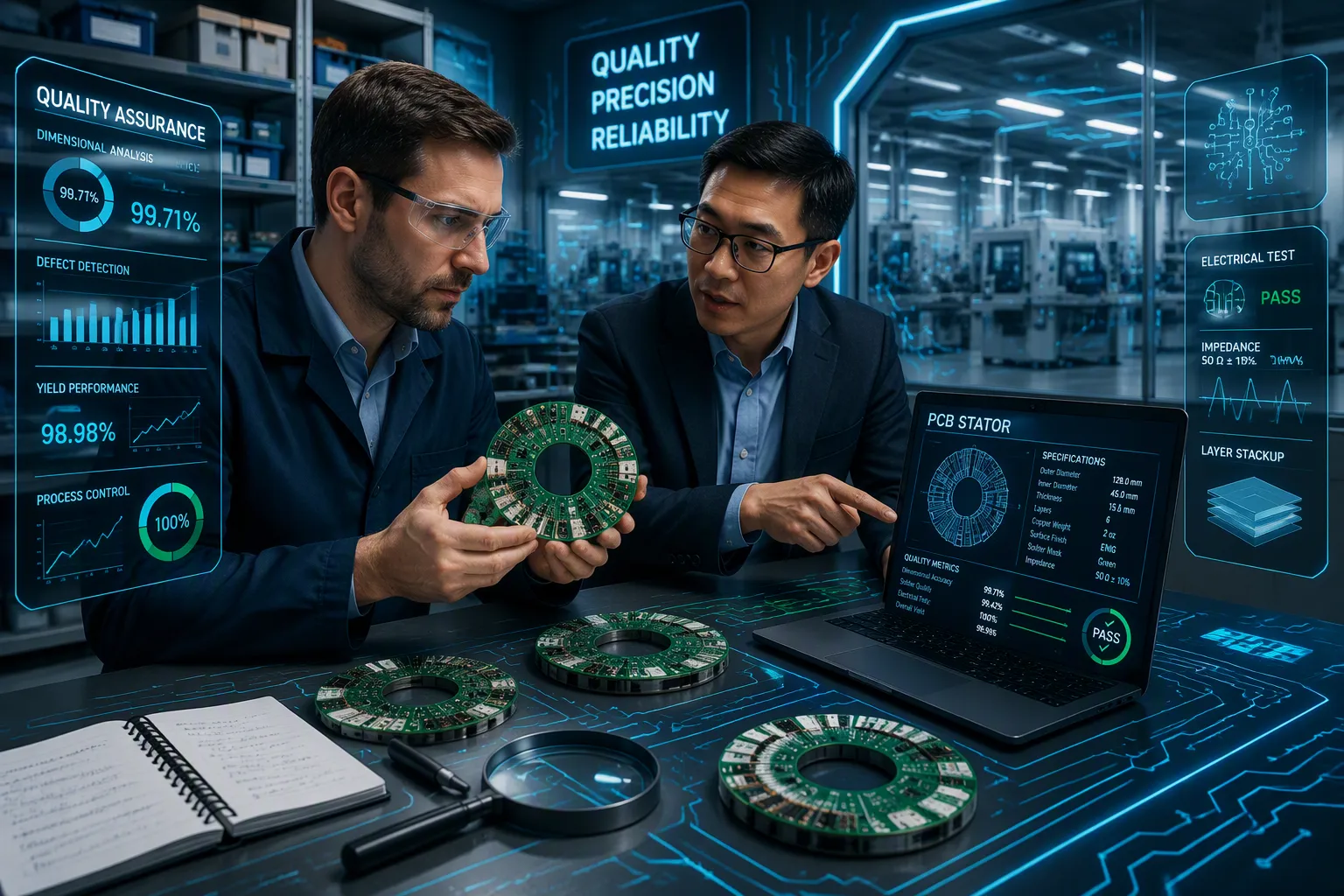
Your motor's performance depends on one thing: how much a manufacturer knows about PCB stator technology. Makers of axial-flux designs, like ECM and Infinitum Electric, build lighter, quieter, and more efficient machines. Their coreless PCB stators weigh less than 10% of a standard iron core wound unit. ECM's motors are lighter, faster, and quieter, and they reach higher efficiencies than standard machines. Noise drops by over 20 dB in some uses. When you choose a PCB stator manufacturer, consider technical depth, quality certifications (ISO/AS9100, IPC), production scalability, cost transparency, and ongoing support. They solve thermal management and torque limits, which challenge coreless PCB designs and printed circuit board stator technology. Command of PCB stator technology sets them apart.
Key Takeaways
Look for quality certifications such as ISO 9001 and AS9100 to make sure stator production stays consistent.
Ask for case studies that show real performance data. This will help you check the manufacturer's track record.
Pick a manufacturer that uses modern design tools. This helps them build prototypes faster and handle heat better.
Make sure the manufacturer can grow from making a few test units to full production without changing how they do things.
Think about the full cost over time and the engineering help you will keep getting. These things matter for a good partnership.
Core Criteria to Choose a PCB Stator Manufacturer
When you pick a PCB stator manufacturer, you need more than just a supplier. You need a partner who gets the physics and the production needs of coreless PCB stators. Two things set qualified vendors apart from the rest: certified quality systems and a proven record of success.
Quality Certifications and Standards
Certifications show that a manufacturer follows processes that are repeatable. Look for ISO 9001 as a basic standard for quality management. For aerospace or defense work, ISO 9100 and AS9100 add tighter controls on traceability and risk management. In the PCB world, IPC-6012 and IPC-6013 set the acceptance rules for rigid and flexible printed boards. A vendor who holds these certifications builds PCB stators that meet steady tolerances. That consistency matters because a coreless PCB stator has no iron core to hide winding defects. A single layer misalignment or a plating void can shift losses and create hot spots. Certified processes catch these flaws before they reach your assembly line.
Case Studies and Proven Track Record
Ask for case studies that show real motor design and manufacturing results. ECM, a leader in print circuit board stator technology, publishes performance data from its axial-flux motors. Their coreless PCB stators cut weight by up to 70% compared to conventional designs. Efficiency goes past 90%. Raw material usage drops to 20% of what a traditional core stator needs. Noise falls by up to 30 dB. These motors reach up to 20 kW of power, 30,000 RPM, and 100 Nm of torque. A proven track record like this lowers your risk. You can review test data instead of trusting a sales pitch.
Technical depth also matters. A skilled manufacturer controls DC ohmic loss and eddy current loss through winding structure and parameters. They use a PCB nonoverlapping distributed winding design that makes the most of board space. They derive general expressions for winding resistance and loss. This lets them estimate performance fast during initial design and optimization. They optimize the active conductor width to improve efficiency. They also find the critical frequency that balances DC ohmic loss and eddy current loss. These skills separate a specialist from a general PCB shop.
When you evaluate PCB stators, ask for samples and test reports. Compare the manufacturer's process controls against IPC-6012 and IPC-6013 requirements. Check whether their case studies match your application's power, speed, and torque needs. A vendor with deep PCB stator technology expertise will welcome this scrutiny. A vendor without it will hesitate.
Using PCB Stator Technology
The tools and material knowledge a manufacturer has decide how well your design goes from an idea to a real product. You need a partner who is good at both.
Knowing Materials and Design Tools
Picking the right material affects how well things work in high heat. Regular FR-4 is fine for everyday use, but its glass transition temperature is between 130 and 180 degrees Celsius. High-Tg FR-4 raises that range to 170–200 degrees Celsius for industrial electronics. Polyimide and ceramic-filled substrates can take extreme heat and high power density. Polyimide goes above 250 degrees Celsius, and ceramic-filled materials go past 300 degrees Celsius. Pick a material where your working temperature stays above Tg but well below the temperature where it breaks down. Heavy copper, up to 4–6 oz, and strong via structures make sure current flows reliably. Multilayer stack-ups with separate power and ground planes lower inductance. These choices help coreless PCB stators work well in tough conditions.
Design tools like ECM's PrintStator make trying new ideas much faster. Electromagnetic simulation and datasheet creation finish in 1–2 seconds. That is 100 times faster and lets you try new designs almost right away. Moving from optimized motor outputs to housing design drops from weeks to hours. This happens through automatic parametric and CAD/CAM-ready housing generation.
By cutting production cycles from years down to weeks or months, PrintStator allows for faster iteration and innovation.
This platform improves motors around thermal needs and checks thermal behavior in real time while you design. It lets you design the motor and system together to add good cooling methods. A skilled manufacturer uses these tools to fix the torque limits and thermal problems that make coreless designs hard.
Fast Prototyping and Assembly Services
Speed is important when you design by trying things over and over. You need working custom prototypes in weeks, not months. PrintStator motor CAD gives you designs in hours and working motors in just a few weeks.
With PrintStator motor CAD, designs are ready in a matter of hours and functioning custom motors are just weeks away.
Fast prototyping lets you test power, torque, size, and cost limits early. A manufacturer who does PCB assembly services made for stator needs keeps your project on time. They control exact manufacturing steps for stator windings and make sure every board meets your needs.
PCB stator technology swaps old copper windings for PCB traces. This gives you exact control over conductor shape and lowers copper losses by improving how current spreads out. It helps heat escape through better thermal paths and keeps temperatures more even across the motor. These benefits set coreless PCB stators apart from a regular core stator PMSM. A core stator needs iron, which adds weight and holds back efficiency. Coreless PCB stators get rid of that iron, which cuts weight a lot.
Your manufacturing partner should offer customization for material grades, layer counts, and assembly options. They must understand motor design and manufacturing very deeply. The right manufacturing process makes stators that work reliably at high speed and high power. Ask about their experience with printed circuit board fabrication for motor uses. A vendor with strong PCB stator technology credentials will help you pick materials and designs from the start.
Production Capacity and Lead Times
Scalable Manufacturing Options
Your project might begin with a few units and then grow to thousands. A good manufacturer grows with you at each step. They have pilot lines for early builds and high-volume lines for full production. This matters because coreless pcb stators need tight process control at any volume. A shop that only makes prototypes will have trouble when your order grows. A shop that only does high volume will not want small test batches.
Ask about their equipment for multilayer pcb fabrication and heavy copper plating. These skills decide if they can handle your stator's power needs. A vendor with flexible capacity moves your design between lines without changing the process. That steady approach protects your yield as you scale. You avoid the hidden cost of re-qualifying a new line mid-project.
Turnaround Times and Flexibility
Speed shapes your development schedule. PrintStator motor CAD gives designs in hours and working motors in weeks. That pace lets you test and improve before you commit to tooling. A manufacturer who quotes months for a prototype will slow your whole program. Ask for a clear timeline at each stage: design review, bare board fabrication, assembly, and test.
Flexibility matters as much as raw speed. Your design will change after the first test run. A strong partner takes those changes without restarting the whole process. They save capacity for engineering changes and rework. They also share delays early, so you can adjust your plan. Compare quoted lead times against real delivery data from their case studies. A vendor who meets deadlines on coreless pcb stators earns your repeat business. One who misses them adds risk to every future order.
Cost, Value, and Support
Total Cost of Ownership
The price tag on a PCB stator is not the whole story. You need to think about the full lifespan. Coreless PCB stators usually cost more to start. The reason is that making multilayer heavy-copper boards is harder. But looking closer at coreless PCB technology shows where you save money. Coreless PCB stators use only 20% of the raw material that a traditional stator needs. That means you are less hurt by price changes in materials. Steady quality from certified processes means less checking and fewer failures in the field. When you figure out cost, add in the hidden costs of rework, downtime, and warranty claims. A good shop lowers those risks with tight process control. They also show how material choice and layer count affect performance and final price. Ask for a detailed cost breakdown for the whole production cycle.
Engineering Support and After-Sales Partnership
Your work with the manufacturer does not end when the first batch ships. Ongoing engineering help is key for coreless PCB designs. A strong partner looks at your thermal management plan. They suggest changes to the stack-up and other materials when your operating temperature gets high. They help you pick the best conductor width and layer count for your torque and speed goals. This support saves months of trial and error. After-sales partnership means they stand behind what they make. They share test data from each production lot. They track manufacturing costs across your product line. They respond fast when a dimension drifts or a yield drops. They set aside room for growth without charging extra for small orders. Look for a manufacturer who treats your design as a shared project. One who answers technical questions about copper weight, via size, and dielectric clearance without charging a consulting fee. That level of support turns a supplier into a true development partner. A committed partner gives you a better total cost over the motor's life. You get both higher performance and lower risk over the motor's lifetime.
You now hold a clear path. Start with a manufacturer's command of pcb stator technology. Verify quality certifications and case studies next. Match production capacity to your scaling needs. Then weigh total cost with ongoing support. A partner with a track record in custom axial-flux designs, like ECM or Infinitum, often delivers superior performance and efficiency. Their work with coreless pcb stators proves it.
So build a weighted scorecard from these criteria. Score each vendor on print circuit board stator technology, coreless pcb expertise, and proven results. Request a design review from your shortlisted manufacturers. Compare their feedback on coreless designs, thermal limits, and pcb stack-ups. This process helps you choose a pcb stator manufacturer with confidence. The right partner turns coreless pcb stators into a lasting advantage. Choose a pcb stator manufacturer who treats print circuit board stator technology as a shared engineering project.
FAQ
What certifications should a PCB stator manufacturer hold?
ISO 9001 is the basic one for quality management. For aerospace and defense work, you need AS9100 for tighter traceability and risk controls. For board fabrication, IPC-6012 and IPC-6013 set the acceptance rules for rigid and flexible printed boards. These certifications show that a vendor follows repeatable processes. That means they catch winding defects before the boards reach your assembly line.
How do I verify a manufacturer's track record?
Ask for case studies with real motor performance data. ECM shares results that show weight cuts up to 70%, efficiency past 90%, and noise drops up to 30 dB. Ask for samples and test reports too. Compare their process controls against IPC standards. A vendor with deep expertise will welcome this close look. One without it will hesitate.
What design tools speed up stator development?
Platforms like ECM's PrintStator finish electromagnetic simulation and datasheet creation in 1–2 seconds. That is 100 times faster than normal methods. Housing design drops from weeks to hours through automatic parametric generation. These tools let you test power, torque, and thermal limits early. You iterate faster and get working prototypes in weeks, not months.
Can a manufacturer scale from prototype to full production?
A strong partner has pilot lines for early builds and high-volume lines for full production. This flexibility matters because coreless stators need tight process control at any volume. Ask about their equipment for multilayer fabrication and heavy copper plating. A vendor who moves your design between lines without process changes protects your yield as you scale.
What ongoing support should I expect after delivery?
Your manufacturer should review thermal management plans and suggest stack-up changes when operating temperatures rise. They share test data from each production lot and respond fast when dimensions drift. Look for a partner who answers technical questions about copper weight, via size, and dielectric clearance without charging consulting fees. That support turns a supplier into a true development partner.
See Also
Selecting A Reliable PCB Manufacturing Partner For Your Enterprise
Key Inquiries To Pose Your PCB Producer Prior To Manufacturing
Deciding Between Flexible And Rigid PCBs For Your Project
How To Decide Between ENEPIG And ENIG For PCBs
A Comprehensive Primer On Flexible PCB Fabrication Techniques
